

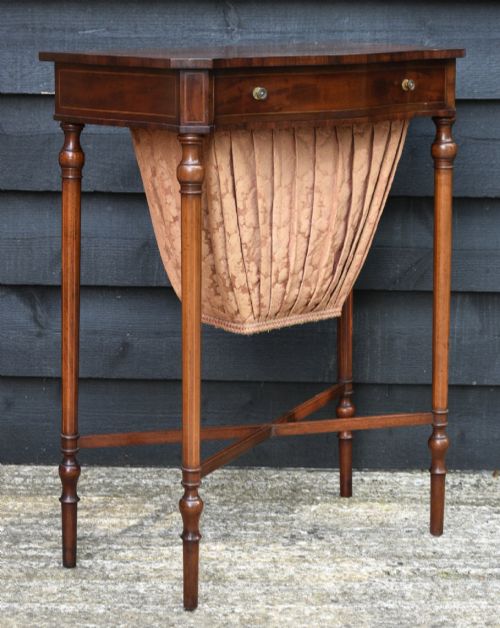


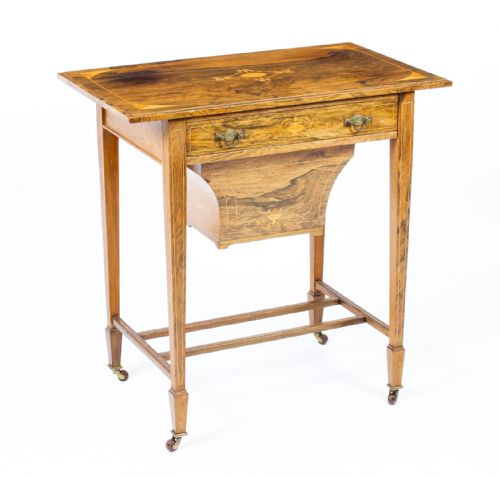


Sheraton Sewing Table
These sheraton sewing table examples bring refined geometry and fitted interiors to a room, offering clever storage disguised as elegant furniture.
Sheraton Sewing Table
A sheraton sewing table combines the clean lines and classical proportions of the late eighteenth and early nineteenth centuries with practical compartments for needlework and correspondence. Buyers encounter these pieces in forms ranging from compact occasional tables to drop-leaf work tables and writing surfaces.
The selection on this page spans several distinct eras, from original Georgian and George III examples to later Victorian, Edwardian, and Sheraton Revival interpretations. Pieces often feature lift-up tops, multiple drawers, and secret rising compartments designed to keep domestic tasks neatly concealed.
Materials vary across the inventory, with satinwood and mahogany forming the primary carcasses, complemented by contrasting boxwood, ebony, and elaborate wood inlay. Many versions function equally well as side tables, occasional tables, or dedicated workboxes within a traditional interior.
Assessing quality and execution
The distinction between standard examples and superior pieces rests on the crispness of the wood inlay and the selection of figured veneers. Elaborate satinwood grain patterns, fine floral or shell motifs, and hand-painted portrait decorations elevate the visual presence of a table.
Internal complexity dictates much of the value, particularly where makers incorporated multiple secret rising compartments and fitted trays for sewing implements. The integrity of the drop-leaf action and the original condition of the fabric components also influence the standing of an individual piece.
Sheraton Sewing Table Retail Price Guide 2026
Typical asking prices for sheraton sewing table among the pieces listed under this phrase on Sellingantiques today, from the lower quarter to the upper quarter. They describe what is for sale here now, not the wider market.
Listings span the eighteenth, nineteenth, and twentieth centuries, incorporating Georgian, Victorian, Edwardian, and Sheraton Revival periods.
The Sheraton Sewing Table Glossary
- Sheraton Revival
- A late nineteenth and early twentieth century style that reinterprets the light, neoclassical forms of the original eighteenth century period.
- Work table
- A multi-functional piece of furniture designed for sewing, needlework, and writing, often equipped with fitted internal trays and fabric bags.
- Satinwood
- A lustrous, yellowish timber prized for its fine grain and utilised extensively for veneering cabinet furniture during the Georgian and Edwardian eras.
- Stringing
- Thin lines of contrasting wood inlay used to outline drawers, tops, and legs on neoclassical furniture.
- Drop leaf
- A hinged flap on the side of a table that can be raised to extend the surface area or lowered when space is limited.
Sheraton Sewing Table: Frequently Asked Questions
What is a sheraton sewing table used for?
These tables served primarily as compact desks and storage units for sewing, embroidery, and correspondence in period homes. The fitted interiors kept threads, needles, and letters organised out of sight.
Today, owners utilise them as versatile side tables or occasional tables in living rooms and hallways where surface space is at a premium.
How do I date a sheraton sewing table?
Dating relies on examining the timber species, construction methods, and stylistic details such as inlay patterns and leg shapes. Original eighteenth-century pieces display heavier hand-tooling and distinct timber ageing compared to later revivals.
Sheraton Revival and Edwardian interpretations from around nineteen hundred often feature lighter satinwood frames, machine-cut veneers, and softer decorative painting.
Are these tables sturdy enough for daily use?
Most examples are structurally sound and well-suited for holding lamps, books, or decorative objects in a modern home. Their original purpose involved daily domestic service, so the frames are built with functional joinery.
Care should be taken with drop leaves and internal compartments to avoid straining delicate hinges or antique veneered surfaces.
What is the difference between a work table and a sewing table?
The terms are largely interchangeable within the historical record, though specific variations reflect how the internal space was arranged. Some versions prioritise writing surfaces and shallow drawers over deep wells for fabric.
Both types share the characteristic lightweight proportions and neoclassical styling associated with the late Georgian period.