
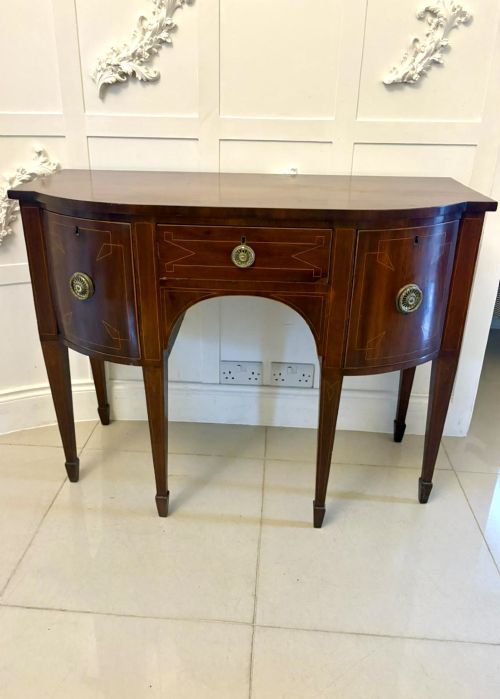
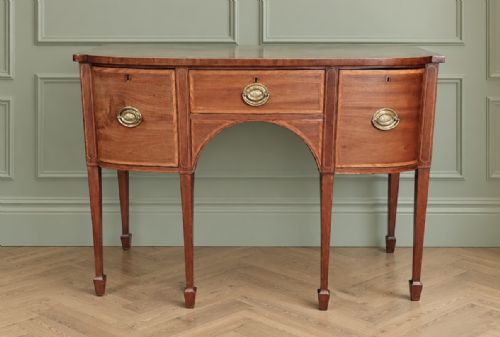
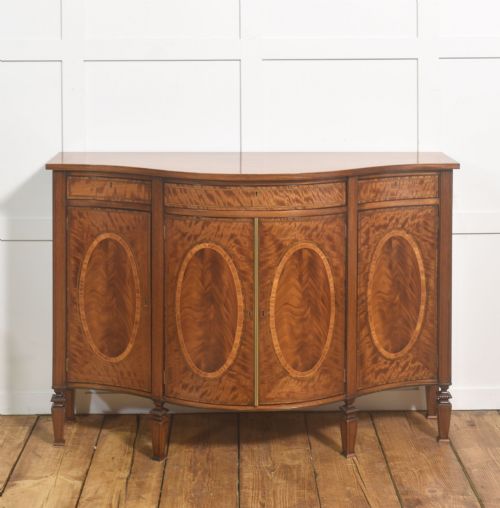
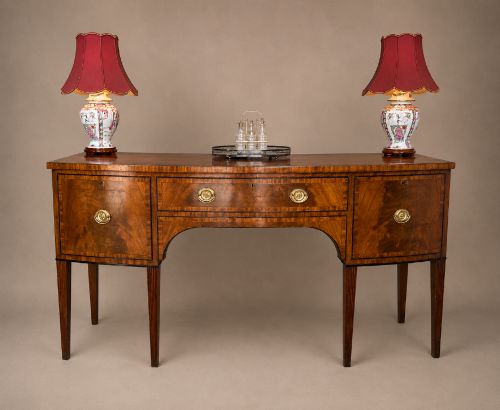


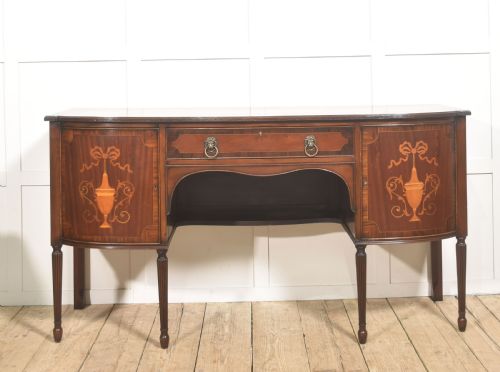

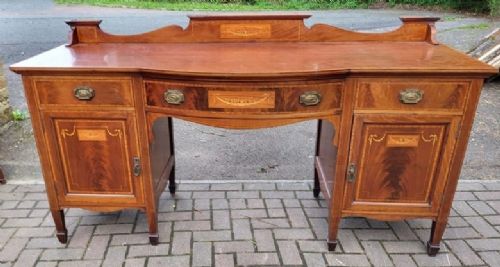


Sheraton Bowfront Sideboard
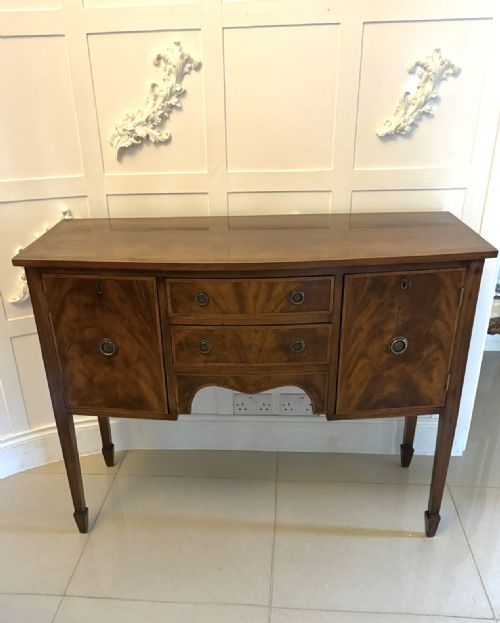
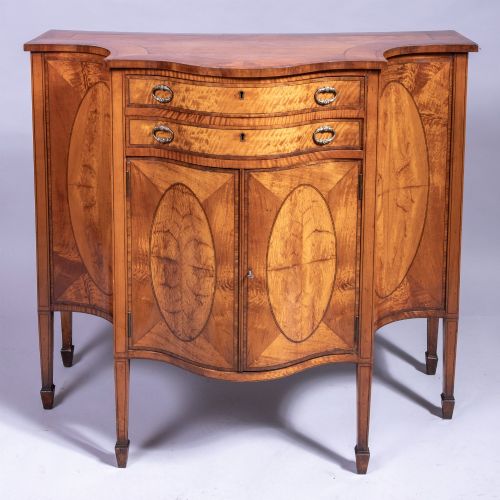
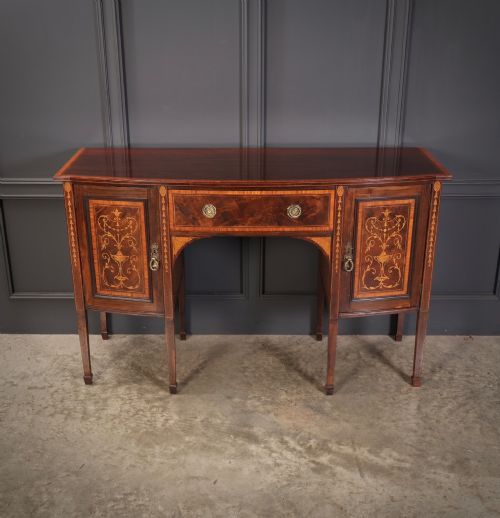
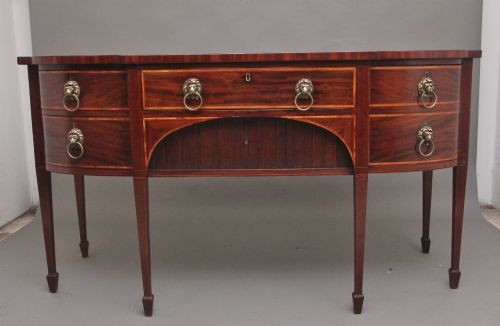
These Sheraton bowfront sideboards combine clean Georgian proportions with elegant curving lines that anchor a dining room.
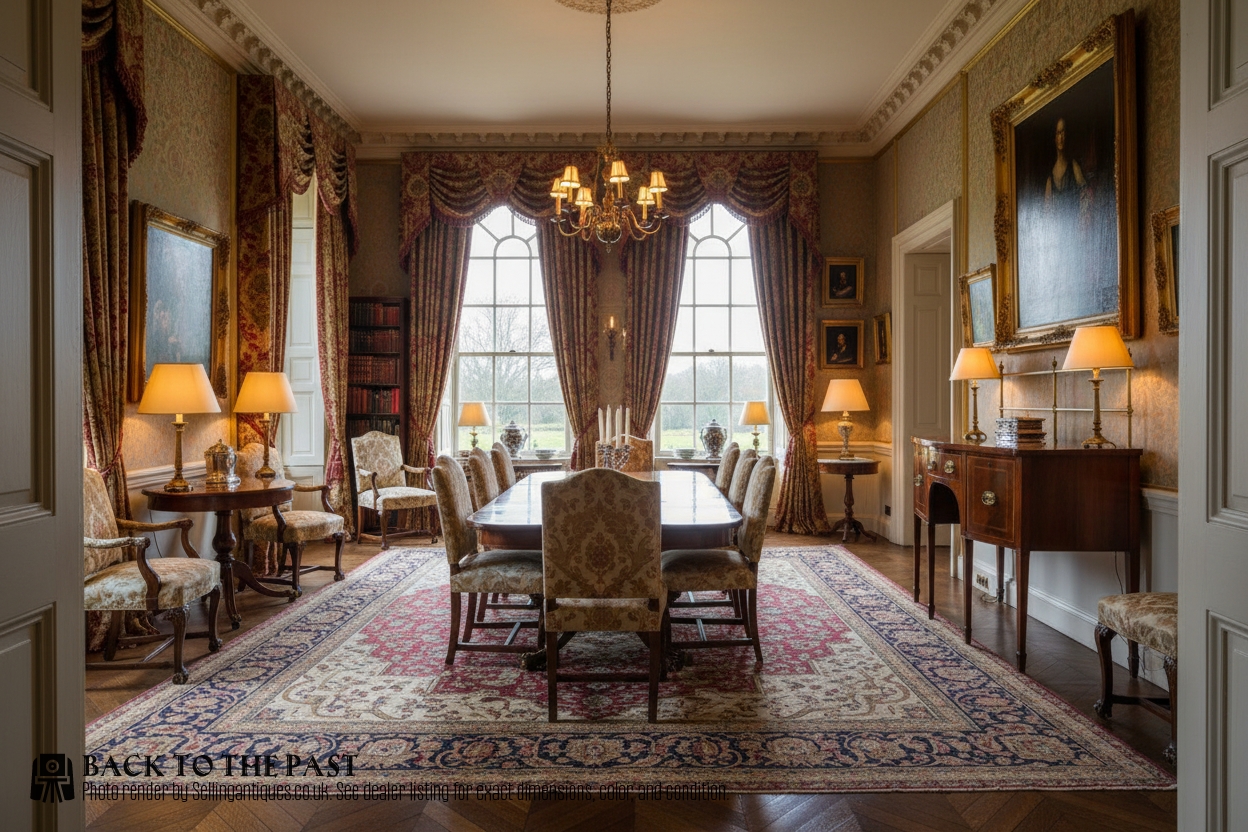
What Sheraton bowfront sideboards are
A sheraton bowfront sideboard offers a curved front that softens the angles of a traditional dining room while providing deep central storage. These pieces date predominantly from the 18th century, with origins in the Georgian period around the turn of the nineteenth century.
Buyers encounter forms described variously as sideboards, side tables, side servers, and console tables and servers. The design relies on balanced proportions and curved timber fronts to create a refined profile.
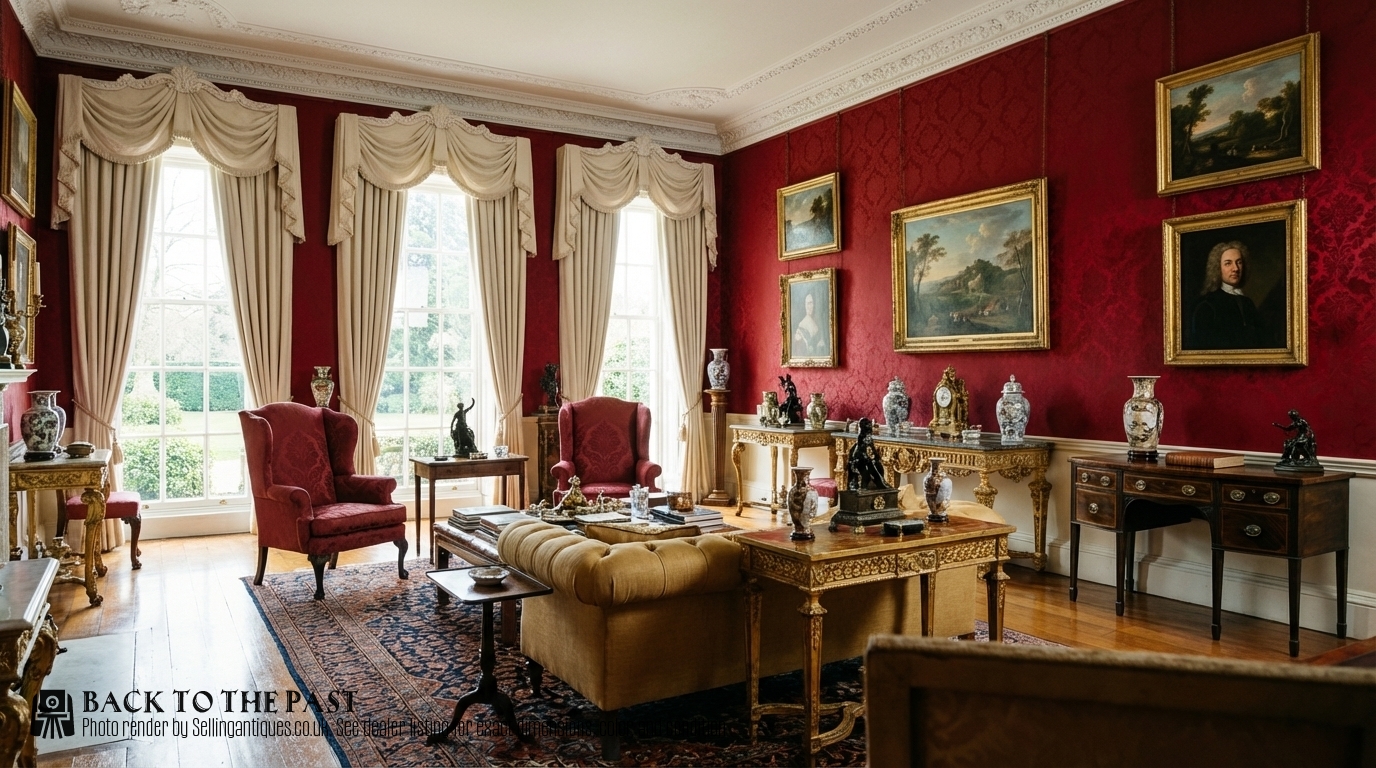
How they were made
Cabinet makers utilised solid mahogany as the primary structural timber, complemented by satinwood and boxwood for decorative contrast. Artisans applied fine boxwood inlay to delineate drawer fronts and frame the curved perimeters.
Brass fittings, including handles and sometimes escutcheons, completed the construction. The curved bowfront shape required precise timber bending and joining techniques executed by skilled Georgian woodworkers.
Retail Price Guide 2026
Typical UK retail prices for sheraton bowfront sideboard, calculated from the Sellingantiques database of over a million retail prices indexed since 2003. This retail price guide relies exclusively on Sellingantiques data; no external sources or auction records are used, so the figures do not describe the wider market.
Object forms include sideboards, side tables, and console servers within the Georgian and Sheraton styles.
What varies in quality
Quality rests in the depth of the mahogany grain and the precision of the boxwood inlay work. Superior examples exhibit harmonious figuring across the curved front panels rather than mismatched timber sections.
The crispness of the joinery along the bow curve and the originality of the brass hardware distinguish finer pieces from simpler utilitarian variants. Excellent colour in the aged mahogany elevates the visual presence of the furniture.
The Sheraton Bowfront Sideboard Glossary
- Bowfront
- A convex curving front profile characteristic of late eighteenth-century case furniture. This shape projects outward in the centre to maximise interior space.
- Inlay
- A decorative technique where contrasting woods like boxwood are inserted into recesses in the primary mahogany surface. This method creates geometric borders and linear patterns.
- Georgian
- The design period spanning the reigns of the first four Georges, encompassing the late eighteenth century. Furniture from this era is noted for classical restraint and fine proportions.
- Server
- A lower form of sideboard or side table used for presenting food and drink during dining. These pieces often feature simplified storage compared to full sideboards.
Frequently Asked Questions
What is a sheraton bowfront sideboard?
A sheraton bowfront sideboard is an eighteenth-century dining room cabinet featuring a convex curved front and classic geometric styling. These pieces provide surface space and internal storage.
They reflect the design principles associated with the Sheraton style during the Georgian period, utilising mahogany and decorative inlay.
How do I style a bowfront sideboard?
These sideboards suit traditional dining rooms where their curved mahogany fronts can be appreciated against flat walls. They function well as serving surfaces during meals.
Pair them with period mirrors or candelabra to complement their eighteenth-century origins and warm wood tones.
Are these sideboards made of solid mahogany?
The primary structure and exterior surfaces utilise mahogany, often paired with secondary woods for internal framing. Artisans selected timber with rich grain patterns for the visible areas.
Inlay details incorporate contrasting woods such as boxwood and satinwood to highlight the curved construction.
How do I date a Georgian sideboard?
Dating relies on construction methods, timber choice, and stylistic markers associated with the late eighteenth century and around 1800. Makers of this era favoured mahogany and specific inlay motifs.
Terminology in listings often references the George III period and Sheraton design influences to indicate the timeframe.