
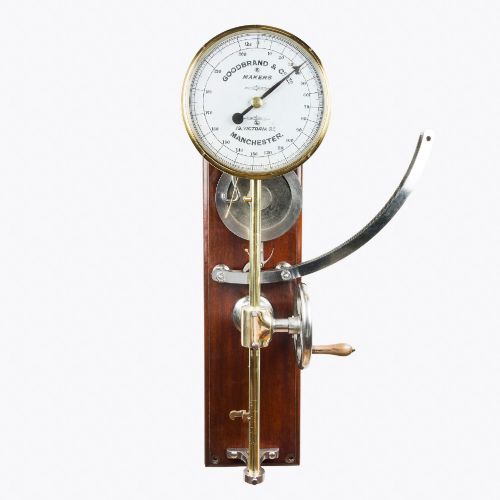
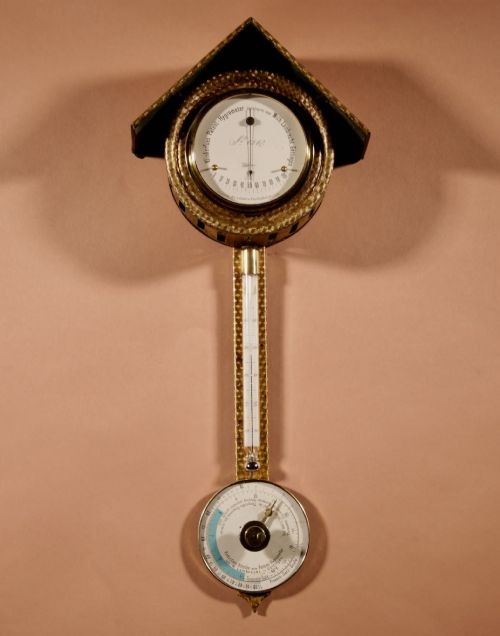
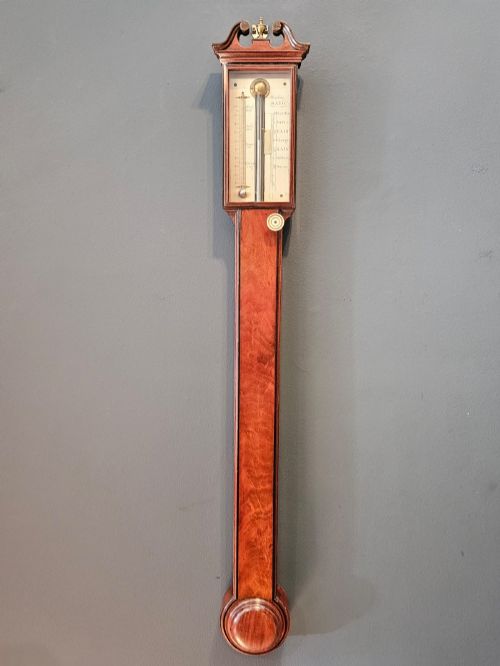
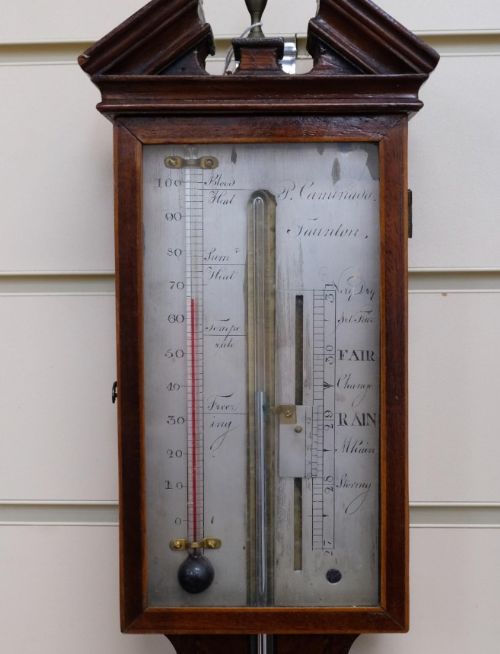







Scientific Wall Instrument
A scientific wall instrument is a brass-fitted barometer, thermometer or weather station designed to read atmospheric changes from a domestic interior.
Scientific Wall Instrument
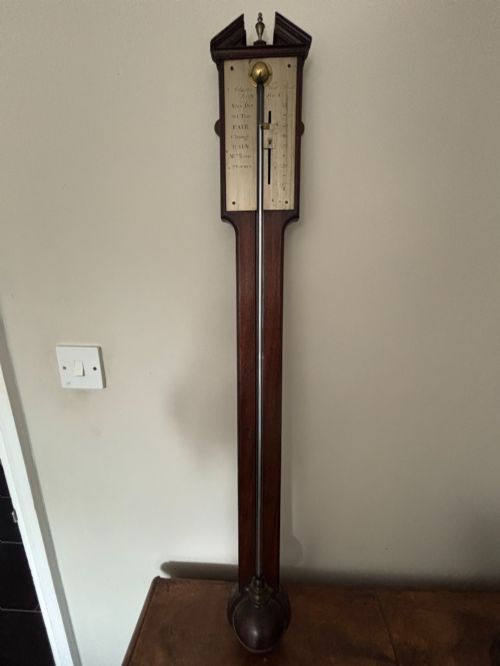
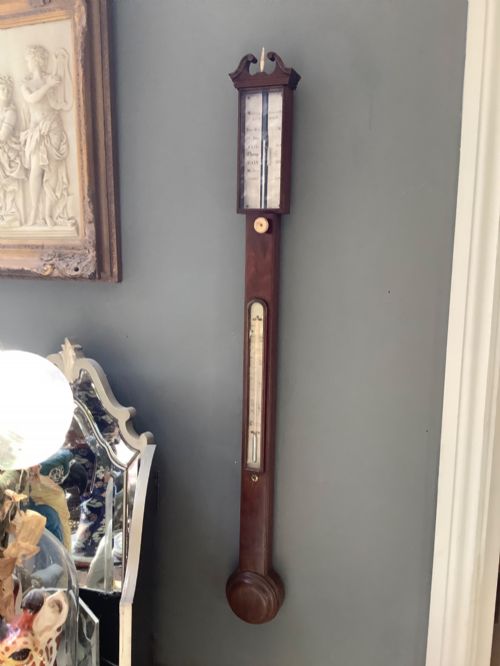
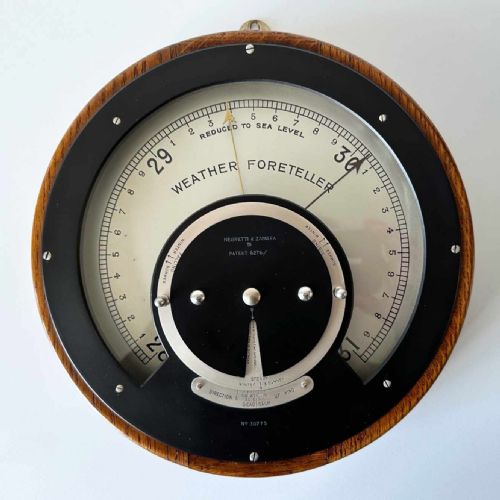
A scientific wall instrument comprises mercurial stick barometers, wheel barometers, wall thermometers, hair hygrometers, and weather stations originating from Georgian, Regency, Victorian, and early twentieth-century periods.
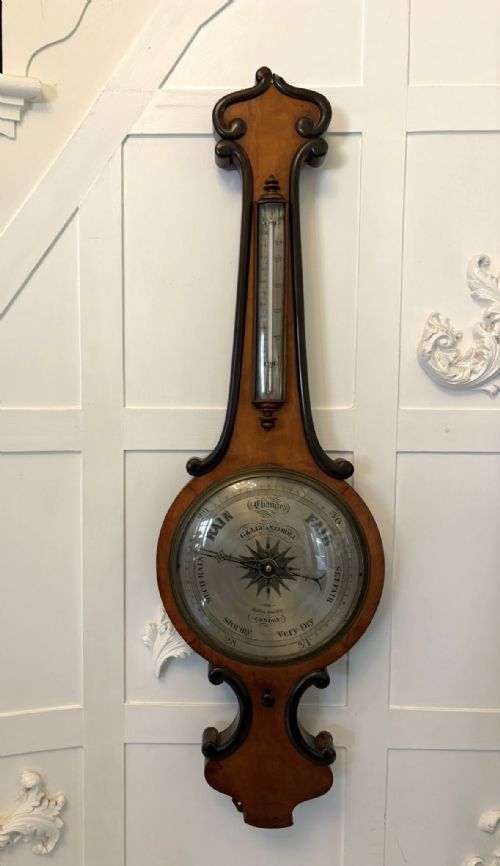
The version most commonly met on this page is the wooden-cased stick or wheel barometer, often housed in mahogany or rosewood, though specialist testing apparatus and hygrometers also appear.
Makers and retailers from London, provincial towns, and continental workshops signed these pieces, mounting glass tubes, silvered metal dials, and bone scales directly onto timber boards meant for vertical hanging.
How They Were Made
Craftsmen built the structural housings from dense hardwoods such as mahogany, rosewood, oak, and walnut, frequently applying fine veneer, marquetry, parquetry, or mother-of-pearl inlay to the elongated or banjo-shaped bodies.
The working mechanism relied on glass tubes filled with mercury or alcohol, paired with finely engraved silvered metal dials, brass fittings, and bone vernier scales to measure pressure, temperature, or humidity with precision.
Scientific Wall Instrument Retail Price Guide 2026
Typical asking prices for scientific wall instrument among the pieces listed under this phrase on Sellingantiques today, from the lower quarter to the upper quarter. They describe what is for sale here now, not the wider market.
Makers represented on this page include notable London opticians alongside specialist continental instrument workshops producing hair hygrometers.
What Varies in Quality
The standard of a scientific wall instrument rests upon the reputation of the maker inscribed on the dial or scale, alongside the crispness of the engraved silvering and the complexity of the cabinetry.
Examples featuring signed brass plates by notable instrument makers command greater attention than unsigned provincial work, while intact mercury columns and sophisticated hydrometric or barometric complications elevate the standing of the piece.
George Adams·Negretti & Zambra·Short & Mason·Dollond of London·Wilh. Lambrecht
The Scientific Wall Instrument Glossary
- Stick barometer
- A tall, slender wall instrument that measures atmospheric pressure by the height of a column of mercury in a vertical glass tube. Most Georgian and Regency examples use this simple form.
- Wheel barometer
- A banjo-shaped wall instrument where a float on the mercury column connects to a pulley and pointer that rotates around a circular dial. These often incorporate secondary spirit thermometers.
- Hygrometer
- An instrument designed to measure the moisture content or humidity of the air. Versions utilising human hair are common in nineteenth-century meteorological apparatus.
- Vernier scale
- A auxiliary sliding scale used on barometers to read fractions of the main graduated scale accurately. It allows precise observation of barometric changes.
- Fortin barometer
- A precision mercurial barometer featuring an adjustable leather-bottomed cistern to set the mercury level to a zero point. These were standard for scientific observation.
Scientific Wall Instrument: Frequently Asked Questions
How do stick barometers work?
A stick barometer balances the weight of atmospheric pressure against a vertical column of mercury sealed in a glass tube. As pressure rises or falls, the mercury level moves up or down against an engraved scale.
These movements indicate impending weather shifts, allowing observers to track high and low pressure systems directly from a wall mounting.
Where should I hang a barometer?
Barometers require a stable interior wall away from direct sunlight, central heating radiators, and heavy vibrations. Plaster or masonry surfaces away from exterior doors provide the best environment.
Correct placement ensures the wooden case remains stable and the internal mechanical or mercurial components function without disruption.
How do I read a wheel barometer?
Wheel barometers translate vertical mercury movement into rotational motion using a pulley system attached to an indicator needle. You read the primary pressure value where the pointer rests on the circular dial.
Many wheel instruments include a secondary hand operated by a brass knob, which you set over the main needle to track whether pressure rises or falls.
What is a weather station?
A weather station combines multiple measuring instruments, such as a barometer, thermometer, and hygrometer, mounted together on a single wooden backboard. These multi-function boards offered comprehensive domestic meteorological data.
Victorian households utilised these panels to monitor atmospheric pressure, temperature, and humidity simultaneously from one location.