
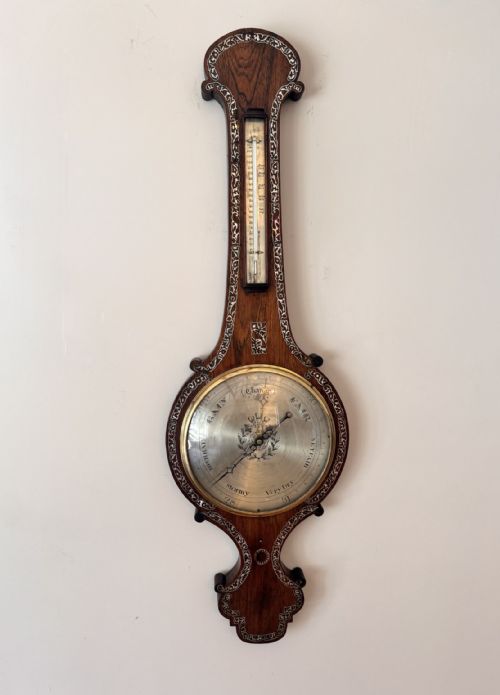


Inlaid Mahogany Barometer
An inlaid mahogany barometer brings both reliable weather tracking and crisp Georgian or Edwardian craftsmanship into a room.
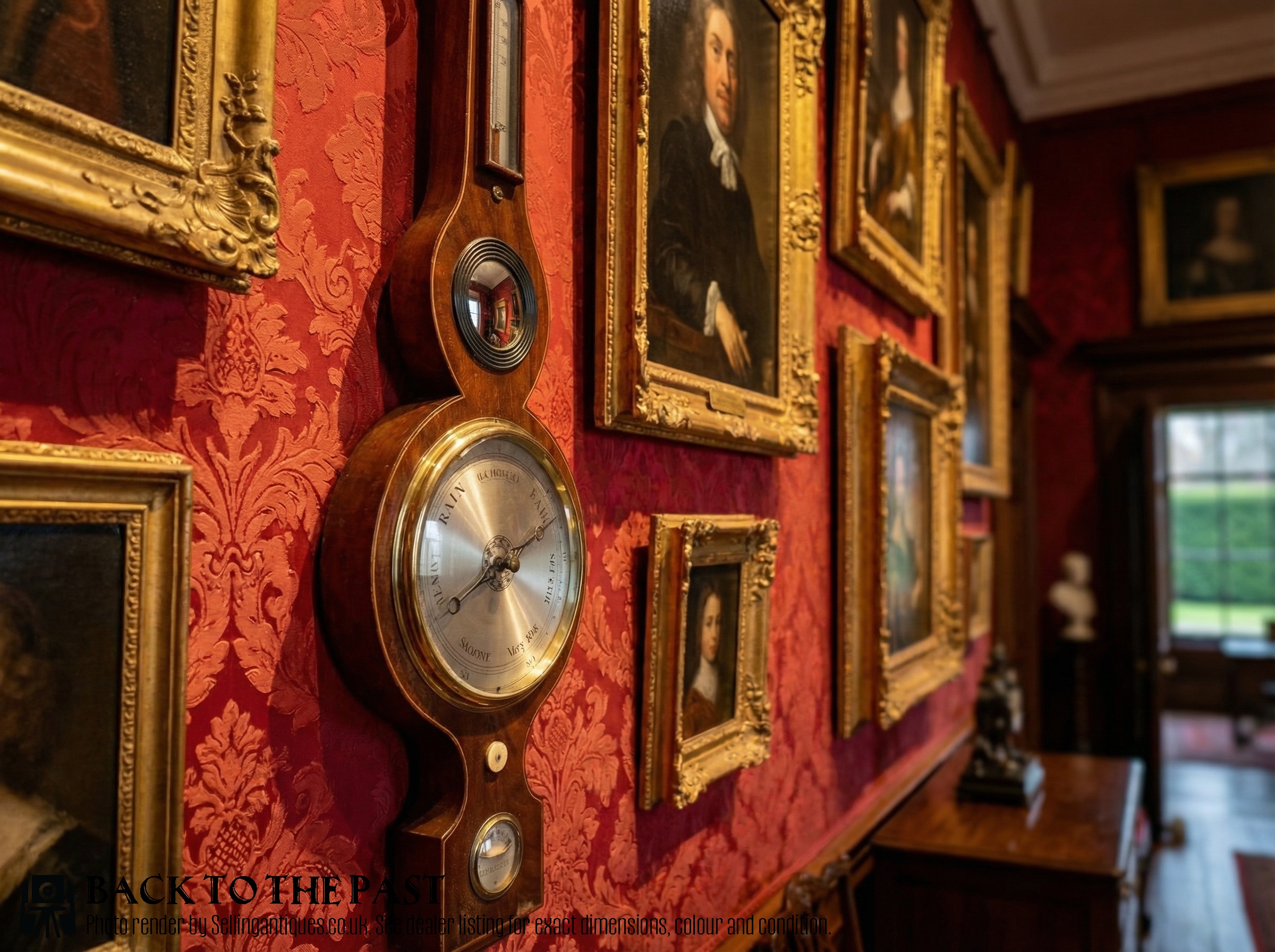
Inlaid Mahogany Barometer
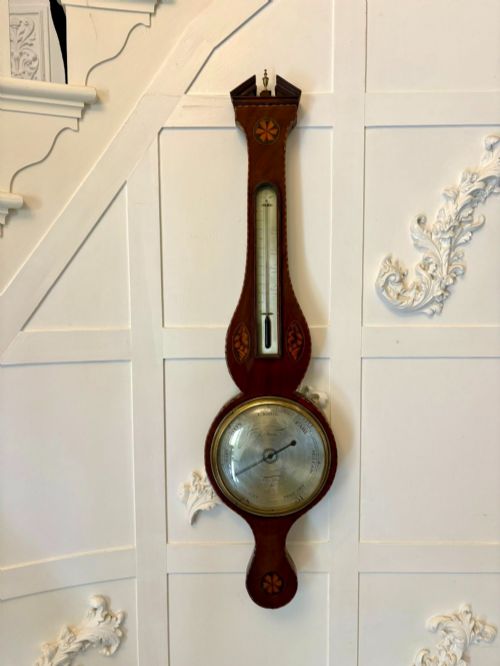
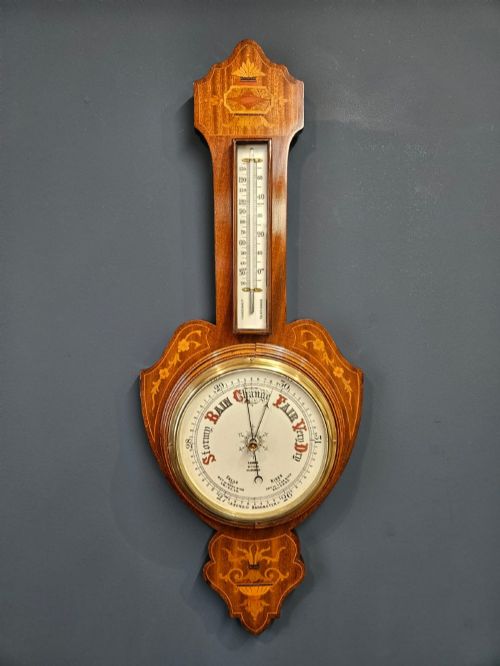
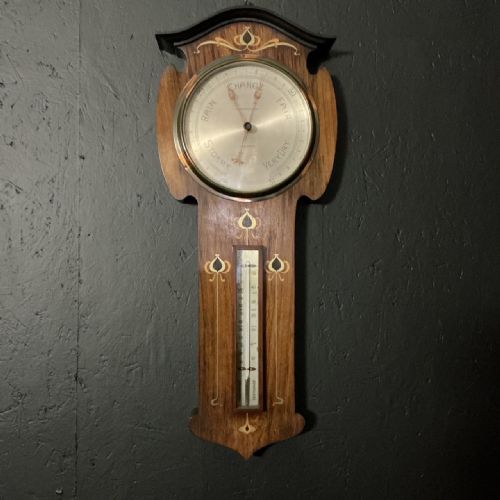
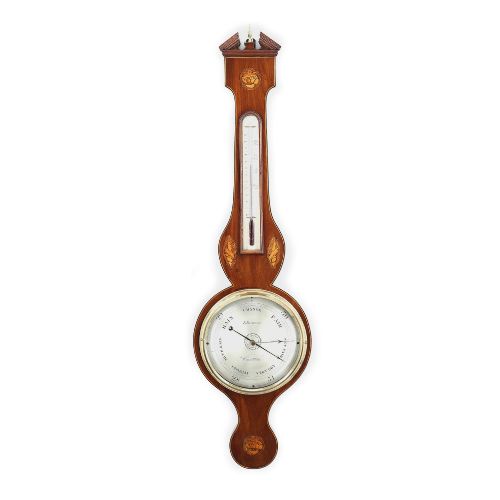
An inlaid mahogany barometer is a domestic weather glass housed in rich timber cabinetry, designed to measure atmospheric pressure while serving as an interior focal point. The pieces gathered here span from the late eighteenth century through the Edwardian era, taking the form of wheel barometers, stick barometers, and aneroid models.
The version most commonly met on this page is the banjo barometer, named for its distinctive curved silhouette that accommodates a large dial at the base and a thermometer or hygrometer along the stem. These instruments reflect styles ranging from Georgian and Regency to Arts and Crafts and Art Nouveau.
Makers recorded in the archive and current listings placed their signatures upon these dials, often travelling from Italy to establish workshops in British towns such as London, Liverpool, Norwich, and York. Buyers will encounter both stick barometers with exposed tubes and wheel barometers featuring intricate spirit levels and convex mirrors.
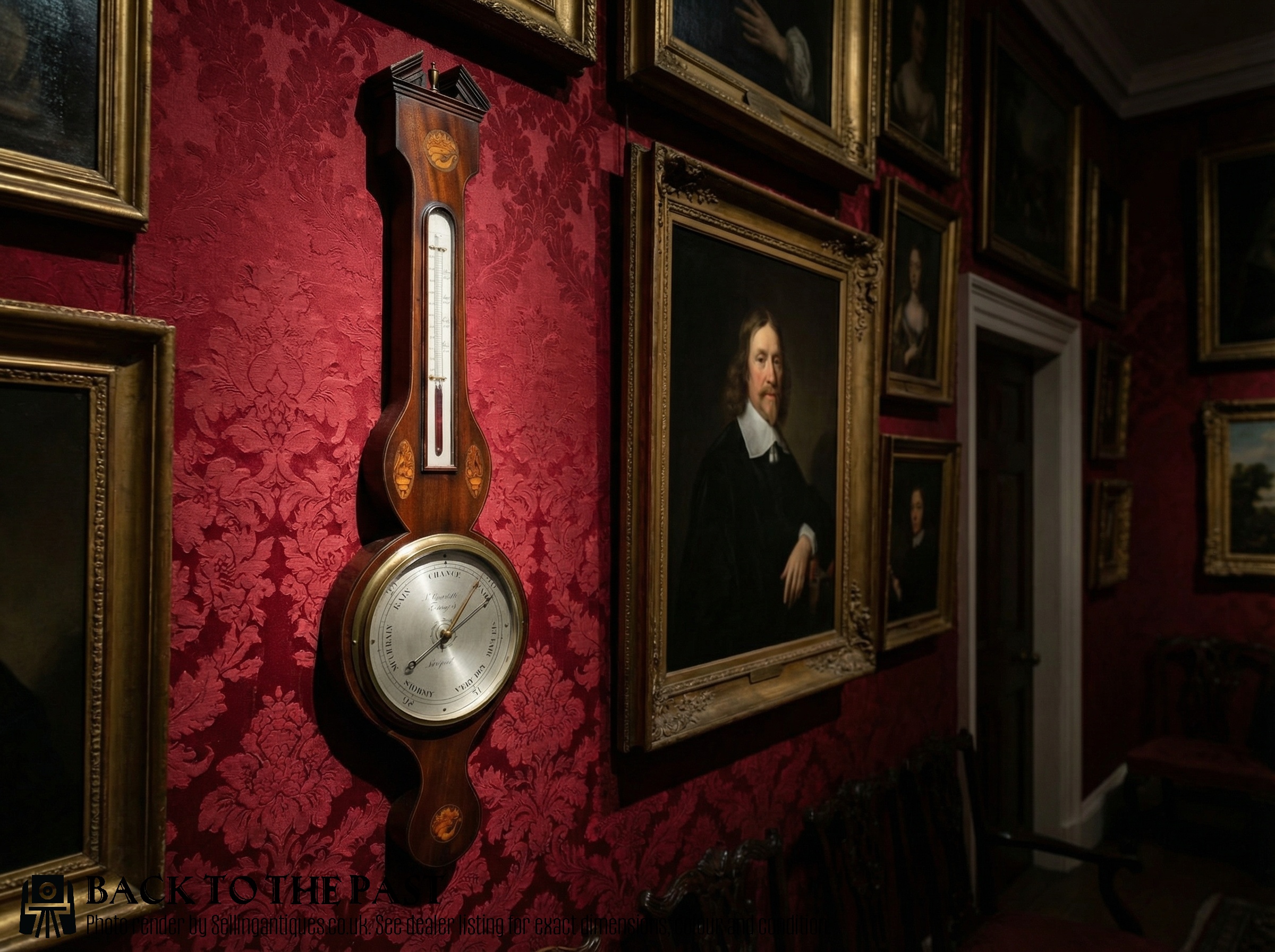
How they were made
Cabinet makers utilised solid and veneered mahogany as the primary carcass material, selecting timber with deep grain patterns for the main body. They embellished these surfaces with contrasting stringing and shell motifs executed in boxwood, satinwood, ebony, and mother-of-pearl.
The internal mechanics combined glass barometer tubes filled with mercury or aneroid metal capsules connected to brass dials and steel indicators. Silvered metal plates received hand-engraved weather scales and maker inscriptions, protected behind brass bezels and heavy glass covers.
Inlaid Mahogany Barometer Retail Price Guide 2026
Typical asking prices for inlaid mahogany barometer among the pieces listed under this phrase on Sellingantiques today, from the lower quarter to the upper quarter. They describe what is for sale here now, not the wider market.
Makers tucked small spirit levels into the bottom of banjo barometers so proud owners could prove their walls were plumb.
What varies in quality
The standard of craftsmanship shows in the crispness of the boxwood and satinwood inlay work, where tight joints and balanced floral or shell motifs distinguish finer London and provincial workshops from simpler production pieces. The proportion of the case, the choice of well-figured mahogany, and the inclusion of dampness indicators or mercury thermometers elevate certain examples above standard domestic instruments.
The execution of the engraved silvered dial plate indicates the level of investment in the piece, with deep, clear lettering and delicate floral scrollwork marking superior production. Preservation of the original brass finials, hygrometers, and mercury tubes also dictates the standing of an individual barometer.
B. Besozzi of Weymouth·Ganthony of London·Prada of High Wycombe·Molton of Norwich·Luisetti of London·Giana of Shrewsbury·L Casatelli of Liverpool·Vecchio & Co of Shaftsbury·A. Rivolta·J Groce of York·Charles Aiano of London·A Pozzobon of London·Pinchetti & Co of London·F Salteri & Co of Nottingham·Dominic Gatty·Schiavi of Chesham·A Abraham of Liverpool·Gugeri & Belotti·Walter Gough of London
The Inlaid Mahogany Barometer Glossary
- Banjo barometer
- A wall barometer featuring a rounded dial at the base and a long, tapering upper stem resembling the musical instrument. This format became the dominant domestic weather glass shape throughout the Georgian and Victorian periods.
- Stick barometer
- A vertical instrument that houses the mercury tube and scale directly within a narrow wooden trunk without a circular dial. These earlier designs offer precise barometric readings through a vernier scale.
- Wheel barometer
- An instrument that uses a float on the mercury column connected to a silk thread and pulley to turn a pointer around a circular dial face. This mechanism translates small pressure changes into wide needle movements.
- Aneroid barometer
- A weather glass that measures atmospheric pressure using a sealed, flexible metal box rather than liquid mercury. This mechanical system gained widespread popularity during the later nineteenth century.
- Marquetry
- The art of creating decorative patterns on wooden surfaces by fitting small pieces of contrasting veneer together. Craftsmen utilised boxwood and satinwood to form floral and shell designs on the mahogany background.
Inlaid Mahogany Barometer: Frequently Asked Questions
Where should I hang a wall barometer?
Mount the instrument on an interior wall away from direct sunlight, radiators, and heavy drafts to protect the mahogany case and ensure accurate temperature readings. A stable environment prevents the timber from warping and keeps the internal mechanisms functioning smoothly.
Secure the barometer firmly to a wall stud or use appropriate wall anchors, as heavier mercury-filled models require solid support. Hang the piece at eye level so the engraved dial and thermometer scale remain easy to read.
How do I date an inlaid mahogany barometer?
Examine the shape of the case, the style of the inlay work, and the signature on the silvered dial plate to establish a period of origin. Earlier eighteenth-century stick barometers feature simple architectural pediments, while Georgian banjo barometers often incorporate delicate shell marquetry.
Later Victorian and Edwardian examples tend to display heavier proportions, aneroid movements, or contrasting satinwood stringing. Maker signatures traced to recorded trade directories further narrow the decade of production.
Did these barometers travel from Italy?
Many instrument makers who settled in Britain during the Georgian and Regency periods originated from the Italian lakes region, particularly Como. These skilled craftsmen established workshops in London and provincial towns to supply domestic weather glasses.
Their surnames appear engraved upon the silvered brass dials alongside British town names. Over generations, these immigrant families integrated into local trade guilds while maintaining high standards of glassblowing and cabinet making.