




Georgian Mahogany Barometer
A georgian mahogany barometer measures atmospheric pressure while bringing warm timber tones and crisp silvered dials into a room.

Georgian Mahogany Barometer
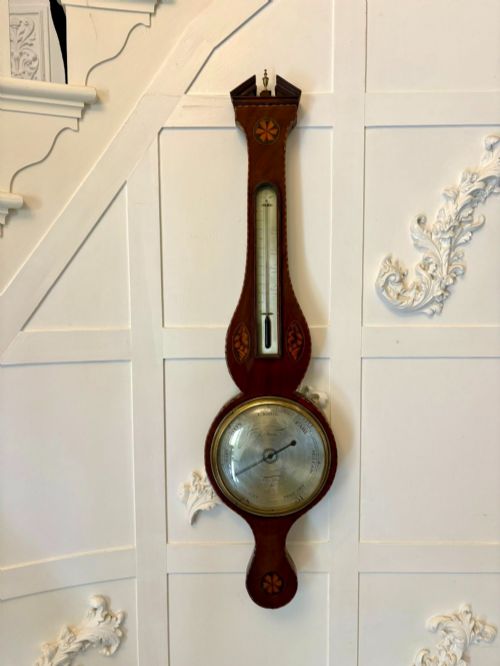
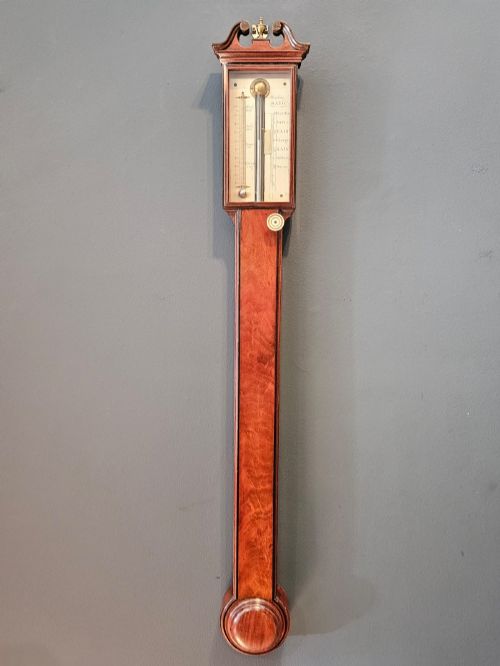
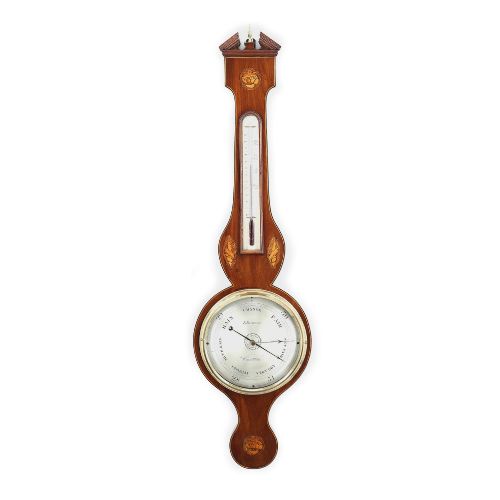
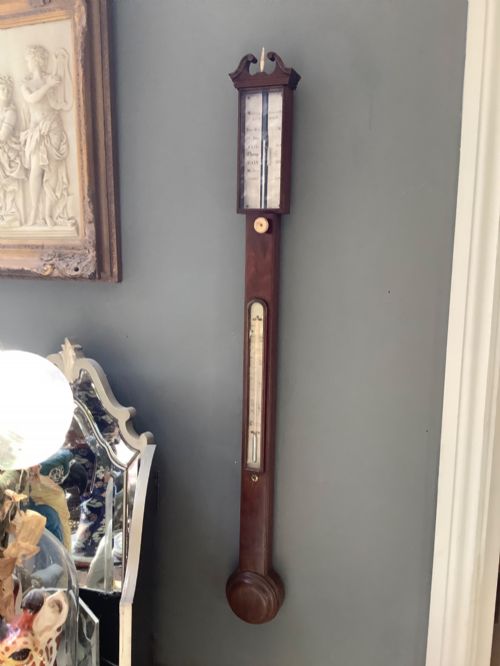
A georgian mahogany barometer is a domestic weather instrument housed in a rich wooden case designed to hang upon a wall. Collectors encounter both vertical stick models and wider wheel or banjo variants.
The selection ranges from eighteenth-century examples originating in London workshops to regional provincial pieces carrying the names of makers from Newcastle to Weymouth. Many incorporate thermometers and hygrometers alongside the primary pressure scale.
Makers utilised dense tropical timber for the long trunks and flared cistern covers, often enhancing the surface with delicate stringing or shell marquetry. These instruments served both a practical scientific purpose and an important decorative function in period interiors.
How they were made
Craftsmen built the cases from solid mahogany, shaping the timber into slender stems or curving wheel bodies and applying boxwood inlay for geometric contrast. The wood was polished to a deep gloss that accentuated the grain.
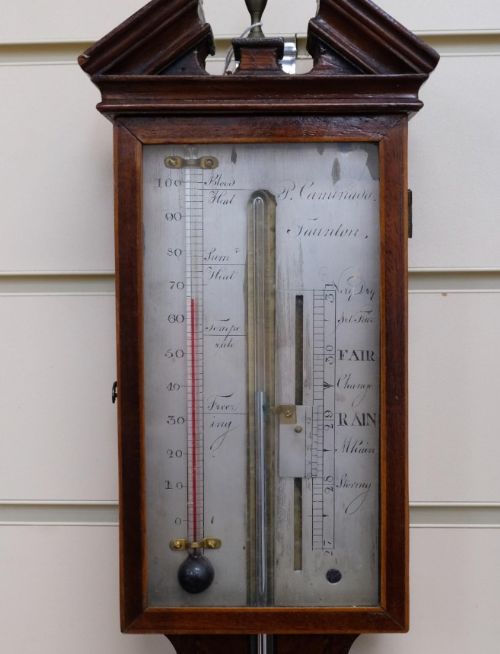
The weather data was displayed on engraved silvered metal or silvered brass plates, marked with calibrations and signed by the maker. Glass tubes containing mercury were mounted within the wooden trunk to track atmospheric shifts.
Georgian Mahogany Barometer Retail Price Guide 2026
Typical asking prices for georgian mahogany barometer among the pieces listed under this phrase on Sellingantiques today, from the lower quarter to the upper quarter. They describe what is for sale here now, not the wider market.
Several makers operated under the careful watch of the weather, signing dials in towns from Bolton to High Wycombe.
What varies in quality
The standard of a georgian mahogany barometer depends heavily on the crispness of the dial engraving and the fidelity of the maker's signature. Provincial pieces often display charming vernacular quirks, whereas London workshop pieces demonstrate exceptional precision in their brass work and scale divisions.
The complexity of the case architecture also sets pieces apart, from plain architectural stick frames to elaborately inlaid banjo layouts featuring multi-tiered dampness and temperature dials. Preservation of the original mercury tube and delicate surface veneers elevates an example above modified survivors.
P. Caminada·George Adams·B. Besozzi·Blunt·Dollond of London·Ganthony of London·JB Bergna·Prada·Molton·Luisetti·Giana·Bate·Jenkins·Ronchetti·L Casatelli·Watkins·Roncoroni·H Marks·Sandrino·Hayward·Vecchio & Co·Gilbert·Bianchi·H Andrews·Malaerieda
The Georgian Mahogany Barometer Glossary
- Banjo barometer
- A domestic weather instrument housed in a case shaped like a banjo, featuring a circular dial at the base and a long stem above. These gained popularity during the late Georgian and Regency periods.
- Stick barometer
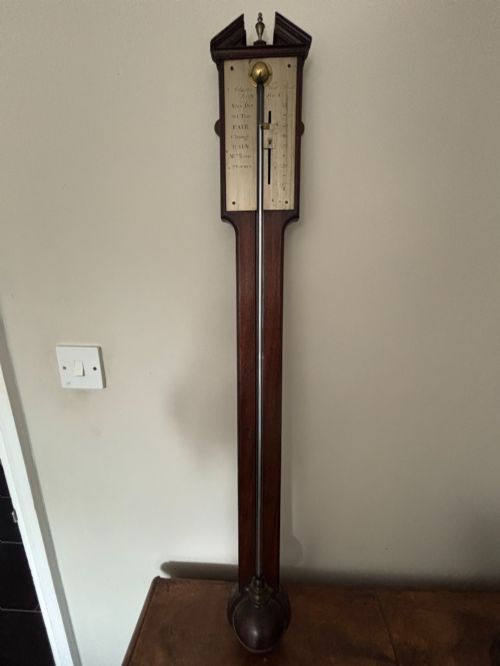
- A tall, narrow wall instrument that encloses the mercury tube vertically within a straight wooden trunk. They represent the earlier and more scientifically direct approach to atmospheric measurement.
- Silvered metal
- A brass or copper plate treated with a silver solution to create a pale reflective surface for the engraved scale numerals. Makers used this material to ensure high legibility against the dark mahogany case.
- Boxwood inlay
- Contrasting pale wood inserted into channels cut within the darker mahogany body to form geometric lines or shell motifs. This technique defines the decorative vocabulary of many Georgian pieces.
- Cistern cover
- The bulbous wooden housing at the base of a stick barometer that protects the mercury reservoir. It is frequently turned into an urn shape or finished with a brass finial.
Georgian Mahogany Barometer: Frequently Asked Questions
How do wheel barometers work?
Wheel barometers use a siphon tube containing mercury with a small glass float resting on the surface. As pressure changes, the movement of the float turns a delicate pulley linked to the pointer on the large circular dial.
This mechanical linkage translates vertical mercury movement into a sweeping rotation across an engraved silvered face.
Where were these barometers made?
Makers worked both in major urban centres like London and across provincial towns throughout Britain. Signatures on the dials often record workshops in locations ranging from Newcastle and Liverpool down to Weymouth and Ashford.
Many instrument makers originated from immigrant Italian families who travelled to Britain to establish successful barometer businesses.
How do I date a Georgian barometer?
Dating relies on stylistic shifts in the mahogany case architecture, the shape of the cistern cover at the base, and the complexity of the dial layout. Earlier eighteenth-century examples favour plain stick formats, while nineteenth-century pieces often expand into decorated banjo shapes.
Makers' signatures recorded on the silvered brass plates also allow researchers to cross-reference working dates and trade directories.