




Antique Cistern Barometer
An antique cistern barometer is a sensitive instrument for measuring atmospheric pressure, prized by collectors for its elegant timber case and early scientific ingenuity.
Antique Cistern Barometer
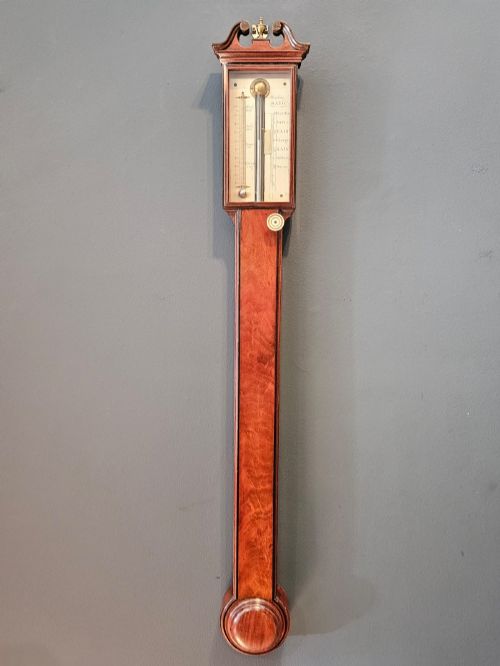
When you search for an antique cistern barometer, you are looking at mercury-filled scientific instruments housed in upright wooden cases designed for domestic use. The pieces appearing here span from the early eighteenth century through the nineteenth century, encompassing Georgian, Regency, and Victorian periods.
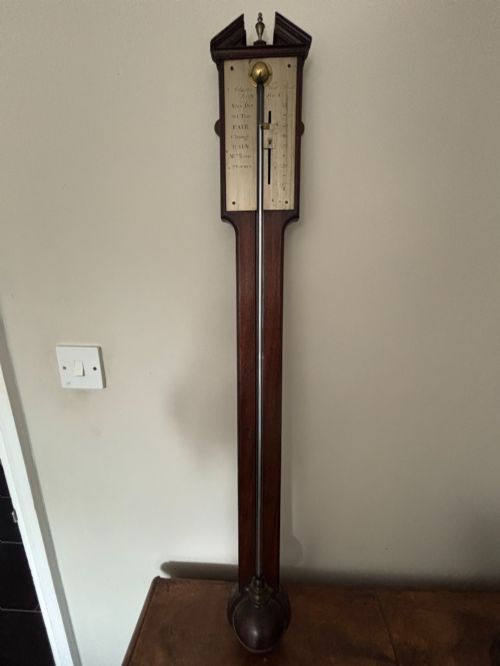
The most common form you will meet on this page is the stick barometer, frequently constructed from mahogany, walnut, or oak. These tall, narrow instruments record barometric fluctuations through a visible tube of mercury against a marked register plate.
Makers ranged from provincial opticians to prominent London instrument houses, with many examples originating from Italian migrant instrument makers working across Britain. Their creations combine functional meteorology with cabinet-making traditions of the period.
Materials and construction
The cases rely heavily on dense hardwoods such as mahogany and walnut, frequently shaped with straight stems or bow fronts to accommodate the glass tube within. Selected pieces incorporate oak, boxwood inlay, or ebonised finishes.
Graduated scales are traditionally engraved on silvered brass or silvered metal plates, allowing precise reading of atmospheric pressure alongside descriptive weather terms. Bone components occasionally appear for vernier scales or adjustment keys.
The core mechanism utilises an open cistern of mercury at the base connected to a sealed glass tube, a configuration requiring careful stabilization within the wooden trunk.
Antique Cistern Barometer Retail Price Guide 2026
Typical asking prices for cistern barometer among the pieces listed under this phrase on Sellingantiques today, from the lower quarter to the upper quarter. They describe what is for sale here now, not the wider market.
Several instruments proudly bear the signature of itinerant Italian meteorologists who walked Britain to sell their barometers.
Distinguishing quality
Superior quality in an antique cistern barometer rests upon the crispness of the cabinet work and the untouched state of the engraved silvered brass scale. Master makers distinguished their work through refined proportions, choice veneers, and carefully calibrated register plates.
The reputation of the maker inscribed upon the dial significantly influences the standing of an instrument, with signed examples from notable opticians commanding particular attention. Provincial makers working in regional centres also produced work of considerable merit when paired with robust framing.
The preservation of the original glass tube, mercury charge, and cistern cover without modern replacement parts dictates the historical integrity of the piece.
George Adams London·Negretti and Zambra·Dollond of London·J Hughes London·James Gatty London·Alexander Adie
The Antique Cistern Barometer Glossary
- Cistern barometer
- An atmospheric pressure measuring device where the lower end of the glass tube is immersed in an open reservoir of mercury. This foundational design allows the column of mercury to rise and fall directly with atmospheric changes.
- Stick barometer
- A tall, narrow wall-mounted instrument featuring a long enclosed glass tube and a weather scale. It represents the predominant style found across Georgian and Victorian domestic interiors.
- Silvered brass
- A metallic alloy treated with a silver compound to produce a bright, matte surface suitable for fine engraving. Instrument makers used this material for the register plates where weather conditions and barometric inches are marked.
- Vernier scale
- A sliding auxiliary scale that enables fractional readings of the main barometric scale. It allows precise observation of minute shifts in atmospheric pressure.
- Bow front
- A convex, outwardly curved cabinet profile fashionable during the Regency and nineteenth-century periods. This styling softens the vertical lines of the instrument case.
Antique Cistern Barometer: Frequently Asked Questions
How do I read an antique cistern barometer?
Observe the height of the mercury column against the graduations on the silvered brass plate, using the adjustable pointer to track movement. Rising mercury typically indicates settling weather, while falling levels suggest approaching rain or wind.
Compare the current reading with the descriptive weather words engraved on the dial, such as stormy or fair. The sliding vernier scale allows you to measure precise fractions of an inch for accurate record keeping.
Where should I hang a stick barometer?
Mount the instrument on an interior wall away from direct sunlight, central heating radiators, and busy doorways. Sudden temperature fluctuations can affect the mercury and strain the wooden case.
A stable indoor environment ensures the timber does not warp and helps preserve the historic finish of the mahogany or walnut housing.
How do I date an antique cistern barometer?
Examine the style of the wooden case, the typography on the silvered brass dial, and any signature engraved by the maker. Georgian examples generally feature simpler architectural lines, while nineteenth-century versions often introduce bow fronts or more elaborate crests.
Researching the active dates of the maker named on the register plate provides a reliable window for the period of manufacture.
Can these barometers still be transported safely?
Moving a mercury-filled instrument requires tilting the case gently to allow the mercury to fill the tube completely, preventing air pockets from breaking the glass during transit. Many collectors prefer to consult a specialist restorer before relocating an antique barometer.
Once repositioned in a new home, the instrument must hang plumb and undisturbed for several hours to stabilise.