
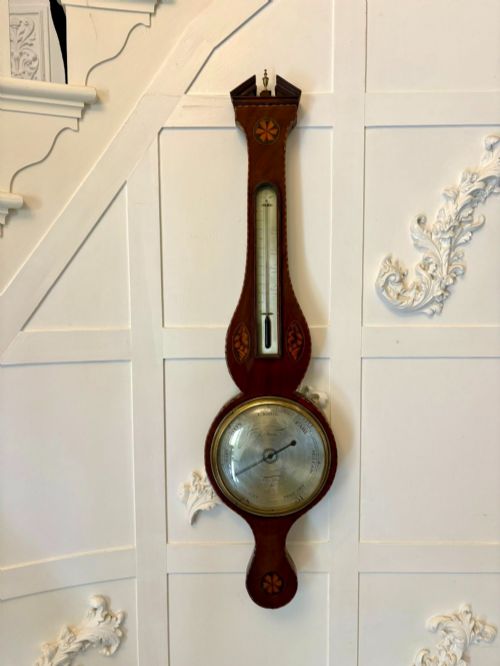


George III Barometer
A george iii barometer records atmospheric pressure with scientific precision while serving as a commanding piece of period furniture.
What george iii barometer pieces are
When you search for a george iii barometer, you encounter instruments created during the Georgian era, spanning the eighteenth and early nineteenth centuries. The selection divides primarily between straight-shafted stick barometers and the wider, curved-top banjo barometers.
Mahogany forms the dominant housing material, frequently paired with contrasting boxwood inlay or rosewood veneers. Many examples survive from workshops located in London as well as regional centres like Bath, Liverpool, York and Macclesfield.
The stick barometer format offers a slender profile suited to narrow hallways, whereas the banjo barometer provides a more decorative presence with its expanded dial face. Both types reflect the domestic scientific interests of the period alongside cabinet-making standards.

Materials and construction
Cabinet makers constructed the wooden cases from solid mahogany, walnut or rosewood, incorporating boxwood inlay and ebony detailing to outline the edges. Glass protected the delicate dials and mercury columns, while brass components formed bezels, pointers and cistern covers.
Dials were typically rendered in silvered metal or silvered brass, carrying engraved scales and maker signatures. Mercury provided the working fluid within the enclosed glass tubes, responding directly to barometric pressure changes.
Retail Price Guide 2026
Typical UK retail prices for george iii barometer, calculated from the Sellingantiques database of over a million retail prices indexed since 2003. This retail price guide relies exclusively on Sellingantiques data; no external sources or auction records are used, so the figures do not describe the wider market.
Several makers ensured their home towns were permanently recorded on the dial alongside their own surname.
Distinctions in quality
The refinement of the cabinet work dictates the standing of an individual piece, visible in the choice of figured mahogany veneers and the precision of boxwood stringing. Cases with sophisticated bow-fronts or detailed shell inlay represent the upper tier of the range.
The clarity and legibility of the silvered metal dial, alongside the crispness of the engraved maker inscription, separate standard production from superior workshop output. Original brass fittings and untouched mercury tubes further elevate the standing of surviving instruments.
Blunt·John Bleuler·Dollond·Fasana of Bath·N. Ortelly and Co·A Abraham of Liverpool
The George III Barometer Glossary
- Stick barometer
- A tall, slender wall instrument enclosing a mercury-filled glass tube to measure atmospheric pressure. This form offers a direct view of the column.
- Banjo barometer
- A domestic weather glass featuring a circular dial at the base and a long trunk above, resembling the shape of a banjo. These versions often incorporate multiple dials including thermometers and hygrometers.
- Silvered brass
- A metallic alloy treated with a silver compound to produce a bright, matte finish suitable for engraved gauge scales. This surface catches light without causing sharp glare.
- Cistern
- The enclosed reservoir at the base of the barometer tube that holds the reserve mercury. Its design allows atmospheric pressure to act upon the fluid.
- Stringing
- Fine inlay work of contrasting timber used to create decorative borders along the edges of the cabinet. Boxwood provides a pale line against dark mahogany.
Frequently Asked Questions
How do stick and banjo barometers differ?
Stick barometers present a narrow, vertical wooden trunk designed to display the mercury column directly against a scale. Banjo versions expand the lower section into a rounded dial face to accommodate multiple weather indicators.
Both forms utilise the same underlying barometric principles but occupy very different visual spaces within a room.
Where should I hang a mercury barometer?
Select an interior wall away from direct sunlight, radiators and heavy draughts to ensure the internal mercury responds solely to atmospheric changes. Stable ambient temperatures help preserve the antique cabinet wood.
Ensure the wall fixings can securely support the weight of the hardwood case and glass components.
Can these antique barometers still predict the weather?
The mercury columns within these historical instruments continue to rise and fall with changes in atmospheric pressure. Interpreting the engraved dial scales allows you to track local weather trends much as original owners did.
Professional handling is recommended if the instrument requires relocation or re-securing of the internal mercury.
How do I identify a Georgian period barometer?
Examine the timber selection, construction methods and dial typography for characteristics consistent with eighteenth and early nineteenth-century cabinet making. Mahogany cases with hand-engraved silvered brass dials and regional signatures point directly to this era.
Subtle details like boxwood inlay and secondary wood choices help confirm the period of manufacture.