
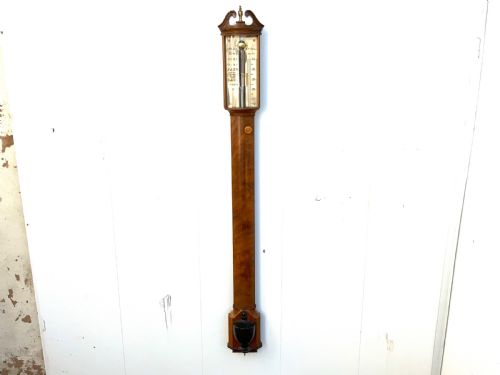


English Stick Barometer
An English stick barometer brings the quiet authority of Georgian and Victorian science into a room, registering atmospheric pressure with clean vertical restraint.

English Stick Barometer
When you search for an english stick barometer, you encounter tall, slender instruments designed to show barometric pressure through a mercury column visible behind a glass tube. The examples seen here span from the early eighteenth century through the Victorian era, reflecting the steady evolution of domestic weather-recording.
Most pieces on this page take the form of wall-hanging cases in timbers such as mahogany, walnut, oak, and rosewood. You meet both domestic wall models and marine versions configured for use at sea, alongside bow-fronted and boxwood-inlaid variations.
Makers working in London, Liverpool, Halifax, and High Wycombe produced these pieces across the Georgian and Victorian periods, signing their brass scales or register plates. The styles range from plain early Georgian proportioning to mid-Victorian carved walnut cases with twin verniers.
Materials and construction
Cabinetmakers constructed the tall narrow trunks from dense hardwoods including mahogany, walnut, rosewood, and oak, often selecting figured veneers or adding boxwood stringing. These timbers provided the dimensional stability required to house the long glass tubes securely.
The working parts combine blown glass for the barometer tube with engraved brass or silvered brass plates for the scales and verniers. Bone or ivory indicators and brass cistern covers complete the mechanical assembly of the instrument.
English Stick Barometer Retail Price Guide 2026
Typical asking prices for english stick barometer among the pieces listed under this phrase on Sellingantiques today, from the lower quarter to the upper quarter. They describe what is for sale here now, not the wider market.
Many a Victorian sea captain trusted his rosewood tube to keep him out of the ditch, even if the cook dinner was burning.
Assessing quality and proportion
The standard of a piece rests on the crispness of the cabinetwork and the legibility of the engraved silvered brass scale. Finer examples display carefully chosen wood grain, harmonious proportions, and original signed plates rather than replacement parts.
Signatures by established makers working in London or the provinces elevate an instrument, as does the retention of delicate architectural pediments, cistern covers, and original glass tubes.
Prada of High Wycombe·J Hughes London·Negretti & Zambra London·Sandrino of Liverpool·Gilbert London·James Gatty London·Gowland London·A Pinchetti & Co London·Charles Howarth Halifax·Comitti·Torre and Co London·Davis Leeds
The English Stick Barometer Glossary
- Vernier
- A small movable auxiliary scale that allows the main barometric scale to be read to a fraction of a subdivision. It slides alongside the primary column of mercury.
- Cistern
- The reservoir at the base of the barometer tube that holds the reserve of mercury. In marine stick barometers, this often includes a special fitting to prevent spillage at sea.
- Silvered brass
- A brass plate treated with a silver composition to create a bright, legible background for engraved numbers and maker inscriptions. It tarnishes gracefully over time.
- Marine stick barometer
- A specialised weather glass designed to hang on gimbals aboard a ship, featuring a constricted tube to prevent the mercury from surging with the motion of the vessel.
English Stick Barometer: Frequently Asked Questions
How do I read a stick barometer?
You read the height of the mercury column against the scale, using the sliding vernier to measure fractions of an inch or millimetres. Rising mercury generally indicates improving weather, while falling mercury points toward approaching storms.
Most instruments feature dual columns or engraved weather descriptions alongside the numbers to help interpret the atmospheric pressure changes.
Where should I hang a stick barometer?
Mount the instrument securely to a sturdy interior wall away from direct sunlight, central heating radiators, and exterior doors. Stable room temperatures ensure the metal and wood components do not warp or stress the glass tube.
Because these barometers are long and relatively heavy, use appropriate wall fixings that engage directly with the structure behind the plaster.
How do I date an English stick barometer?
Examine the timber, the shape of the case, the style of the pediment at the top, and the signature engraved on the brass plate. Early eighteenth-century examples often feature plain walnut trunks, while Georgian and Victorian pieces introduce mahogany, rosewood, and more ornate carving.
Makers' names and addresses recorded on the scale plate also provide firm clues to the active working dates of the workshop.
What is the difference between a domestic and marine barometer?
Domestic stick barometers hang flat against a wall in a fixed position, intended for steady household use. Marine barometers are built to swing on gimbals and possess restricted glass tubes to withstand the motion of a ship.
Marine versions frequently incorporate brass cistern covers and robust gimbal mounts to keep the instrument vertical at sea.
Can antique barometers still predict the weather?
Many surviving examples remain fully functional mechanical instruments that register true barometric pressure changes accurately. The mercury column responds directly to local atmospheric weight just as it did centuries ago.
Some instruments may require professional checking of the sealed tube and mercury charge before relying on them for daily forecasting.