
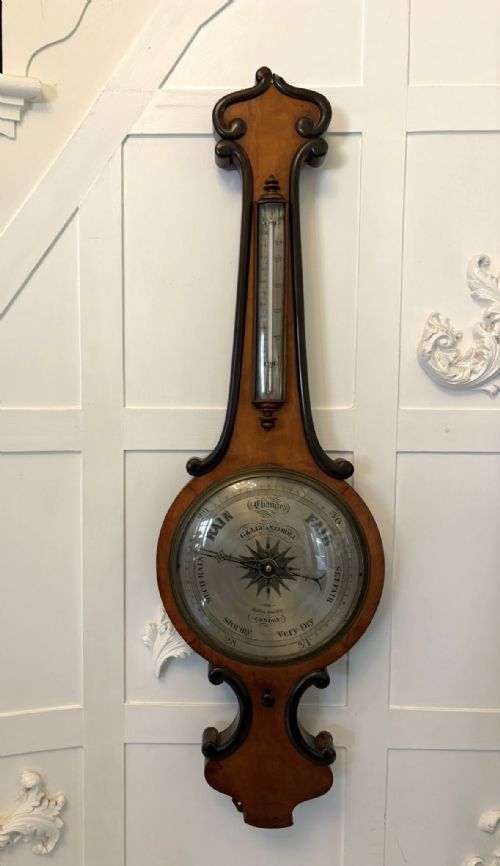


Carved Walnut Barometer
A carved walnut barometer measures atmospheric pressure while displaying the rich grain and deep relief carving typical of nineteenth-century domestic interiors.
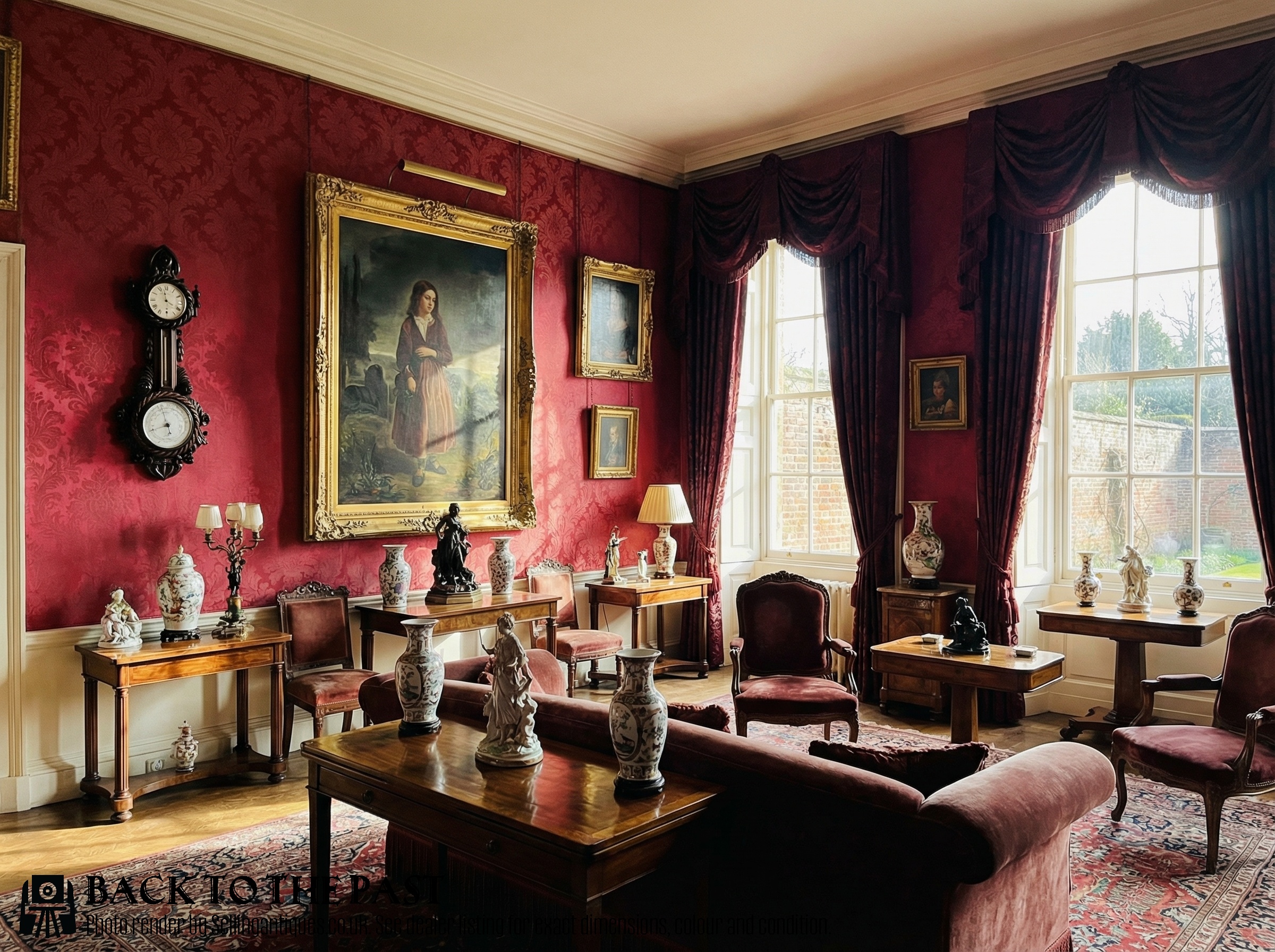
Carved Walnut Barometer
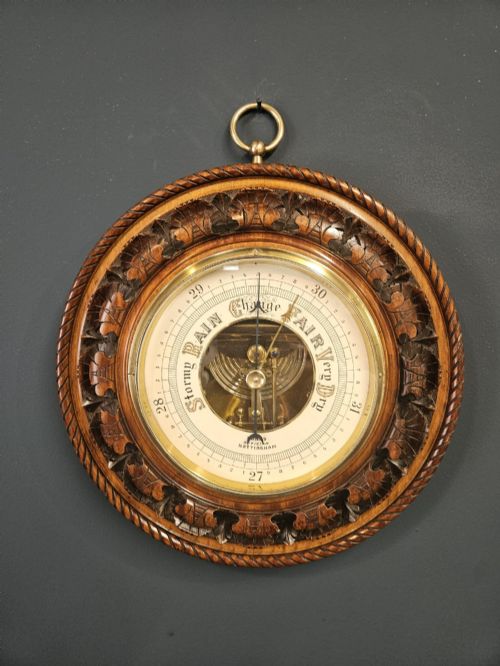
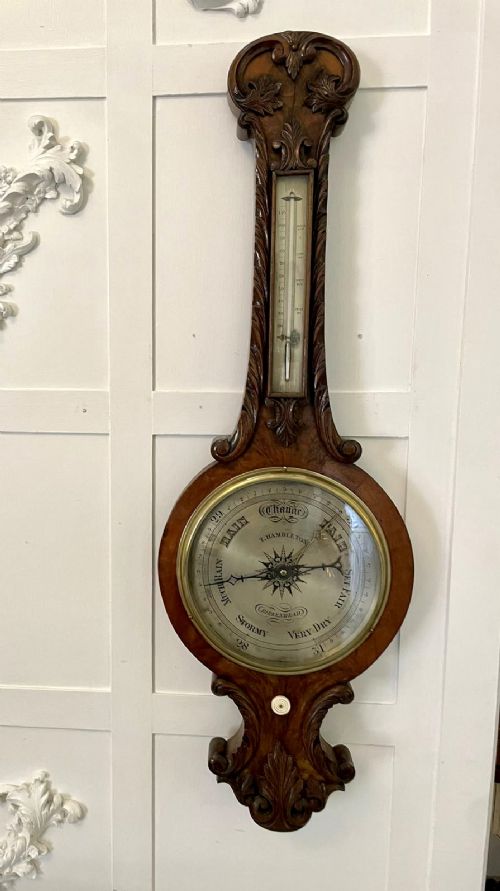
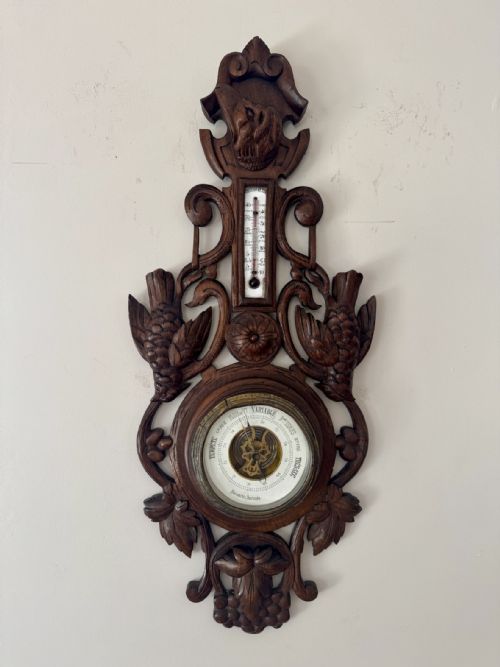
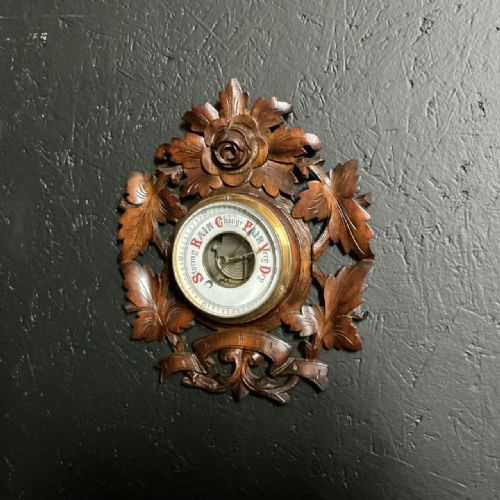
When you search for a carved walnut barometer, you encounter domestic weather glasses housed in timber cases shaped by nineteenth-century makers. The most common examples on this page are Victorian banjo barometers, wheel barometers, and aneroid instruments originating from English workshops or Black Forest carvers.
These instruments hung in hallways and libraries to measure barometric pressure, often combining thermometers and occasionally clocks within the same carved wooden housing. The record shows robust representation from the Victorian era alongside Edwardian interpretations.
Origins stretch from English provincial towns and London makers to continental European workshops, particularly those producing Black Forest carving in golden walnut and lindenwood.
How they were made
Cabinet makers utilised solid walnut, burr walnut veneers, and lindenwood to construct the cases, applying hand-carved foliage, rocaille motifs, and geometric turning. The wood was selected for distinct grain patterns and dark patination.
Workshops integrated brass bezels, silvered dials, porcelain components, and glass faces to protect the delicate internal movements. Aneroid mechanisms and mercurial tubes were fitted to translate atmospheric changes into movement on the dial.
Carved Walnut Barometer Retail Price Guide 2026
Typical asking prices for carved walnut barometer among the pieces listed under this phrase on Sellingantiques today, from the lower quarter to the upper quarter. They describe what is for sale here now, not the wider market.
Object forms include stick barometers, banjo shapes, wheel configurations, and combined clock-and-barometer units.
What varies in quality
The distinction between ordinary and superior pieces rests on the depth and definition of the wood carving, particularly the crispness of leaf scrolls and animal or foliage motifs. Plain turned surrounds contrast with deeply undercut relief work executed by skilled hands.
Quality also appears in the integration of secondary functions, such as matched thermometers and clock movements, alongside signed dials from established makers rather than anonymous workshop output.
G and L Guanziroli·Negretti and Zambra·W Johnson·James Pitkin·Maple and Co
The Carved Walnut Barometer Glossary
- Aneroid barometer
- An instrument measuring atmospheric pressure by the expansion and contraction of a flexible metal box, operating without liquid mercury. This design allowed makers to construct wall instruments in varied banjo and skeletonised formats.
- Banjo barometer
- A wall barometer featuring a rounded top and an elongated trunk shaped like the stringed instrument. It typically houses a thermometer above and a dial below.
- Wheel barometer
- A domestic weather glass connected to a pulley system that turns a pointer around a circular dial. These often incorporate hygrometers or thermometers in the main case.
- Skeletonised barometer
- An instrument design exposing the internal brass plates, wheels, and levers behind a glass face. This layout displays the mechanical workings alongside the carved wooden surround.
- Black Forest style
- A decorative manner originating in central Europe characterised by naturalistic carvings of foliage, animals, and rustic scenes. Pieces in this style utilise walnut and lindenwood to create high-relief ornamentation.
Carved Walnut Barometer: Frequently Asked Questions
What is an aneroid barometer?
An aneroid barometer measures atmospheric pressure using a sealed corrugated metal box that expands or contracts as pressure changes. This movement connects mechanically to a pointer on a visible dial.
Unlike traditional mercurial columns, this mechanism contains no liquid, making the instrument safer to transport and hang on domestic walls.
How do I read a wheel barometer?
The main circular dial shows pressure readings labelled from stormy through changeable to fair. A secondary manual pointer is set over the active needle to track whether pressure rises or falls.
Additional dials on the case often display temperature via a thermometer or humidity via a hygrometer.
Where should I hang a wall barometer?
These instruments require a stable interior wall away from direct sunlight, radiators, and heavy vibrations. Sudden temperature shifts can affect the internal mechanical response.
Ensure the hanging bracket securely supports the weight of the solid wood case and glass face.
How do I date a walnut barometer?
Dating relies on the style of the wood carving, the shape of the case, and the construction of the dial. Victorian and Edwardian examples show distinct aesthetic preferences from heavy scrolling to refined burr veneers.
Signatures on the dial or backing paper from makers provide more precise attribution.