


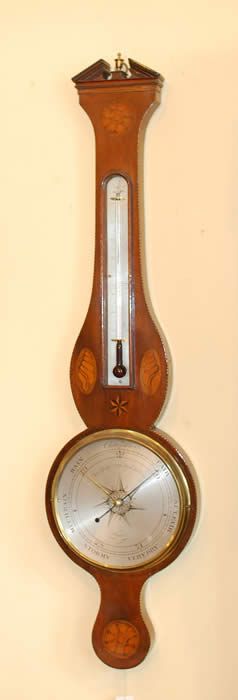


Regency Wheel Barometer
A regency wheel barometer is a practical household instrument that brings classic style to a wall, and these mahogany examples deliver traditional charm.
What a regency wheel barometer is
When you search for a regency wheel barometer, you examine banjo-shaped wall instruments housing dials, hygrometers, and thermometers. These pieces date from the Regency period, the nineteenth century, and around eighteen hundred, capturing a classic Georgian and George IV aesthetic.
You are most likely to meet mahogany versions on this page, occasionally featuring satinwood stringing or dials. The forms include standard wheel barometers and clock wheel combinations housed in distinctive wooden cases.
How they were made
Maker workshops constructed these instrument cases using solid mahogany and sometimes satinwood veneers. Artisans shaped the wood into curving banjo silhouettes designed to hang flat against a wall.
Brass fittings, dials, and glassbezels protect the instrumentation face. Makers integrated mercury tubes inside the wooden trunk to measure atmospheric pressure alongside secondary dials.
Retail Price Guide 2026
Typical UK retail prices for regency wheel barometer, calculated from the Sellingantiques database of over a million retail prices indexed since 2003. This retail price guide relies exclusively on Sellingantiques data; no external sources or auction records are used, so the figures do not describe the wider market.
Makers working in locations from Norwich to Colchester signed their dials, recording provincial trade networks across England.
What varies in quality
The sophistication of the timber figure and the crispness of the dial engraving separate standard examples from finer pieces. Cabinetmakers who selected richly grained mahogany and added delicate stringing elevated the overall presence.
The reputation of the maker inscribed on the dial alters the character of an instrument. Signed provincial and London workshop pieces carry distinct historical weight compared to unmarked alternatives.
Molton of Norwich·Roncoroni·H Marks·F Salteri and Co·Schiavi of Chesham·C Bellatti·P Aggio of Colchester
The Regency Wheel Barometer Glossary
- Wheel barometer
- An instrument that uses a mechanical pulley system and a weight inside a tube to move a pointer around a circular dial in response to air pressure. This layout replaced traditional stick barometers in many homes.
- Banjo barometer
- A popular collector term for a wall barometer shaped like a banjo, featuring a narrow trunk and a circular dial at the base. It is the defining silhouette of the period.
- Hygrometer
- A device fitted to the upper section of the instrument to measure humidity in the air. It often sits in a circular brass bezel matching the main dial.
- Stringing
- Thin decorative lines of contrasting wood inlay, such as satinwood, set into the mahogany border. This technique highlights the geometric form of the case.
Frequently Asked Questions
How do I hang a wheel barometer?
You hang a wheel barometer securely from a sturdy wall fixing using the hanging ring or bracket provided on the back of the mahogany case. Ensure the wall plug matches the weight of the instrument.
Keep the barometer away from direct heat sources and exterior doors to protect the wooden case and internal mechanisms. Stable indoor temperatures help the instrument settle correctly.
Are these barometers accurate?
These historical instruments reflect atmospheric changes based on the movement of mercury within their sealed glass tubes. While they respond to weather shifts, they serve primarily as decorative antiques rather than precision meteorological tools.
Many retain their original mechanical linkages, but variations can occur over centuries of atmospheric exposure. Collectors appreciate them for their craftsmanship and historical function.
How do I identify the period?
You identify the period by examining the mahogany timber, the style of the dial engraving, and the shape of the wooden case. Regency examples often feature distinct architectural pediments and satinwood accents.
Signatures inscribed on the brass or paper dials often name the maker and town, providing a direct link to nineteenth-century workshops. Comparing the case silhouette to Georgian design standards confirms the era.