




Satsuma Ware Urn
Satsuma ware urn describes highly decorated Japanese ceramic vessels featuring intricate enamel and gold leaf, prized for elaborate figural scenes.
Satsuma Ware Urn
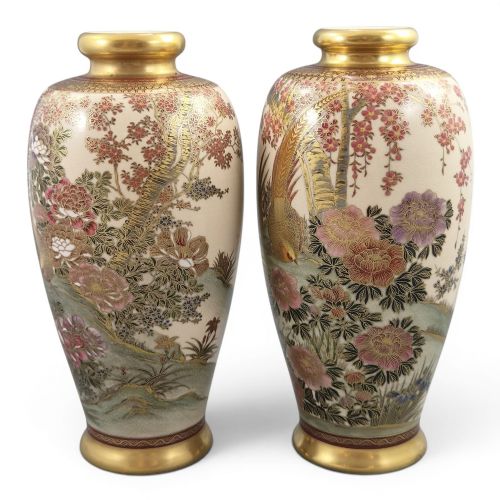
When a buyer searches for a satsuma ware urn, they examine earthenware vessels originating primarily from the Meiji period alongside Edwardian and later examples. These objects appear as large decorative jars, lidded vessels, incense burners, and vases displaying traditional Japanese motifs.
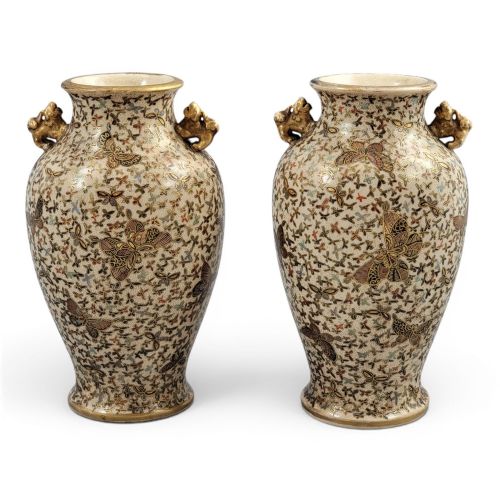
The selections span miniature pieces to monumental display items, often formed as pairs with hexagonal or globular bodies. Makers from Kyoto and Kobe produced these works for domestic and export markets, establishing distinct regional styles.
How They Were Made
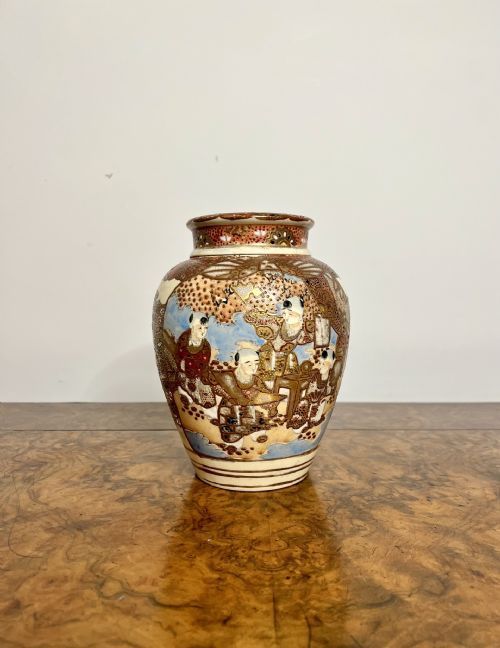
Artisans built these pieces using earthenware, applying a characteristic ivory-coloured cracked glaze that formed the pale base for detailed painting. Painters then worked in polychrome enamel and gold leaf to render dense figural processions, landscapes, and floral patterns.
Techniques such as moriage built up raised slip decorations to accent the surface design, while artists incorporated signatures, studio marks, and the Shimazu family crest directly into the enamel or gilding.
Listings feature earthenware vessels spanning the Victorian and Edwardian eras, predominantly created during the Japanese Meiji and Showa periods.
What Varies in Quality
The standard of painting dictates the distinction between ordinary production and masterworks, seen in the precision of facial expressions on arhats and figures. Dense, controlled application of gold leaf and enamel without crowding separates superior workshops from simpler export items.
Signatures by notable studios such as Kinkōzan or Hododa indicate higher artistic ambition and execution. The crispness of the moulded earthenware body and the fineness of the crackle in the glaze further define the grade of the piece.
Manpei, Kobe·Kinkōzan, Kyoto·Kinzan·Hotoda·Chosei, Kyoto·Nanzan·Seiko-en Chokei·Yamashu·Kizan·Hakusan·Tagawa·Hattori
The Satsuma Ware Urn Glossary
- Satsuma ware
- Earthenware pottery originating from Satsuma province in Japan, characterised by a fine crackle glaze and ornate enamel decoration. This style became widely popular during the Meiji period.
- Moriage
- A ceramic technique where clay slip is piped onto the surface to create raised decorative relief before glazing and gilding. This adds tactile depth to garments and borders.
- Koro
- A traditional Japanese incense burner fitted with a pierced cover to release fragrance. These vessels frequently feature tripod supports or handles.
- Shimazu mon
- The heraldic crest of the Shimazu clan, depicting a cross within a circle. Its presence denotes patronage or production associated with Satsuma domains.
- Rakan
- Japanese term for an arhat, representing an enlightened follower of Buddha. These figures appear frequently in detailed hand-painted processions.
Satsuma Ware Urn: Frequently Asked Questions
How do I identify a Meiji period satsuma urn?
Meiji period pieces typically display dense polychrome enamel work combined with heavy gilding over a fine crackle earthenware glaze. Many carry artist signatures or studio seals on the base.
Older examples tend to show meticulous brushwork in scenes depicting arhats, immortals, or wisteria gardens rather than simplified export decoration.
Where were satsuma urns made?
Production centred in Satsuma province on Kyushu island initially, but major Kyoto workshops like Kinkozan and studios in Kobe produced the vast majority of exported pieces found today. These urban centres drove innovation in rich enamel and gold leaf designs.
Kyoto makers particularly catered to international tastes during the late nineteenth century.
How should I display satsuma ware at home?
Place these vessels away from direct sunlight to protect the delicate gold leaf and polychrome enamels from fading over time. Stable shelving is essential due to the heavy earthenware construction of larger examples.
Pairing matching vases or placing a koro centrally allows the detailed figural panels to be viewed clearly.