
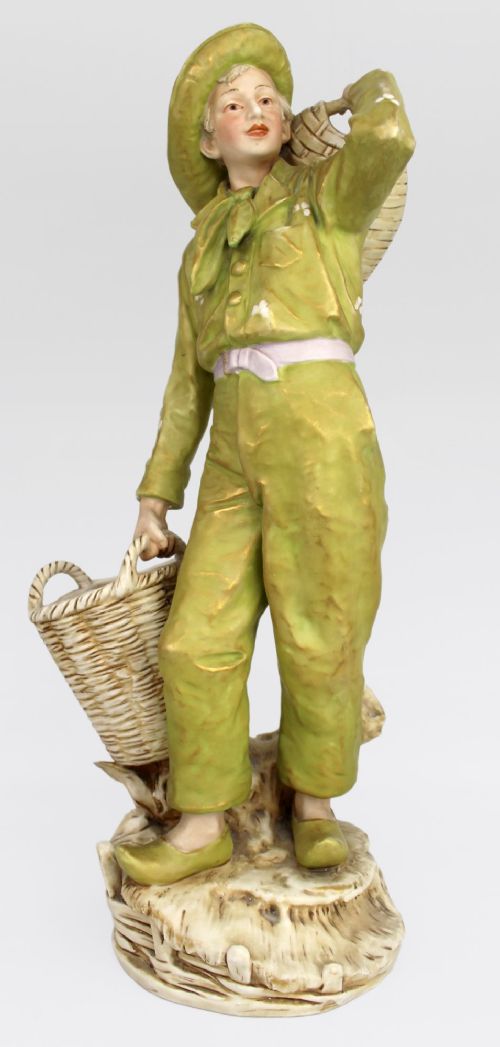


Royal Dux Figures
Royal Dux figures bring graceful continental modelling and distinctive ceramic craftsmanship into a room.
Royal Dux Figures
Royal Dux figures encompass porcelain figurines, decorative sculptures, and figural groups originating from Bohemia across the late nineteenth and early twentieth centuries. When searching for royal dux figures, a buyer encounters subjects ranging from shepherdesses and water carriers to animals and dancers.
The pieces on this page span several notable periods including the Edwardian era, the nineteenth century, and the nineteen-twenties. Common forms include large pairs, centrepieces, and individual figures depicting human subjects and animals.
Stylistic influences vary significantly across the selection, moving from nineteenth-century pastoral themes and Victorian Orientalism into flowing Art Nouveau curves and geometric Art Deco designs.
Materials and technique
Gilt and gold leaf often accent the surfaces, catching the light on garments and architectural elements. Glaze finishes alternate between high-gloss sheens and the matte texture characteristic of biscuit porcelain.
Listed items incorporate figures of young girls, shepherds, water carriers, setters, and hunting dogs with game.
Assessing quality
Quality in these ceramics rests upon the crispness of the modelling and the sensitivity of the hand-painting on the porcelain. Early numbered models and works associated with specific designers show superior attention to anatomical detail and drape of fabric.
Scale also influences distinction, with monumental figures and large pairs demonstrating greater ambition in the kiln than smaller production items. The integration of glaze, gilt, and biscuit porcelain determines the visual depth of the finished sculpture.
H Schubert·Alois Hampel·Eichwald
The Royal Dux Figures Glossary
- Biscuit porcelain
- Unglazed ceramic fired to a matte, porous finish. This technique preserves fine sculptural detail without surface shine.
- Turn-Teplitz
- The Bohemian region and pottery centre where the manufactory operated. Pieces carrying this association link directly to the local ceramic tradition.
- Art Nouveau
- A decorative style characterised by asymmetric flowing lines and organic motifs. It appears frequently in figures from the Edwardian period.
- Art Deco
- A later design movement defined by clean geometric shapes and stylized human forms. Flapper girls and nude studies often reflect this aesthetic.
- Centrepiece
- A large decorative object designed to sit in the middle of a table or sideboard. These substantial porcelain works frequently incorporate figural groups.
Royal Dux Figures: Frequently Asked Questions
What periods do royal dux figures span?
The listings include pieces originating from the late nineteenth century through the Edwardian era and into the nineteen-twenties and nineteen-thirties.
Production evolved from classical pastoral scenes into Art Nouveau organic forms and later Art Deco geometries.
How do I identify art nouveau pieces?
Art Nouveau figures typically display flowing hair, drapery that mimics natural movement, and floral or aquatic motifs like shells.
These pieces often date from the Edwardian period and share design traits with contemporaneous European decorative arts.
What materials are used in these sculptures?
The works are fashioned from porcelain, ceramic, and biscuit porcelain, occasionally combined with enamel and gold leaf.
Surface finishes range from glossy glaze to matte biscuit surfaces that highlight the underlying modelling.
How were large pairs utilised?
Large pairs of figures, such as water carriers or shepherds and shepherdesses, served as decorative focal points in domestic interiors.
They were frequently displayed on sideboards, mantels, or as table centrepieces in period homes.