




Rosewood Chinese Nesting Tables
Rosewood chinese nesting tables are graduated sets of small tables that slide neatly beneath one another, offering practical surface space without crowding a room.
Rosewood Chinese Nesting Tables
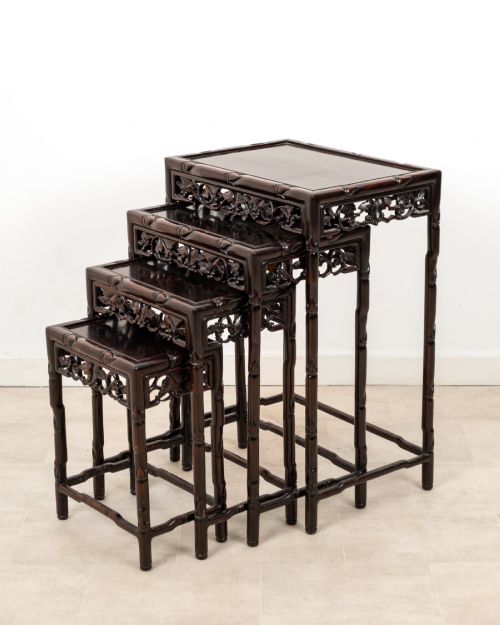
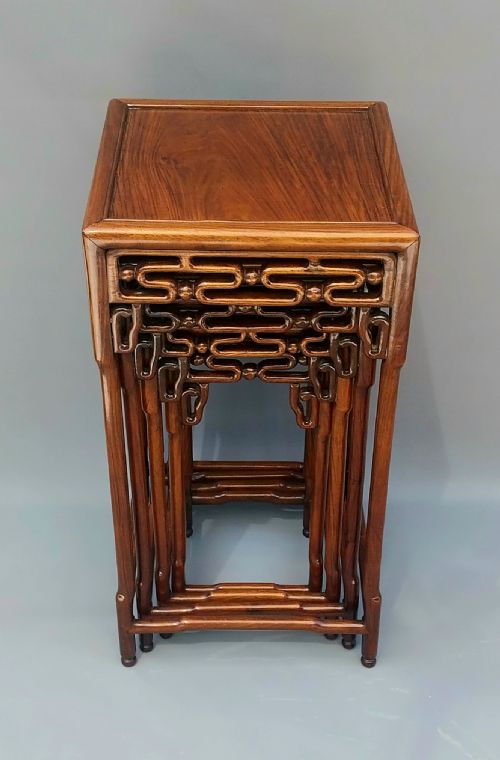
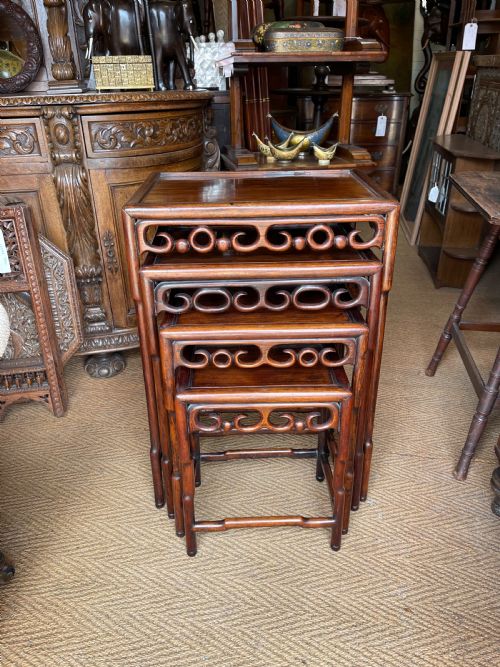
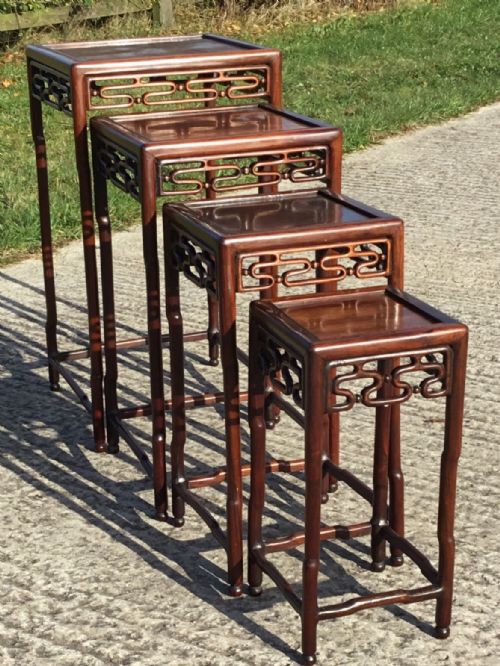
When you search for rosewood chinese nesting tables, you encounter sets designed to fit smoothly into one another, typically comprising four graduating tables or occasionally three. These pieces appear across various periods such as the nineteenth century, the Edwardian era, and through the early decades of the twentieth century. Forms span from coffee tables and side tables to occasional tables, reflecting traditional Chinese and Qing dynasty influences.
The most common versions on this page are sets of four carved hardwood and hongmu tables from the late nineteenth and early twentieth centuries. These tables frequently incorporate Chinese export and Qing styles, displaying craftsmanship intended for both domestic utility and overseas markets. Buyers find both simple polished surfaces and heavily carved designs.
How they were made
The makers of these tables utilised dense timbers such as rosewood, hongmu, and burrwood to ensure the frames could withstand the friction of sliding together repeatedly. These heavy hardwoods provide natural durability and a rich grain structure that responds well to traditional polishing techniques.
Joinery techniques focused on tight tolerances so that each graduated table fit its designated slot without binding. Carving was executed directly into the hardwood frame or panels, often featuring traditional motifs associated with Qing dynasty and Chinese export work.
Listings feature hardwood, rosewood, hongmu, and burrwood across the nineteenth and early twentieth centuries.
What varies in quality
Quality in these sets rests upon the selection of timber and the precision of the graduating dimensions. Finer examples employ dense hongmu or rosewood with consistent grain patterns across all four pieces, whereas simpler sets rely on mixed hardwoods.
The depth and crispness of the carving distinguish higher grades of work, as do the structural tightness of the joints and the smoothness with which the tables slide together. Tables that retain their original finish and structural integrity without excessive timber shrinkage represent the upper tier of the range.
The Rosewood Chinese Nesting Tables Glossary
- Hongmu
- A traditional Chinese term describing dense, durable hardwoods, often translated as red wood. It encompasses several heavy species used in fine furniture making.
- Quartetto
- A matched set of four small occasional tables designed to nest together. The term appears frequently in nineteenth-century British records for nested table sets.
- Graduated
- Describing a set of tables where each piece decreases in height and width to fit inside the next larger one. This allows the entire group to occupy the footprint of a single table.
- Qing Dynasty
- The last imperial dynasty of China, spanning from sixteen forty-four to nineteen twelve. Furniture from this period heavily influences the carved styles seen in these tables.
- Burrwood
- Timber taken from a tree growth where the grain has deformed into swirling patterns. It is used as a decorative veneer or panel insert on select furniture.
Rosewood Chinese Nesting Tables: Frequently Asked Questions
How were nesting tables used?
These tables served as versatile furniture in reception rooms and parlours, deployed only when guests required extra space for tea or writing.
Once tea was finished, the smaller tables slid back beneath the largest one to clear the floor space.
How do I tell periods apart?
Nineteenth-century examples often display heavier carving and denser hongmu timber, reflecting traditional craftsmanship.
Pieces from the Edwardian era and the nineteen-twenties sometimes show lighter construction and simpler surface decoration.
Why are there sets of four?
Sets of four represent the standard configuration for traditional Chinese nesting tables, allowing a gradual step down in size.
Some sets contain three pieces, though four remains the most common arrangement found in these listings.
How do I care for rosewood furniture?
Keep the wood away from direct heat sources and sudden temperature shifts to prevent timber movement and cracking.
Regular dusting with a soft cloth preserves the polish without the need for heavy chemical treatments.