



Rosewood Campaign Box
A rosewood campaign box is a portable writing or storage chest built for travel, offering rich timber grain and robust brass mounts.
Rosewood Campaign Box
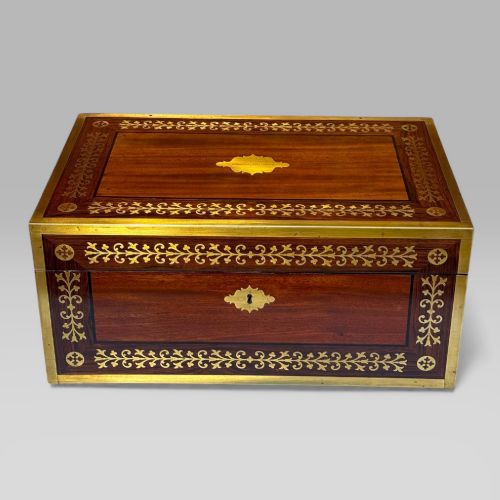
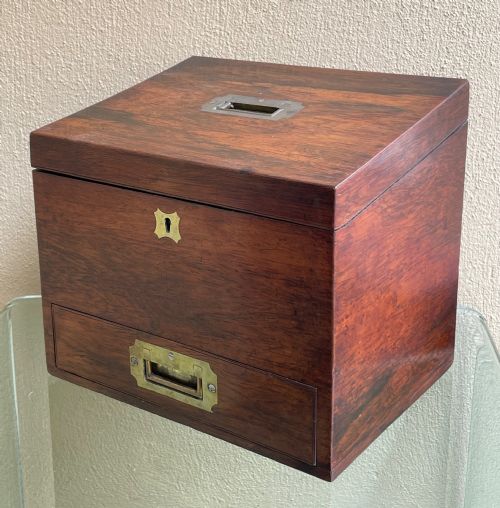
A rosewood campaign box is a portable chest designed for travel, most commonly found as writing slopes, correspondence boxes, and dressing cases. These pieces emerge primarily from the Georgian, Regency, and Victorian periods, spanning the nineteenth century.
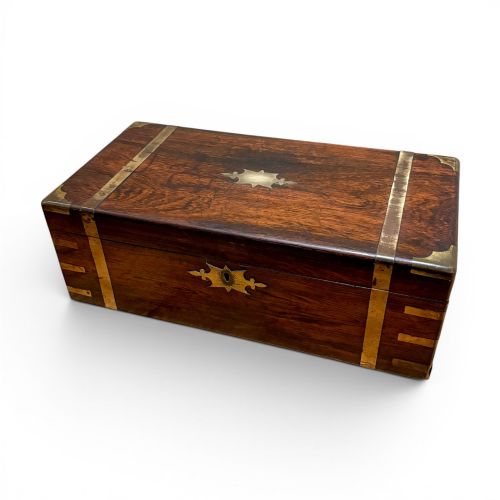
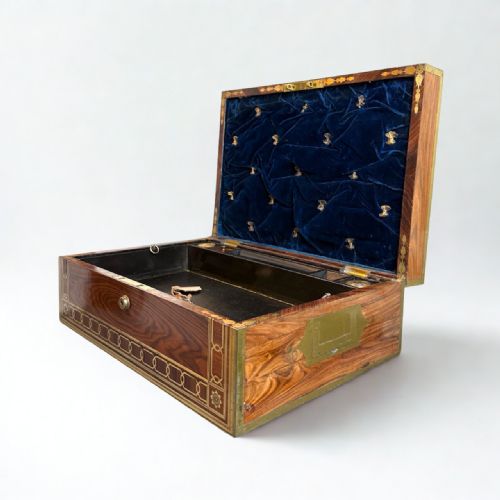
The version you meet most often on this page is the brass-bound writing slope, hinged to fold open into a sloping writing surface lined with velvet. Alongside these, the selection includes jewellery boxes, stationery boxes, and occasional colonial or Chinese travelling chests in rosewood, hongmu, and huanghuali.
How they were made
Cabinet makers utilised dense rosewood timbers, often complemented by mahogany, boxwood inlay, and bone inlay, constructed to withstand the rigours of military movement. Brass banding and flush corner mounts were screwed into the exterior edges to protect the timber from impact during transit.
Interiors were fitted with glass bottles, secret drawers, and velvet-lined compartments designed to hold writing instruments securely in place. Brass handles fitted flush into the sides allowed multiple boxes to be stowed tightly inside baggage.
Object types include writing slopes, dressing boxes, and merchants trunks alongside Chinese hongmu and huanghuali travelling chests.
What varies in quality
The distinction between standard examples and the finest pieces lies in the precision of the brass inlay, the intricacy of the internal secret drawers, and the preservation of the original velvet lining and working keys. Substantial proportions and heavier gauge brass mounts denote superior workshop output.
Construction methods also separate ordinary items from exceptional ones, particularly where dovetailed joints remain tight and the rosewood grain exhibits deep, unblemished figuring across the exterior surfaces.
The Rosewood Campaign Box Glossary
- Campaign slope
- A portable desk that folds in half to create a writing surface, built with protective brass edges for travel. These boxes often contain hidden compartments for correspondence.
- Brass bound
- A method of reinforcing box corners and edges with recessed brass strips to prevent splitting during transit. This technique defines much of nineteenth century military furniture.
- Secret drawers
- Concealed compartments hidden behind false panels within a writing box, accessed by removing specific interior dividers. Makers utilised these to store valuables securely.
- Huanghuali
- A fragrant tropical hardwood native to China, prized for its distinctive grain and utilised in high status travelling boxes. Cabinet makers shaped this timber into refined scholarly containers.
- Dressing case
- A fitted box containing glass bottles and compartments for personal grooming items during journeys. These pieces frequently feature velvet interiors and folding mirrors.
Rosewood Campaign Box: Frequently Asked Questions
What is a rosewood campaign box?
A rosewood campaign box is a portable timber chest fitted with brass mounts, designed for military officers and travellers during the Georgian, Regency, and Victorian eras.
These pieces typically open to reveal fitted compartments for writing, correspondence, or personal grooming, combining dense tropical hardwood with robust metal protection.
How were campaign boxes used?
Owners utilised these portable chests as mobile desks and storage units while on military campaigns or long sea voyages.
The folding design provided a stable writing surface and secure storage for ink, paper, and valuables in temporary quarters.
How do I date a campaign box?
Dating relies on observing construction styles, brass mount designs, and secondary timbers like mahogany or boxwood inlay.
Georgian and Regency examples tend to feature sharper brass corners and simpler fitted interiors, while Victorian versions often incorporate elaborate stationery racks and glass bottles.
What woods are used besides rosewood?
Cabinet makers occasionally supplemented rosewood with mahogany for internal framing, alongside boxwood and bone inlay for decorative stringing.
Chinese export examples encountered in these listings utilise specific regional hardwoods such as hongmu and huanghuali.
How do I care for a campaign box?
Keep the rosewood timber away from direct heat sources and sudden humidity changes to prevent the wood from splitting and the brass from loosening.
Light application of appropriate wax maintains the polish on the exterior grain without harming the original finish.