
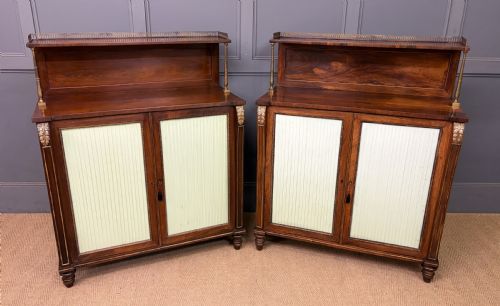
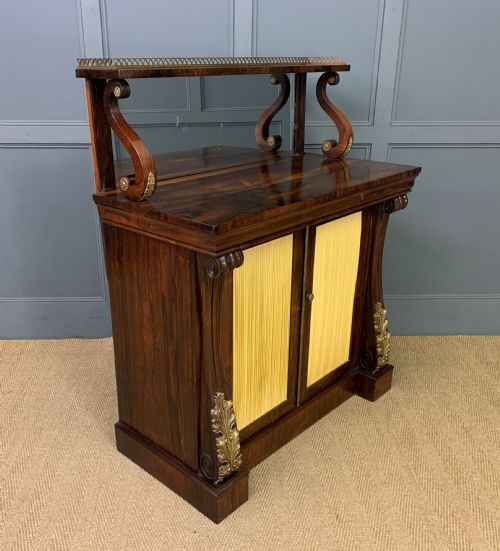


Rosewood Brass Chiffonier
A rosewood brass chiffonier brings a disciplined elegance to a room, combining rich timber with bright metal inlay.
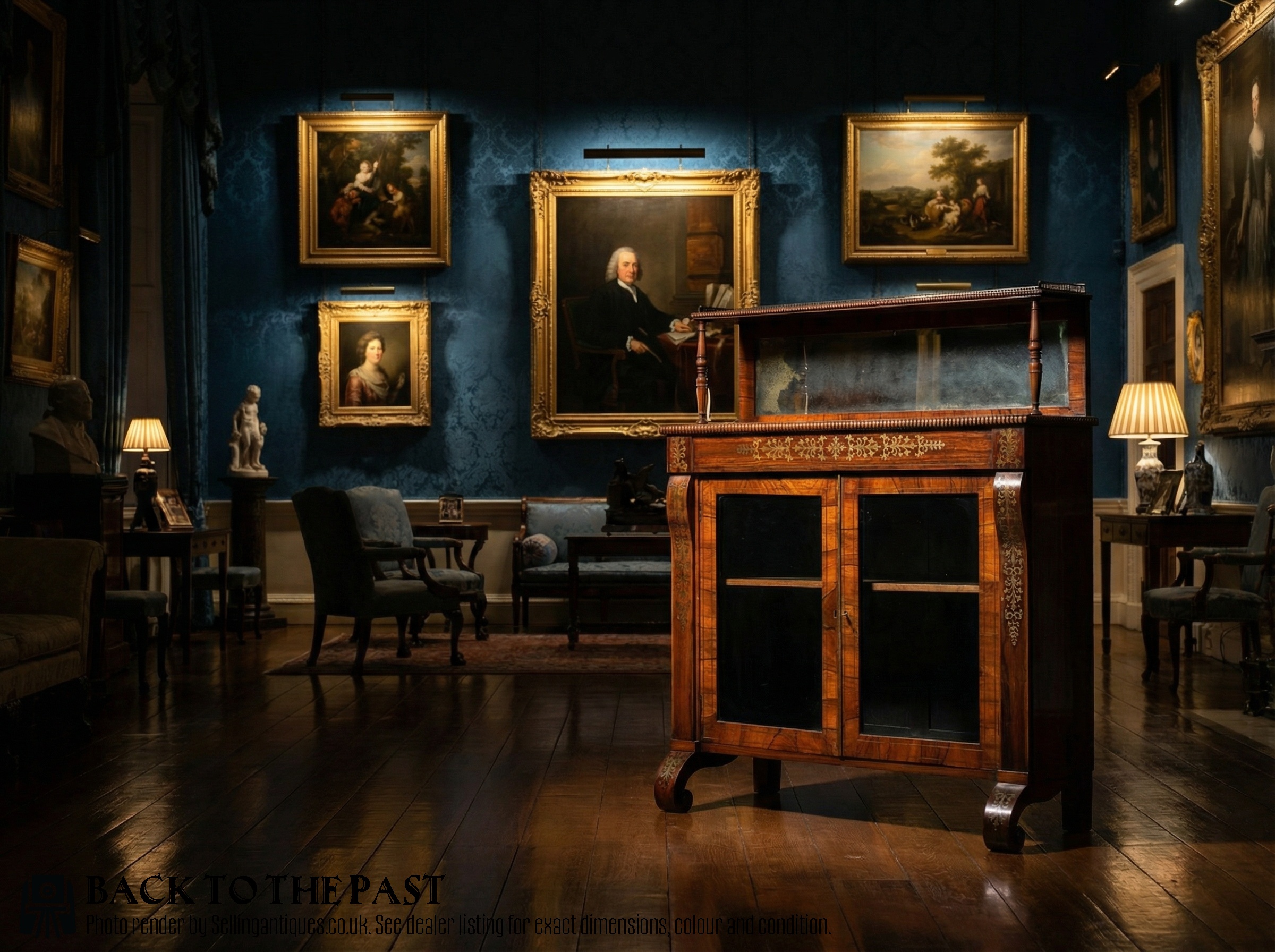
Rosewood Brass Chiffonier
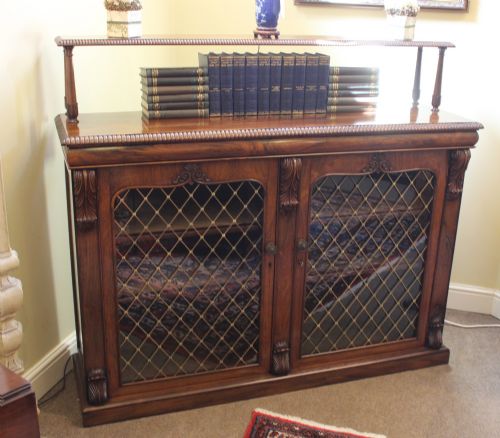
When you search for a rosewood brass chiffonier, you are looking at a compact low cabinet designed for the nineteenth-century drawing room or parlour. These pieces combine enclosed storage below with shelving or superstructure above, often serving as a refined surface for display.
The version you are most likely to meet on this page dates from the Regency or early Victorian period, reflecting the height of cabinet-making skill during the early decades of the eighteen-hundreds. They frequently appear alongside related side cabinets and bookcases from the same era.
Makers of the period utilised dense tropical timbers paired with contrasting details, creating a silhouette that is both grounded and decorative. They sit comfortably against a wall, offering functional storage without dominating the floor space.
Materials and Construction
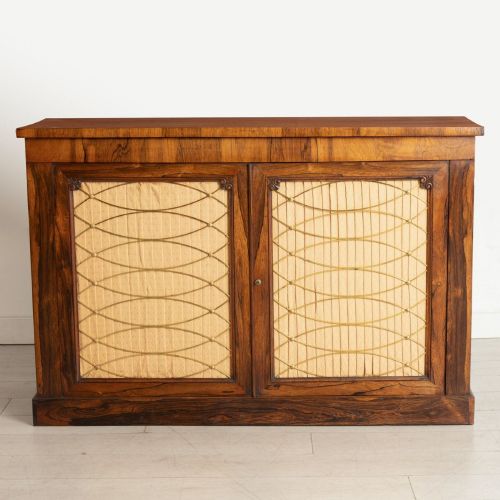
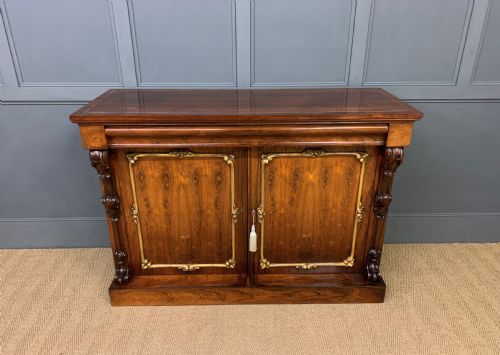
Cabinet-makers relied on dense, dark rosewood veneers applied to secondary woods, providing a stable foundation with a heavily figured surface grain. Brass featured prominently, drawn into fine lines of stringing or cast into mounts, grilles, and galleries.
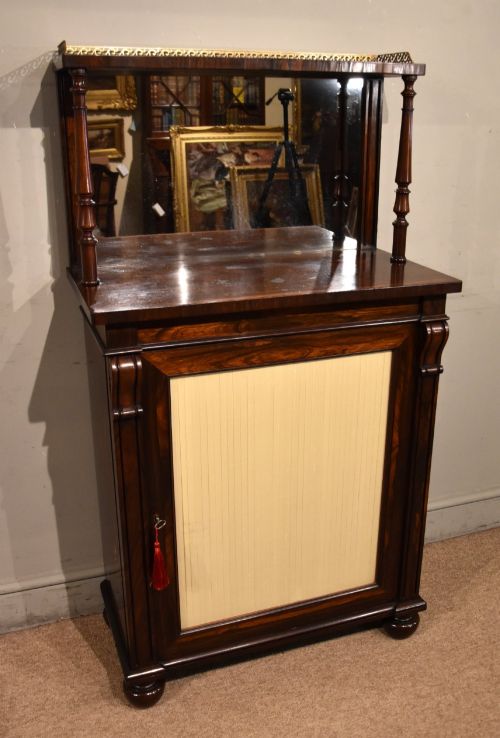
Interiors often incorporated secondary woods such as mahogany, while specialised versions utilised mirror glass, silk, or pleated fabric panels behind glazed or open doors. Marble tops occasionally provided a durable, cool surface on breakfront examples.
Makers occasionally added pleated silk behind brass grilles, allowing gentlemen to hide their correspondence from curious guests.
Judging Quality
Quality rests heavily on the precision of the brass inlay and the selection of the rosewood veneer. Finer examples show seamless integration of metal into timber without gaps, alongside symmetrical grain matching across the doors and drawers.
Proportion and scale dictate the tier of the piece, with narrower proportions and restrained brass mounts generally indicating a more thoughtful design. The crispness of carved details and the weight of cast brass fittings separate standard production from master workshops.
Holland and Sons·Gillows·John McClean
The Rosewood Brass Chiffonier Glossary
- Chiffonier
- A low cabinet featuring a combination of shelves, drawers, and cupboards. It developed in the early nineteenth century as a versatile piece for the dining room or parlour.
- Regency
- A style period spanning roughly from the late Georgian era through the reign of George IV. It draws heavily on classical Greek, Roman, and Egyptian motifs.
- Inlay
- A technique where contrasting materials such as brass or lighter woods are set into recessed channels in the surface timber. This creates decorative geometric or floral patterns.
- Breakfront
- A cabinet design where the central section projects forward from the flanking wings. This adds architectural depth to sideboards and large bookcases.
- Gallery
- A decorative railing, usually made of brass, positioned along the top shelf of a cabinet. It prevents displayed items from sliding off.
Rosewood Brass Chiffonier: Frequently Asked Questions
What is a chiffonier used for?
A chiffonier served as a versatile storage and display piece in nineteenth-century homes, often holding linens, glassware, or books.
The upper shelves displayed decorative ceramics and ornaments, while the enclosed cupboards below kept items out of sight.
How do I tell Regency from Victorian pieces?
Regency pieces generally display sharper neoclassical lines, restrained brass inlay, and lighter proportions reflecting the early nineteenth century.
Victorian cabinets tend to be heavier in scale, sometimes incorporating richer carving, glazed doors, or marble tops.
Are these cabinets suitable for modern living rooms?
Their compact depth makes them exceptionally well-suited for contemporary hallways, living rooms, or dining spaces where floor space is limited.
The enclosed lower cupboards offer practical storage for modern media or tableware while maintaining a traditional aesthetic.
What distinguishes a chiffonier from a sideboard?
A chiffonier typically includes a raised shelf or superstructure on top, whereas a traditional sideboard remains flat across the surface.
Chiffoniers are also generally smaller in scale, intended for drawing rooms rather than grand dining halls.