


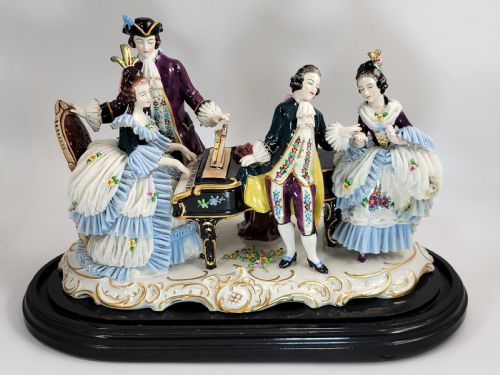


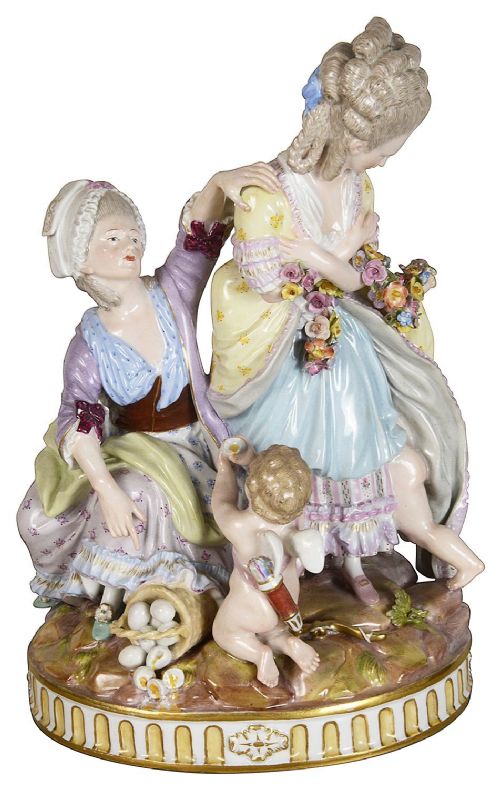


Rococo Style Porcelain Group
A rococo style porcelain group brings exuberant theatricality and pastural romance straight to the cabinet, capturing 18th-century courtly performance in miniature.
Rococo Style Porcelain Group
A rococo style porcelain group presents figures engaged in romantic, musical, or mythological scenes, populated by lovers, musicians, children, and classical deities. These sculptural arrangements draw directly from the theatrical energy and dynamic compositions of the mid-18th century, translated into glazed ceramic form.
The versions most commonly met on this page date to the 19th century, drawing heavily on earlier Meissen models and Chelsea tastes. Makers across Germany, France, and the wider Continent produced elaborate figural groups featuring couples, allegorical sets like the Four Seasons, and pastoral narratives.
Forms range from intimate pairs of lovers to complex multi-figure table ornaments involving pianos, gardens, and mythological subjects such as Venus and Cupid or the Drunken Silenus. These pieces transform fluid movement and asymmetrical scrollwork into solid, three-dimensional tableaux.
Materials and production
Hard-paste porcelain forms the structural core of these sculptural groups, fired at high temperatures to achieve a dense, durable body capable of supporting complex, cantilevered gestures. Artisans shaped the clay through detailed moulding before applying delicate additions, such as real lace dipped in slip to fire into fabric-like texture.
Enamel colours and gold leaf provide the rich palette and gilding characteristic of the style, highlighting garments, architectural elements, and natural bases. Secondary materials like wood occasionally appear in associated display elements, while gilding accentuates the scrollwork and rocaille motifs.
Listings span from the mid-18th century to the 1930s, showing consistent reliance on hard-paste porcelain and enamel decoration.
Assessing quality and execution
The crispness of the modelling dictates the visual success of the piece, separating finely carved facial expressions and fluid drapery from softer, blurred secondary casts. Superior examples retain sharp definition in tiny details like fingers, floral garlands, and musical instruments.
The application of enamel and the precision of the gilding determine the refinement of the surface, with master painters achieving subtle gradients on skin and fabric. Colour control during the kiln firing ensures clean separation of tones without bleeding across the porcelain body.
Meissen·Samson Paris·Ernst Bohne Söhne·Eugene Clauss
The Rococo Style Porcelain Group Glossary
- Hard-paste porcelain
- A dense, vitrified ceramic compound composed of kaolin and petuntse, fired at very high temperatures. It provides a durable, bright white canvas for enamels and resists scratching.
- Gilding
- The application of gold leaf or powdered gold onto the ceramic surface to highlight borders and decorative motifs. It adds a reflective warmth that complements the pastel enamel palette.
- Rococo Revival
- A 19th-century design movement that reinterpreted the curving, asymmetrical lines and playful naturalism of the original 18th-century French court style. This aesthetic dominates the Victorian figural groups seen here.
- Figural group
- A sculptural ceramic composition featuring more than one human or mythological figure interacting within a shared scene. These pieces often tell a narrative story or represent an allegory.
Rococo Style Porcelain Group: Frequently Asked Questions
What are porcelain groups?
Porcelain groups are multi-figure sculptural compositions modelled in clay, glazed, and painted with enamels to depict narrative or allegorical scenes. They were designed primarily as decorative table centrepieces or cabinet ornaments for wealthy interiors.
These pieces capture human interaction, mythology, and pastoral life in three dimensions. Their intricate details reflect the high technical skill of European ceramic factories.
How were these figures used?
Historically, these figural groups stood on dining tables during formal meals as conversation pieces, or sat within display cabinets in drawing rooms. They demonstrated the owner's cultural refinement and appreciation for theatrical art.
Over time, their function shifted entirely from dining room ornament to collector's cabinet display. Today, they serve as focal points in period-inspired interiors.
How do I spot 19th-century copies?
Nineteenth-century factories frequently reproduced 18th-century models, particularly those originating from Meissen. Examining the paste, the quality of the hand-painting, and the secondary mark helps distinguish a revival piece from an original 1750 model.
Stylistic cues also assist, as Victorian interpretations often feature denser enamel palettes and heavier gilding. Comparing the modelling sharpness against documented factory archives clarifies the exact period of production.
Where should I display them?
These delicate sculptures require secure placement within an enclosed glass cabinet to protect them from dust and accidental impacts. Stable shelving away from direct sunlight preserves the vibrancy of the hand-painted enamels.
Because many groups feature fragile elements like lace, extended fingers, or musical instruments, low-traffic areas work best. Proper lighting from above highlights the subtle textures of the hard-paste porcelain and gilding.