
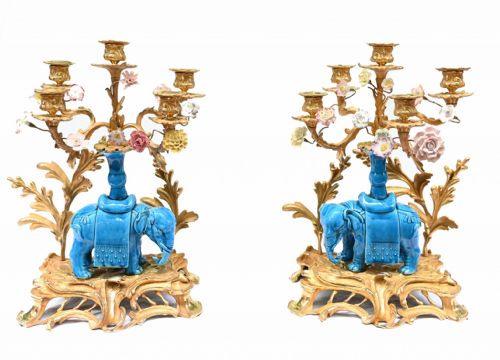


Rococo Style Candle Holders
Rococo style candle holders bring curving asymmetrical forms and elaborate ornamentation into a room, spanning 19th Century revivals and European porcelain manufactures.
Rococo Style Candle Holders
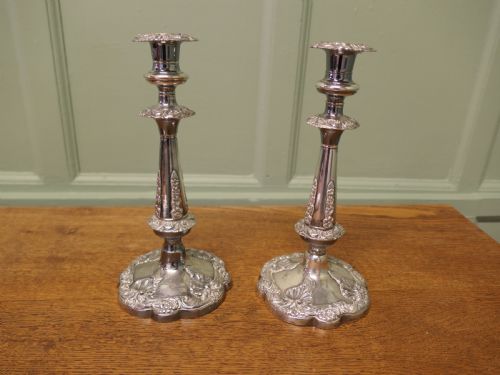
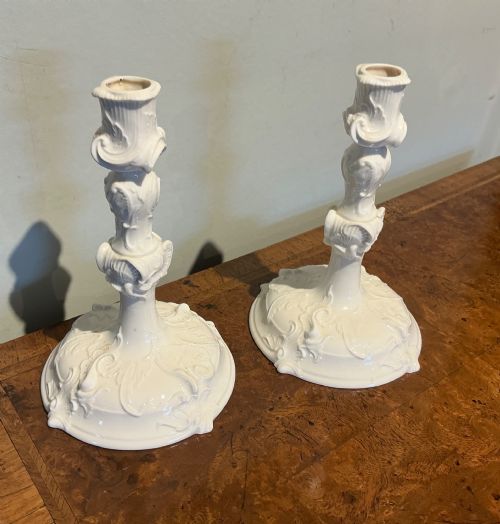
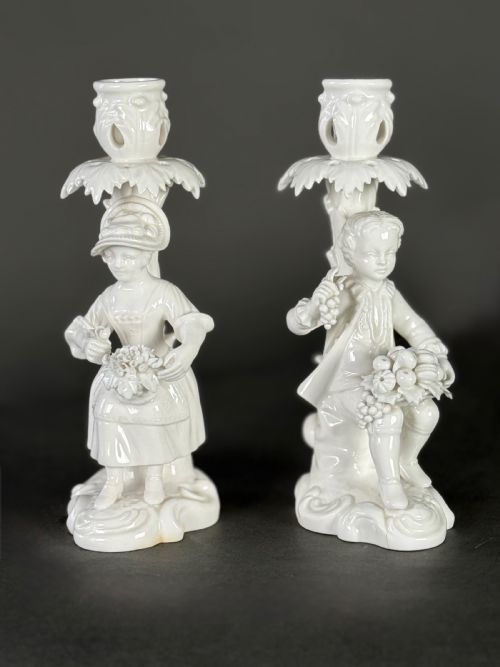
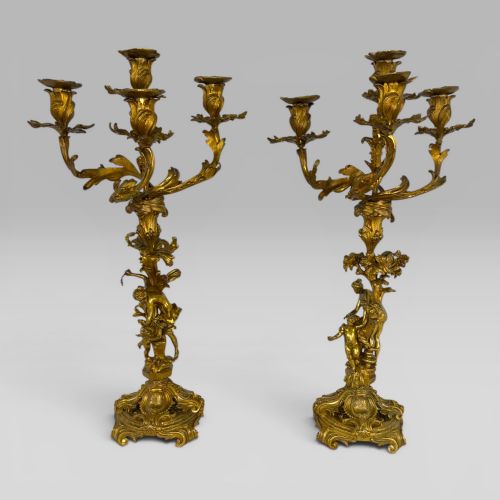
When searching for rococo style candle holders, collectors encounter candlesticks, multi-branched candelabra, wall sconces, chambersticks and girandole mirrors dating predominantly from the nineteenth century. The selection leans heavily towards Victorian and French rococo revival designs, alongside German hard paste porcelain figures from factories such as Sitzendorf and Volkstedt. Pairs dominate the offerings, often incorporating figural elements like puttis, shepherds or allegorical representations of the seasons.
The forms draw directly upon eighteenth-century French taste, reinterpreted through nineteenth-century manufacturing methods. Pieces range from simple silver plated brass candlesticks to elaborate ormolu candelabra mounted with porcelain birds or figures upon marble bases. English manufacturers like Derby and Minton also appear, alongside continental workshops producing ornate branch arrangements.
How They Were Made
The manufacture of these pieces combined metal casting, fire gilding and ceramic production. Ormolu and bronze components were cast, chased and treated with gold leaf or mercury gilding to achieve a bright metallic lustre, while silver plated items utilised base metal foundations. Marble bases provided stable weighting for heavier figural candelabra.
Porcelain elements involved hard paste ceramic bodies modelled with delicate floral encrustations, hand-painted enamels and glazed finishes. Figures were shaped in moulds, assembled with applied details like leaves or baskets, and fired at high temperatures before secondary enamelling.
Several porcelain pairs depict energetic birds, pug dogs, and seated musicians serenading rooms with silent metallic tunes.
What Varies in Quality
The integration of mixed materials also defines the grade of the piece, particularly where porcelain figures meet metal branches or marble plinths. Tighter mechanical joints and heavier gauge metals separate workshop standards from standard commercial production.
Nymphenburg·Derby·Volkstedt·Smith & Sissons & Co·Minton·Sitzendorf·Helena Wolfsohn·Meissen
The Rococo Style Candle Holders Glossary
- Ormolu
- A gilded bronze technique utilising finely ground gold mercury amalgam applied to cast bronze. This finish gives a rich, warm yellow hue characteristic of French decorative objects.
- Candelabra
- A multi-branched lighting device designed to hold several candles simultaneously. These often feature removable nozzle inserts and central shafts.
- Chamberstick
- A low candlestick equipped with a flat drip pan and a loop handle for carrying from room to room. They frequently include a small conical snuffer.
- Hard paste porcelain
- A dense ceramic compound composed of kaolin and petuntse fired at high temperatures. It produces a hard, vitrified body capable of holding sharp sculptural details.
- Sconces
- Wall-mounted lighting fixtures designed to project candle illumination into a space. They often incorporate mirrored backplates to reflect the light.
- Girandole
- An ornamental wall mirror featuring attached candle sconces arranged around the frame. The reflective glass multiplies the illumination of the flames.
Rococo Style Candle Holders: Frequently Asked Questions
How do I clean gilt bronze and ormolu?
Dust surfaces gently with a soft dry brush to remove particulate matter without scratching the metallic layer.
Avoid chemical polishes or abrasive cloths, which strip away the thin gold leaf or mercury gilding entirely.
Were these pieces used for everyday lighting?
During the nineteenth century, grander multi-branched examples served primarily as decorative table centrepieces and formal drawing-room illumination.
Smaller chambersticks and single candlesticks saw practical use for lighting dark hallways and bedchambers.
How do I identify nineteenth century porcelain figures?
Examine the underside for underglaze factory blue or impressed marks corresponding to known continental and English manufacturers.
Look for hand-painted enamel detailing and fine tool marks on applied floral elements indicating period handwork.