
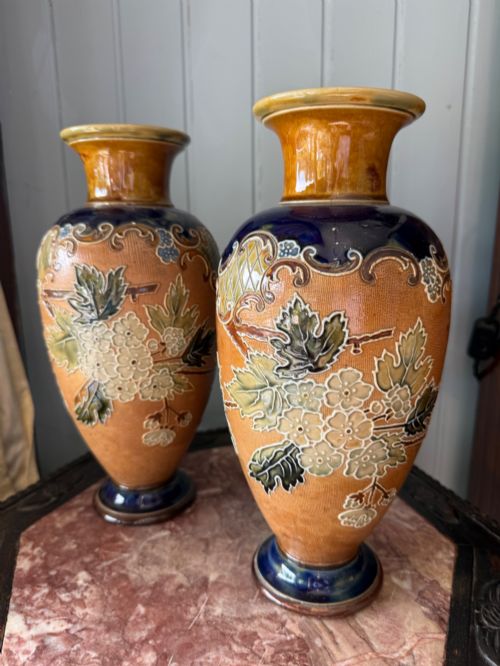


Relief Decorated Stoneware
These relief decorated stoneware vessels bring tactile moulded ornament and robust ceramic bodies to your interior, offering lasting character for any room.
Relief Decorated Stoneware
Relief decorated stoneware encompasses durable ceramic vessels finished with raised surface ornament, ranging from utilitarian filtering vessels to decorative vases and jugs. You encounter Victorian examples most frequently here, particularly pieces from English potteries alongside continental items.
The selection includes drinking vessels, jardinieres, candlesticks, and wine coolers spanning the nineteenth and early twentieth centuries. Makers applied sprigged motifs, incised patterns, and glazed finishes to create distinct textural depth across the body of each piece.
Victorian workshop output dominates the available forms, featuring harvest jugs and Art Nouveau designs alongside German steins and Japanese creations. These vessels served both practical domestic functions and purely decorative display roles in period interiors.
Materials and production methods
Potters utilised dense clay bodies fired at high temperatures to achieve a vitrified, impermeable stoneware structure. This durable material accepted salt glazes, enamel colours, and cream sprigged applications without losing definition in the moulded ornament.
Relief decoration relied on applied sprigs moulded separately and pressed onto the unfired vessel body, or direct moulding of the clay form. Artisans then applied glazes, ranging from smooth ceramic finishes to traditional salt glaze textures, before the final kiln firing.
Listings feature nineteenth-century English and German stoneware, spanning Victorian harvest jugs, Art Nouveau vases, and salt-glazed jardinieres.
Assessing quality and execution
Quality rests upon the crispness of the moulded relief work and the balance of the overall form. Superior pieces exhibit sharp detail in the sprigged or incised ornament without blurring from excessive glaze pooling.
The reputation of the studio and the skill of individual decorators significantly influence the standing of a piece. Hand-finished details, well-executed silver mounts, and harmonious colour palettes separate standard utility items from distinguished exhibition pieces.
Royal Doulton Lambeth·Makuzu Kozan II·Copeland Spode·Mason·Adams
The Relief Decorated Stoneware Glossary
- Stoneware
- A dense, hard ceramic fired at high temperatures until vitrified and waterproof. It resists chipping and allows for crisp surface decoration.
- Salt Glaze
- A glossy, slightly textured finish achieved by throwing common salt into the kiln during high-temperature firing. The sodium reacts with the silica in the clay body.
- Sprigged
- A decorative technique where separately moulded clay motifs are applied to the surface of a vessel before firing. It creates distinct raised patterns.
- Bisk
- Fired unglazed ceramic pottery that possesses a porous, matte texture. It provides a smooth surface for detailed sculptural ornament.
Relief Decorated Stoneware: Frequently Asked Questions
Can I use these antique jugs for serving drinks?
Many historical jugs function perfectly for serving liquids, provided the interior glaze remains intact and free from cracks. Examine the inside of the vessel carefully before putting it to culinary use.
For pieces with delicate exterior ornamentation or metal rims, hand washing is essential. Avoid exposing antique ceramics to sudden temperature extremes to prevent thermal shock.
How do I identify a salt-glazed finish?
Salt glaze displays a distinctive orange-peel texture across the surface caused by the vaporisation of salt inside the kiln. This finish creates a durable, slightly pebbled sheen that protects the underlying clay body.
Run your fingers across the surface to feel the characteristic dimpled texture. This distinguishes traditional salt glaze from smooth modern chemical glazes.
Where should I display heavy jardinieres?
Place heavy stoneware jardinieres on sturdy, level surfaces that easily support their considerable weight. Window sills, plant stands, and heavy side tables provide stable foundations for daily display.
Ensure you use a waterproof liner inside the jardiniere to protect underlying furniture from moisture seepage. Keep them away from high-traffic household areas where they might get knocked.