
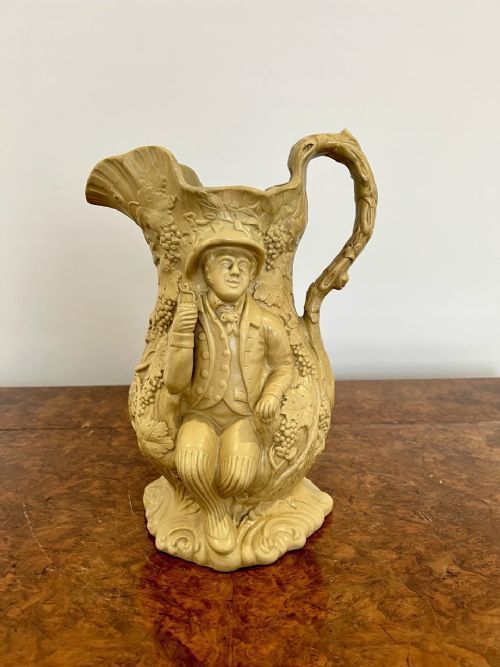


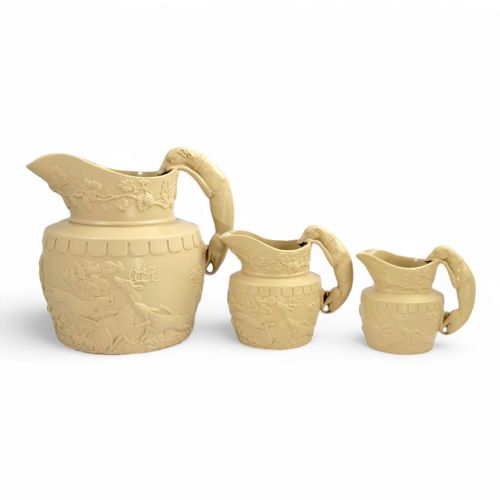


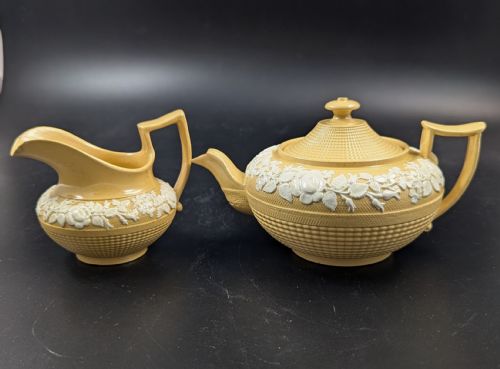

Buff Stoneware Jug
These buff stoneware jugs bring tactile nineteenth-century utility to a room, offering robust ceramic forms that collectors prize for their salt-glazed surfaces and relief-moulded decoration.
Buff Stoneware Jug
The version most commonly met on this page is the Victorian salt-glazed or relief-moulded jug, often associated with London potteries like Doulton Lambeth. Collectors also encounter earlier Regency and Georgian examples featuring classical or sporting motifs.
How they were made
Potters utilised durable stoneware and earthenware clays, applying salt glazing during the firing process to create a characteristic pitted, orange-peel texture. This dense ceramic body made the vessels entirely impervious to liquids without needing internal lead linings.
Decoration relied heavily on relief moulding, where sprigged ornaments or detailed moulds were applied to the clay body before firing. Many pieces also incorporated specialised glazing techniques, such as contrasting buff-coloured bodies with white sprigged reliefs.
Listings feature stoneware, earthenware, and salt glaze materials across Victorian and Georgian periods.
What varies in quality
Quality in these jugs rests upon the crispness of the relief moulding and the uniformity of the salt glaze. Sharply defined Bacchanalian figures, sporting scenes, or classical revivals indicate superior artistic input from prominent potteries and named modellers.
The overall balance of the form and the subtlety of the colouration differentiate standard utilitarian vessels from exhibition pieces. Finer examples display precise handling of handles, such as hound motifs, and clean application of applied sprigged decoration.
Charles Meigh·Emma Shute·Doulton Lambeth·Phillips and Bagster·Wedgwood
The Buff Stoneware Jug Glossary
- Buff stoneware
- A dense, vitrified ceramic body fired at high temperatures, showing a warm pale brownish-yellow or sandy hue. This material forms the durable foundation for nineteenth-century pitchers and ale jugs.
- Salt glaze
- A glossy, slightly textured finish created by throwing common salt into the kiln during high-temperature firing. The sodium reacts with the silica in the clay to form a durable sodium silicate coating.
- Relief moulded
- A technique where decorative motifs are pressed into raised patterns on the surface of the vessel using specialised moulds. This method allowed makers to achieve intricate classical and sporting scenes.
- Sprigged
- A method of ornamentation where separately moulded clay details are applied to the unfired body using slip as an adhesive. These raised elements create a sharp contrast against the main body.
- Puzzle jug
- An interactive drinking vessel featuring perforated necks and misleading spouts designed to challenge the drinker. These clever ceramic items were popular novelty pieces in nineteenth-century taverns.
Buff Stoneware Jug: Frequently Asked Questions
How do I date a buff stoneware jug?
Dating relies on stylistic clues such as Victorian Gothic revival details, Art Nouveau fluidity, or Georgian classical shapes. Examining the manufacturing marks and glaze characteristics also helps narrow the production era to the nineteenth century.
The presence of specific pottery names or registered design stamps provides a more precise window of origin. Comparing the relief moulding style to known historical periods ensures accurate attribution.
Were these jugs used for everyday dining?
Many of these vessels served practical roles as ale jugs, water pitchers, or creamers in nineteenth-century households. Their dense stoneware construction made them durable enough for daily tavern and dining table use.
Larger exhibition pieces and highly ornate salt-glazed examples were often decorative display items rather than functional tableware. Their intricate relief work suggests they were intended to be admired on sideboards.
What is salt glaze on stoneware?
Salt glaze is a historic pottery finish achieved by introducing salt into the kiln at peak firing temperatures. The chemical reaction produces a durable, vitreous coating with a distinctive pebbled texture.
This impervious layer protected the porous ceramic body beneath and made the vessels safe for holding liquids without additional internal glazing.
How do I care for antique stoneware?
Antique stoneware requires gentle cleaning with warm water and a soft cloth to preserve the historic glaze and delicate relief moulding. Harsh chemical cleaners should be avoided to protect the ceramic surface.
Displaying these jugs away from direct sunlight and sudden temperature changes ensures the material remains stable and undamaged over time.