


Classical Relief Stoneware
Classical relief stoneware brings neoclassical motifs into dense, vitrified ceramic bodies that endure daily handling.
Classical Relief Stoneware
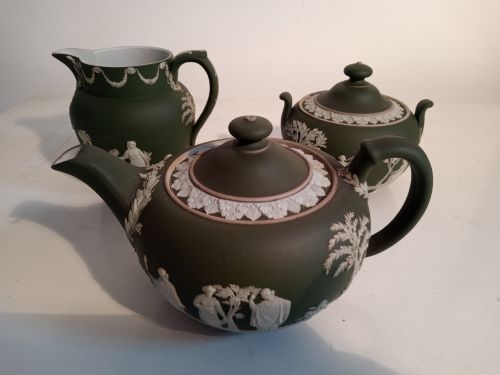
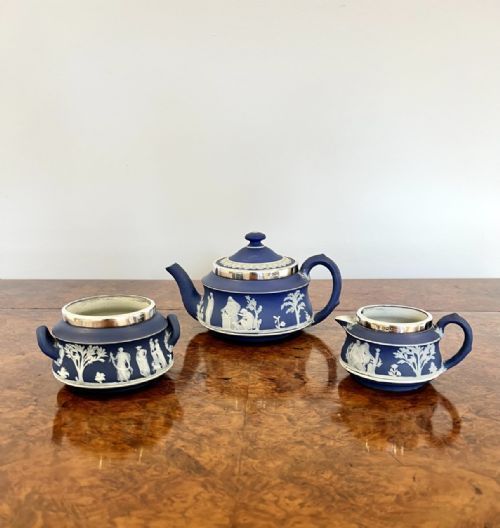
Classical relief stoneware encompasses Victorian and nineteenth-century tea sets, pitchers, urns, and boxes decorated with moulded white bas-relief figures. These decorative vessels draw directly on neoclassical design traditions, pairing matte ceramic grounds with crisp, contrasting classical imagery.
The pieces on this page are most frequently blue or olive green jasperware alongside buff-coloured and white stoneware jugs, urns, and teapots. Makers such as Wedgwood and Charles Meigh dominate the selection, spanning periods from the early nineteenth century through to the 1920s.
How classical relief stoneware was made
Potters utilised vitrified ceramic bodies such as stoneware and jasperware, which fired at high temperatures to achieve a dense, impermeable finish. Relief ornamentation was cast separately in moulds and applied by hand to the contrasting body of the vessel.
Mounts in silver or pewter occasionally completed tea sets, jugs, and biscuit barrels, adding metal collars or lids to the ceramic forms. Glazed ceramic and earthenware also appear among the pieces, varying the surface texture against the typical matte biscuit finish.
Miniature teapots from the Victorian era prove that nineteenth-century tea drinkers took their miniature hospitality remarkably seriously.
What varies in quality
The sharpness of the moulded bas-relief figures determines the visual definition of each piece, as crisp application separates finely detailed ornamentation from softer impressions. The precision with which applied reliefs adhere to the curved ceramic body demonstrates the skill of the workshop.
Material variation, such as the inclusion of silver mounts or multi-coloured jasper bodies, elevates the complexity of certain pieces. Consistency in the saturation of the blue, green, or buff ground further distinguishes standard production wares from superior examples.
Wedgwood·Charles Meigh·Staffordshire
The Classical Relief Stoneware Glossary
- Jasperware
- A type of fine-grained, unglazed stoneware developed with distinct coloured ceramic bodies. It provides a contrasting matte background for white applied bas-reliefs.
- Bas-relief
- A sculptural technique where figures project slightly from a flat background. In these pieces, white ceramic motifs stand proud of the coloured stoneware body.
- Campana urn
- A bell-shaped vessel with a flared rim and footed base, often utilised in neoclassical design. Pairs of these urns frequently feature classical figural reliefs.
- Stoneware
- A robust, vitrified pottery fired at high temperatures until non-porous. It offers exceptional durability for functional items like teapots, jugs, and pitchers.
- Buff-coloured
- A pale brownish-yellow hue characteristic of certain nineteenth-century stoneware bodies. This warm tone serves as an alternative ground to traditional blue or green jasper.
Classical Relief Stoneware: Frequently Asked Questions
What is classical relief stoneware?
Classical relief stoneware comprises nineteenth-century ceramics decorated with moulded neoclassical figures against contrasting matte grounds.
These objects include teapots, pitchers, urns, and boxes produced primarily by prominent English potteries.
How do you date jasperware?
Dating relies on impressed maker marks, colour variations, and stylistic shifts across the nineteenth century.
Specific hue tones and metal mounts like silver collars also provide chronological clues for individual pieces.
Were these jugs used daily?
Many pitchers and teapots served practical dining functions alongside their decorative neoclassical appearance.
Vitrified ceramic bodies made them durable enough for regular service on Victorian tables.
How should I clean jasperware?
Uncertain surfaces benefit from gentle dusting with a soft brush rather than harsh chemical immersion.
Silver mounts require appropriate metal care while keeping polishes away from the porous ceramic body.