




Relief Moulded Pitcher
A relief moulded pitcher brings tactile depth and sculptural form to the table, offering rich historical character through raised decorative scenes.
Defining the Relief Moulded Pitcher
The relief moulded pitcher appears primarily in nineteenth century ceramics, showcasing Victorian and Victorian classical revival styles that turn everyday pouring vessels into sculptural canvases. These pieces span earthenware and stoneware bodies, often featuring applied handles and decorative surfaces shaped directly in the mould.
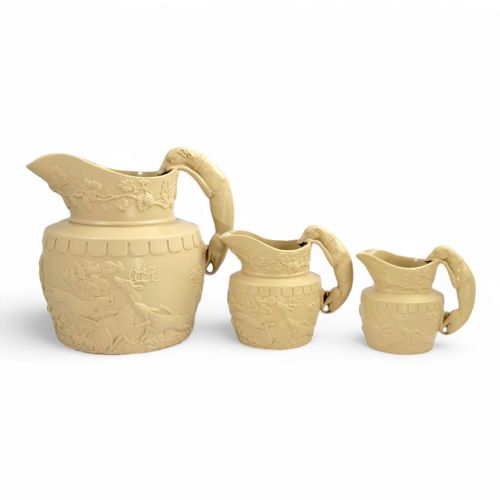
Buyers encounter a variety of forms ranging from large Staffordshire copper lustre milk jugs to graduated sets of three Victorian jugs. Some examples incorporate pewter lids, while others display specialised surface treatments such as flow blue or copper lustre glaze.
Origins trace back to regional potteries and named makers like Charles Meigh and Jones & Walley, reflecting the industrial skill of nineteenth century British ceramic production. Yorkshire pottery also contributes regional variations moulded with distinct pictorial motifs.
Materials and Manufacture
Potters utilised durable earthenware and dense stoneware to form the body of each vessel, preparing clay bodies suited to press-moulding techniques. These materials provided the structural strength required for raising intricate three-dimensional ornament from the surface.
Moulds captured fine details such as classical figures, carriage scenes, and bacchanalian revels before the application of glazes or lustre finishes. Artisans then applied colourful glazes, flow blue effects, or gold leaf highlights to enhance the raised contours of the design.
Many pitchers received functional additions including fitted pewter lids hinged to the upper handle, combining metalwork with ceramic bodies. Firing in traditional kilns set the glaze and bonded any metallic lustres or gold leaf details permanently to the surface.
Retail Price Guide 2026
Typical UK retail prices for relief moulded pitcher, calculated from the Sellingantiques database of over a million retail prices indexed since 2003. This retail price guide relies exclusively on Sellingantiques data; no external sources or auction records are used, so the figures do not describe the wider market.
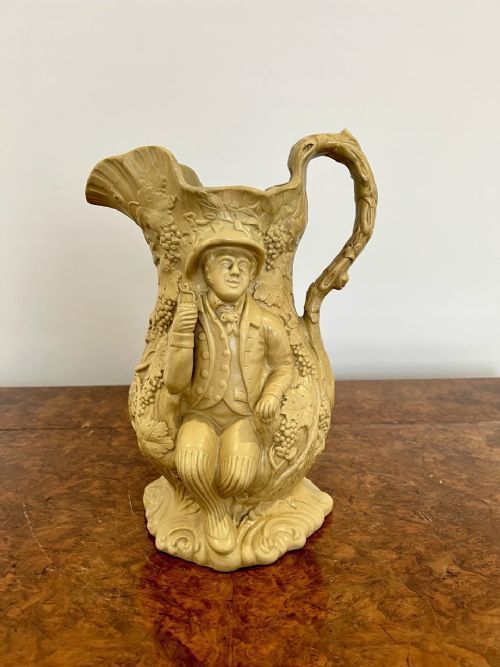
Some nineteenth century drinkers enjoyed their ale beneath the gaze of moulded bacchanalian revellers perched directly on the jug wall.
Assessing Quality and Execution
The crispness of the moulded detail distinguishes finer pieces from simpler commercial output, as sharper relief lines reveal the wear condition of the original production mould. Superior examples maintain deep, legible pictorial scenes without softening or blurring across the ceramic surface.
Glaze application and colour distribution play a major role in the visual success of the piece, particularly where flow blue, copper lustre glaze, or gold leaf are involved. Balanced coverage and harmonious tones elevate the decorative impact of the vessel.
The integration of secondary materials such as pewter lids and the proportions of applied handles indicate the care taken during assembly. Well-balanced handles and securely fitted metal mounts demonstrate higher workshop standards.
Charles Meigh·Jones & Walley
The Relief Moulded Pitcher Glossary
- Relief-moulded
- A ceramic manufacturing technique where decorative patterns are raised above the flat surface using specialised moulds. This process creates distinct tactile depth across the body of the vessel.
- Stoneware
- A dense, impermeable ceramic fired at high temperatures until vitrified. It provides robust durability and a fine surface for detailed moulding.
- Copper Lustre
- A metallic glaze finish that imparts a warm, reflective copper sheen to the ceramic body. It gained widespread popularity during the nineteenth century.
- Flow Blue
- A Staffordshire pottery technique where cobalt blue transfers blur slightly into the surrounding glaze during firing. This creates a soft, hazy aesthetic across the decorated surface.
Frequently Asked Questions
What periods do these pitchers come from?
These vessels originate predominantly from the nineteenth century, aligning with Victorian production methods and stylistic preferences.
Examples span from the early decades through to the late Victorian era, reflecting changing tastes in ceramic decoration.
How were these pitchers used originally?
They served functional roles on the dining table for pouring liquids such as milk, water, or beer.
Many also functioned as decorative display items, showcasing elaborate pictorial scenes and sculptural craftsmanship in domestic interiors.
What materials make up these pitchers?
Potters used earthenware and dense stoneware as the primary ceramic base for shaping the vessel bodies.
Surfaces often feature specialised glazes, copper lustre, gold leaf, and fitted pewter lids.
How do I distinguish different regional styles?
Regional attribution relies on identifying specific decorative motifs, clay bodies, and glazing techniques associated with known manufacturing centres.
Staffordshire and Yorkshire potteries each developed distinct stylistic traits in their moulded ornament and lustre finishes.