


Relief Carved Wood Table
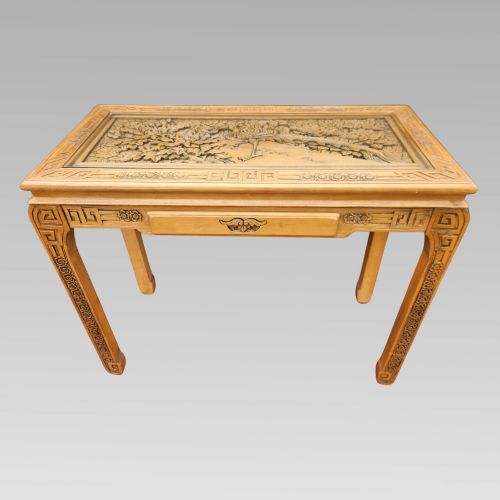
These relief carved wood table pieces bring intricate Oriental and Victorian craftsmanship into a room.
Relief Carved Wood Table
A relief carved wood table encompasses nests, consoles, coffee tables, and occasional stands originating from the nineteenth and early twentieth centuries. Buyers search for these items to introduce rich surface texture and traditional Asian or Victorian design into an interior.
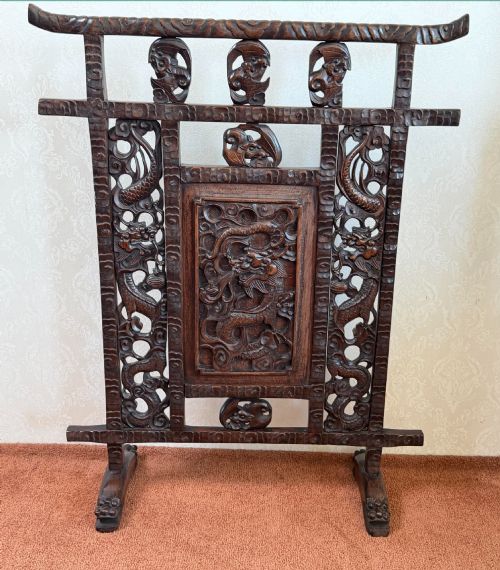
The version most commonly met on this page is the Chinese hardwood nest of tables, often featuring dragon decoration, alongside folding tables and side consoles.
Origins stretch across Chinese export, Anglo-Indian, Chinoiserie, and Japanese Meiji traditions, offering distinct regional interpretations of carved woodwork.
Materials and construction methods
Construction relies heavily on dense hardwoods such as teak, camphorwood, and mahogany, chosen for their ability to hold deep, detailed incisions.
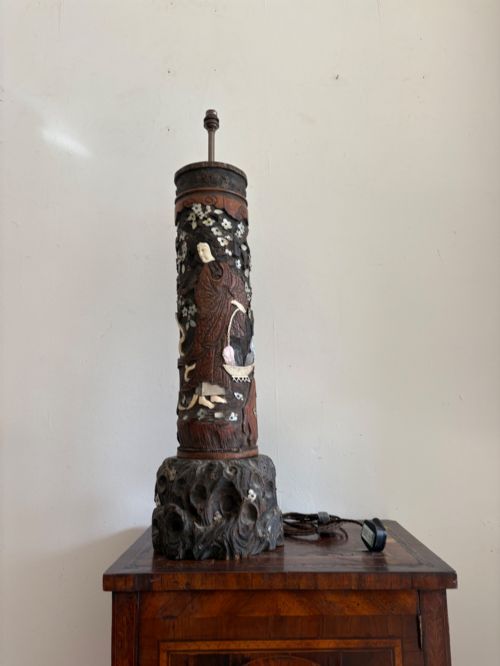
Artisans applied hand-carving techniques to create high and low relief motifs, occasionally incorporating mother-of-pearl, glass, fabric, and bone inlay into the wooden surfaces.
Listings span periods from the mid nineteenth century through to 1930, utilising hardwood, teak, camphorwood, and bone.
Evaluating craftsmanship and execution
The depth and crispness of the hand-carved detail dictate the upper tier of the range, separating deeply undercut figures from shallow surface incisions.
Structural integrity within nests of tables and folding mechanisms reveals the underlying joinery skill applied during production.
The Relief Carved Wood Table Glossary
- Relief carving
- A sculptural technique where figures or patterns project from a background plane. This method creates strong shadow and depth on tabletops.
- Chinoiserie
- European interpretation and imitation of Chinese and East Asian artistic traditions. It appears frequently in decorative furniture.
- Nest of tables
- A set of graduated tables designed to fit neatly beneath one another. They offer space-saving versatility.
- Meiji period
- A timeframe in Japanese history lasting from 1868 to 1912. Works from this era display precise decorative execution.
Relief Carved Wood Table: Frequently Asked Questions
How do I use a nest of tables?
These sets sit compactly together as a single occasional stand until guests arrive or extra surface space is required.
Individual tables pull out easily to hold drinks, lamps, or small decorative objects around a room.
Where do these tables originate?
The pieces span various eastern and colonial production centres, including Chinese export workshops and Japanese Meiji studios.
British Victorian and Middle Eastern influences also appear amongst the recorded items.
How are carved wooden surfaces cleaned?
Dust settles easily within the deep recesses of hand-carved panels and dragon motifs.
A soft brush helps clear debris without disturbing the timber or any inlaid mother-of-pearl.
What woods were used?
Makers utilised sturdy materials including teak, camphorwood, and general hardwood.
These timbers provided the structural strength needed to support intricate surface decoration.