
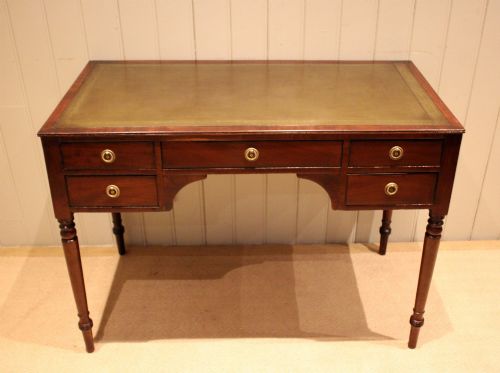
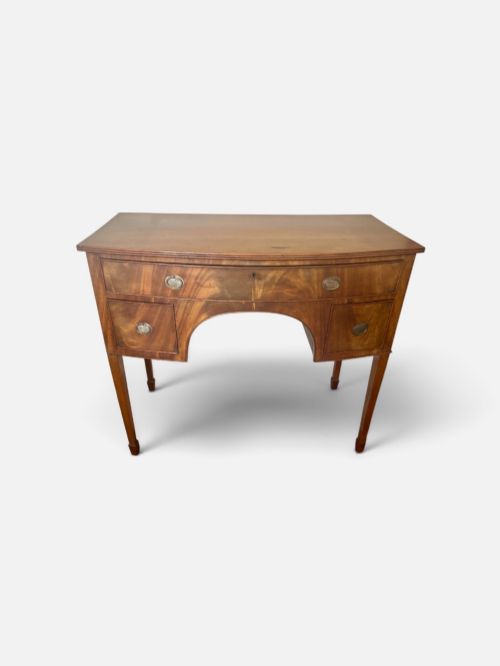
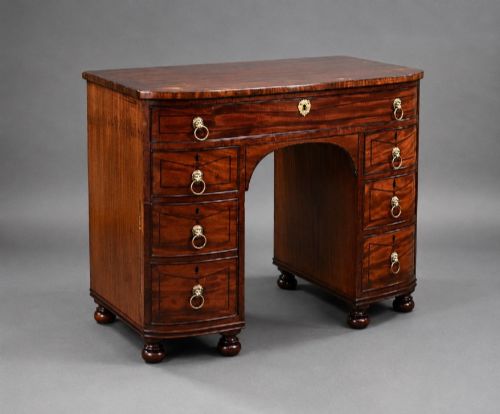
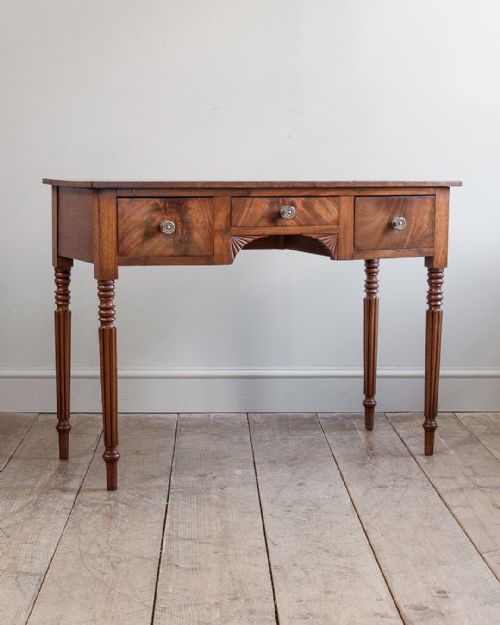
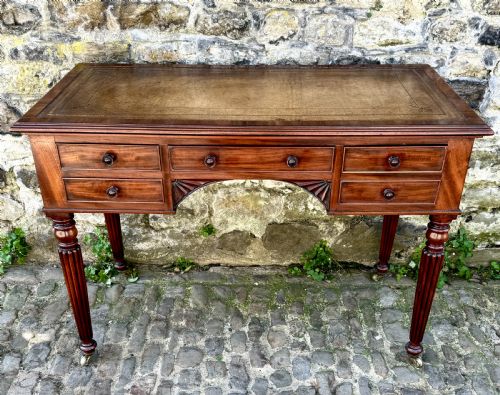


Regency Kneehole Writing Table
A regency kneehole writing table brings architectural proportion and disciplined storage into a study, combining pedestals with a central recess for practical daily work.
Regency Kneehole Writing Table
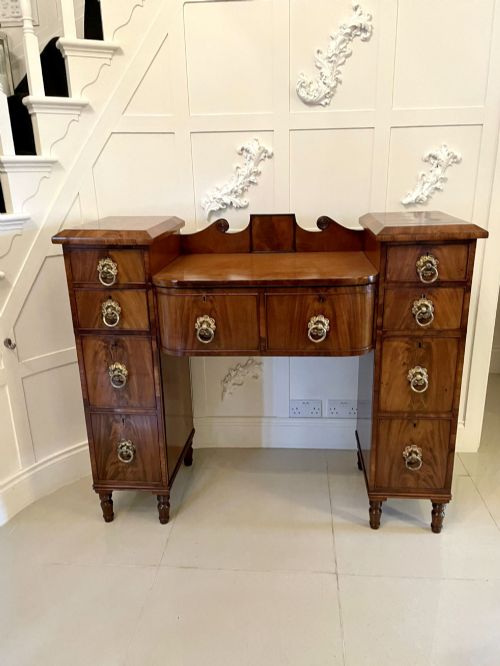
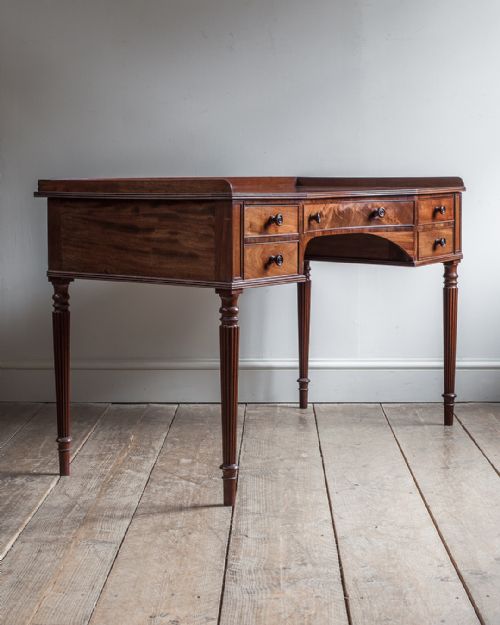
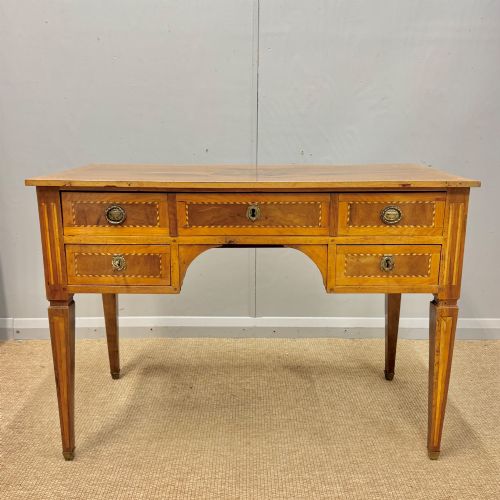
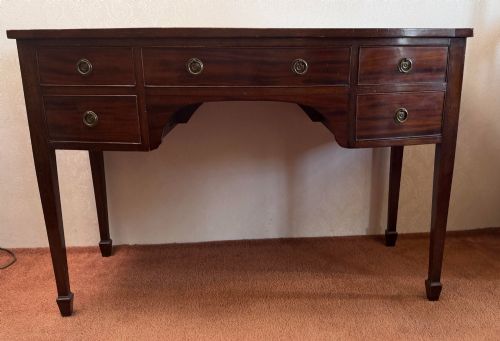
A regency kneehole writing table is a compact workspace featuring pedestals flanking a central recessed opening, designed primarily for correspondence and administrative tasks. The pieces appearing under this search span the Regency, Georgian, and Victorian periods, alongside later twentieth-century interpretations, drawing from object types including writing tables, dressing tables, and compact desks.
Most examples found in these listings utilise mahogany, frequently enhanced by flame mahogany veneer, bowfront profiles, or gallery upstands. These desks range from freestanding partners' tables to smaller three-drawer and five-drawer side variations, reflecting the adaptable domestic requirements of the early nineteenth century.
Buyers frequently encounter variations that served dual purposes as dressing tables or washstands, retaining the proportions of a kneehole desk while incorporating tray tops or back upstands. The integration of brass hardware and leather inserts remains a consistent element across surviving examples from the Regency and George IV periods.
Materials and Construction
Cabinetmakers relied heavily on solid mahogany and flame mahogany veneer, applying the figured timber to drawer fronts and top surfaces to create visual depth. Secondary timbers such as fruitwood, walnut, and boxwood provided contrast in stringing and inlay work.
Hardware details such as brass handles and castors anchored the heavier wooden carcases, while inset leather writing surfaces offered a durable working plane. Construction methods prioritised sturdy dovetail joints in the drawer construction to withstand daily use.
Architects occasionally utilised riser desks equipped with cartographic adjustments to draft plans while standing.
Evaluating Quality
The degree of refinement in the timber selection and veneer matching sets superior examples apart from standard utilitarian pieces. Finely figured flame mahogany and crisp brass mounts indicate a workshop of higher standing.
Proportional harmony and structural integrity define the better specimens, where drawers run smoothly and the pedestals meet the writing surface without awkward transitions. The presence of maker stamps or cohesive secondary woods further elevates an individual piece.
John Gregory
The Regency Kneehole Writing Table Glossary
- Kneehole
- A recessed space beneath the desk top designed to accommodate the user's legs while seated. This configuration allows for flanking banks of drawers on either side.
- Bowfront
- A convex curved front profile that projects outward towards the centre. It is a common stylistic feature on Regency side tables and desks.
- Flame mahogany
- A distinct wood veneer cut from timber where the branches join the main trunk, creating a flamed or feathery pattern. Cabinetmakers prized this figure for principal drawer fronts.
- Gallery
- A low raised rail or upstand running along the back or sides of a desk top. It prevents items from rolling off the surface.
- Partners' desk
- A large double-sided desk designed for two people to work opposite one another. These typically feature drawers and cupboards on both longitudinal faces.
Regency Kneehole Writing Table: Frequently Asked Questions
What is a kneehole writing table?
A kneehole writing table is a desk featuring a central recessed space for the user, flanked by pedestals containing drawers. This arrangement provides storage while maintaining a compact footprint.
Such tables served as functional writing surfaces in studies, libraries, and withdrawing rooms throughout the Regency and Georgian eras.
How do I date a Regency desk?
Dating relies on observing construction techniques, timber choices, and stylistic markers such as bowfronts, reeded legs, and brass hardware. Cabinetmakers of the period favoured solid mahogany and flame mahogany veneers.
Comparing secondary woods and drawer jointing helps distinguish authentic early nineteenth-century pieces from later nineteenth-century or twentieth-century revivals.
Were these tables used for dressing?
Many desks from this period functioned interchangeably as writing tables or dressing tables. Examples frequently include three-quarter galleries or tray tops designed to retain washing basins or grooming items.
Internal compartment layouts and the presence of low upstands often indicate whether a specific table was adapted for personal grooming.
Where should I place a freestanding desk?
Freestanding desks are finished on all sides, allowing them to sit centrally within a room rather than pushed against a wall. Partners' desks and certain library tables are specifically designed for this purpose.
Placing the table away from walls highlights the finished back panels and provides unimpeded access to pedestals from multiple angles.