


Regency Bronze Candlesticks
Regency bronze candlesticks bring the heavy, dark metal and golden flash of the early nineteenth century straight to a dining table or mantelpiece.
What Regency bronze candlesticks are
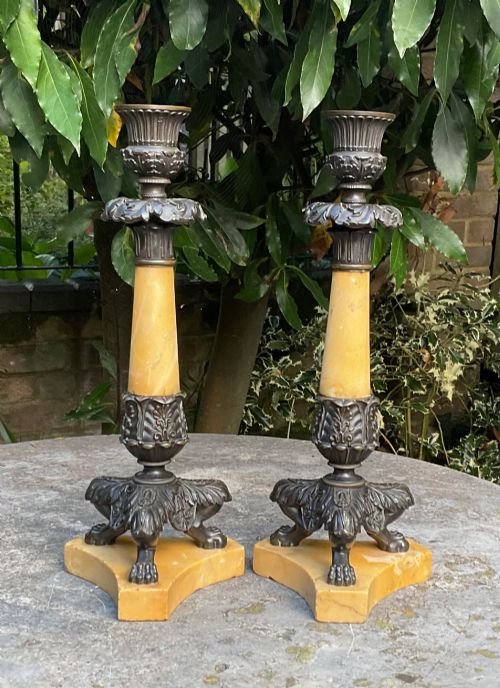
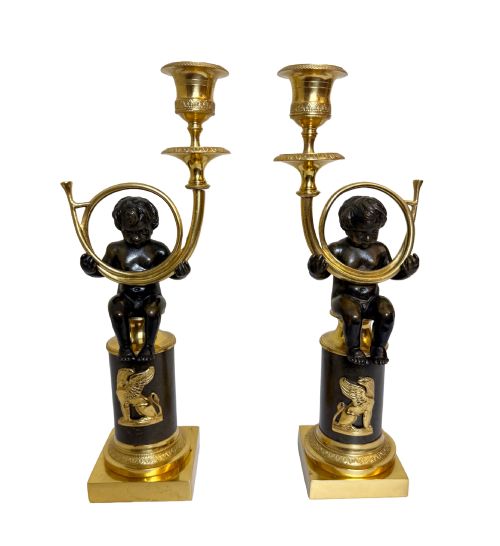
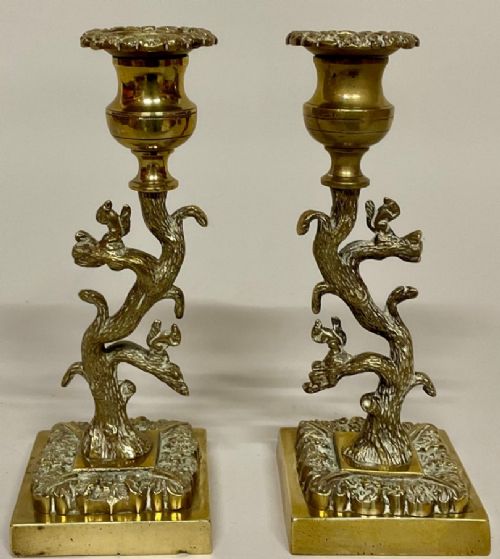
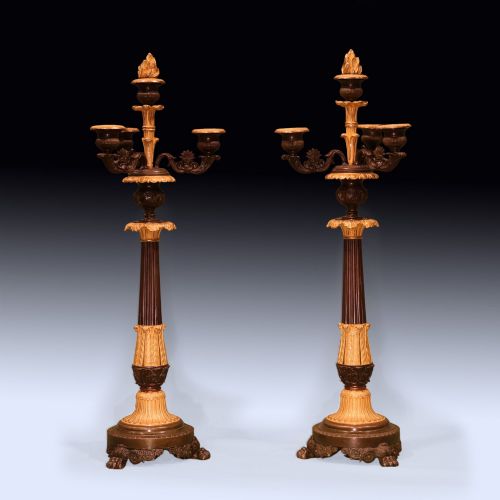
Regency bronze candlesticks are lighting pieces dating from the early nineteenth century, encompassing the Regency, George IV, and French Empire periods. When searching for regency bronze candlesticks, buyers encounter paired items designed to stand symmetrically on side tables, mantels, or dining surfaces. The selection spans standard candlesticks alongside larger four-light candelabra.
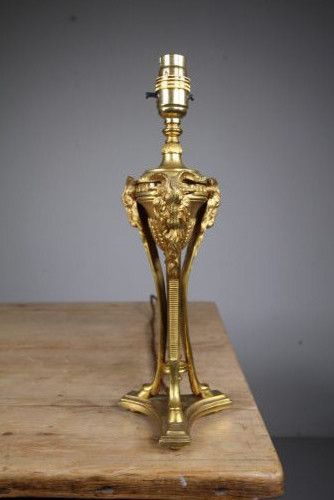
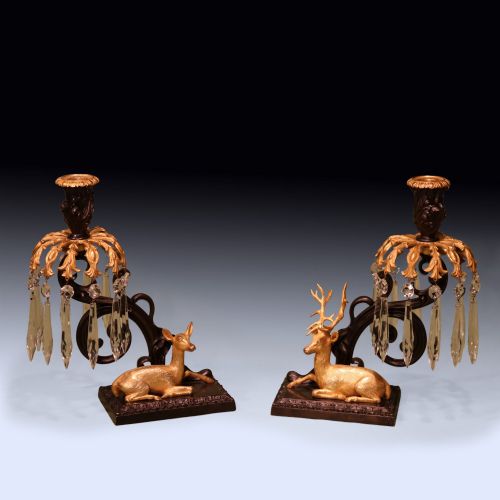
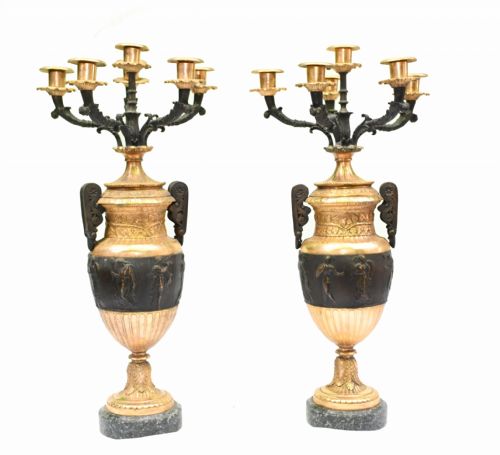
Most examples combine dark patinated bronze with gilded elements or ormolu mounts, frequently resting on marble plinths. Design influences lean heavily into classical motifs, including Athenienne forms, cherubs on crocodiles, zodiac themes, and figural supports like stags, does, and eagles. Some surviving pairs show later conversion to electricity while retaining their original metalwork bodies.

How they were made
Maker workshops utilised two distinct metallic finishes within a single object, pairing dark patinated bronze with bright ormolu or gilt bronze highlights. This contrast defined the Regency aesthetic, using chemical patination to darken the main body while fire-gilding decorative mounts and accents. Marble also served as an integral structural material, forming solid plinths that anchored the heavier metal components.
Casting methods of the period involved pouring molten bronze into complex moulds, followed by meticulous hand-chasing to sharpen details such as feathers, drapery, and classical ornament. Ormolu sections required the application of a mercury and gold amalgam, heated to bond the precious metal to the bronze underneath. Final assembly combined these cast and chased elements with threaded rods and pins.
Retail Price Guide 2026
Typical UK retail prices for regency bronze candlesticks, calculated from the Sellingantiques database of over a million retail prices indexed since 2003. This retail price guide relies exclusively on Sellingantiques data; no external sources or auction records are used, so the figures do not describe the wider market.
Listings demonstrate a strong preference for paired objects, uniting bronze with ormolu, marble, and gilt finishes across nineteenth-century forms.
What varies in quality
The degree of crispness in the metal chasing separates standard production from superior pieces, particularly in rendered details on figural subjects like cherubs, eagles, and stags. Superior examples display deep, sharp toolwork that retains its definition across every fold of drapery and feather. Poorer casting appears soft and blurred, masking the underlying form.
The integration of materials dictates the visual success of the piece, where fine ormolu retains its rich, warm lustre alongside deep, stable patination on the bronze. Lesser examples suffer from worn gilding that exposes the dull base metal underneath, or mismatched marble plinths that disrupt the symmetry of a pair.
The Regency Bronze Candlesticks Glossary
- Ormolu
- A technique of applying finely ground gold mercury amalgam to bronze, creating a rich golden surface finish that resists tarnish. It provides the bright highlights seen against dark patinated bronze bodies.
- Patinated bronze
- Bronze treated with chemical solutions to produce a darkened, stable surface colour ranging from deep brown to near black. This dark tone formed the primary body colour for classical Regency designs.
- Sienna marble
- A yellow-brown decorative marble imported from Italy, featuring dark veining. It was frequently used for the solid plinths supporting early nineteenth-century metalwork.
- Athenienne
- A classical tripod stand or burner form adapted during the Regency period for decorative lighting and metalware. It mimics ancient Greek domestic vessels raised on slender legs.
- Candelabra
- A branched lighting fixture designed to hold multiple candles simultaneously, differing from a single-stem candlestick. Regency examples on this page support up to four lights.
Frequently Asked Questions
Are these candlesticks wired for electricity?
Most pieces remain in their original candle-holding format, though historical conversions to electricity appear among surviving examples. Buyers can find items retaining their original drip pans and sockets.
Originality of the wiring or fittings varies, and collectors often look for unaltered pieces that preserve the original method of manufacture.
How do I care for bronze and ormolu?
Maintenance requires only gentle dusting with a soft, dry cloth to prevent the accumulation of grit on the metal surface. Moisture and chemical polishes must be avoided entirely.
Harsh cleaning agents strip away the delicate ormolu gilding and alter the chemical patina built up on the bronze over centuries.
Did these come in pairs?
Period lighting of this scale was produced and sold as matched pairs to maintain symmetry on dining tables and mantelpieces. Surviving sets retain their corresponding components from the same workshop.
Matching pairs hold greater significance for collectors than single items, preserving the intended decorative balance of the room.
What periods do these pieces date from?
The inventory spans the early nineteenth century, covering the Regency, George IV, and broader nineteenth-century manufacturing windows. Stylistic crossover with French Empire designs is common.
Dates typically centre around eighteen twenty to eighteen thirty, reflecting the height of neoclassical taste in British interior decoration.