
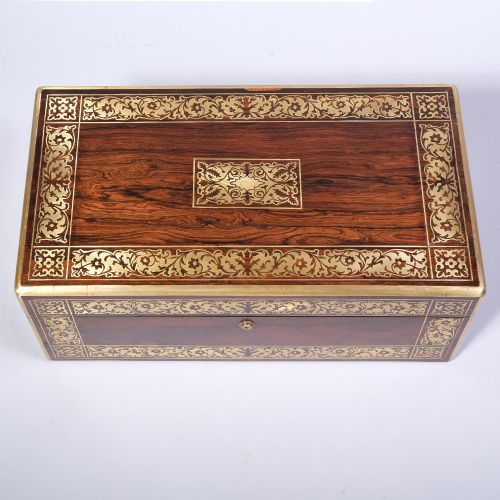


Regency Brass Marquetry Box
A regency brass marquetry box brings together rich rosewood and sharp metal inlay for your desk or table.
Regency Brass Marquetry Box
When you search for a regency brass marquetry box, you encounter refined wooden containers designed for writing, tea, and sewing during the early nineteenth century. Most examples found here date from the Regency period, shaped from dark timber with bright metallic ornament set into the surface.
The forms vary across functional types including tea caddies, writing slopes, jewellery boxes, and larger desk accessories. Many feature tapering oblong shapes or fitted interiors with compartments for glass vessels and smaller containers.
Makers of this era employed rosewood as the primary carcass material, often pairing the dark grain with tortoiseshell, boxwood, and ebonised wood to create strong visual contrast. The items range from compact boxes for personal trinkets to substantial freestanding teapoys on stands.
Materials and construction methods
These pieces rely on solid or veneered rosewood foundations combined with meticulously cut sheet brass inlay. Craftsmen channelled the timber surface to receive thin brass motifs, securing the metal flush with the polished wood grain.
Internal compartments frequently incorporate secondary timbers alongside bone, glass, and tortoiseshell details. Hinges, locks, and escutcheons are cast from brass, providing both structural durability and decorative accents to the exterior.
Several boxes still retain their tiny inner cannisters, reminding us of an era when tea was precious enough to lock away.
Judging the standard of execution
Quality in these objects rests upon the precision of the brass inlay and the selection of the rosewood timber. Finer examples display tight, intricate metalwork with minimal filler, whereas simpler pieces show broader brass lines and plainer grain patterns.
The complexity of the interior fittings also distinguishes higher tiers of work. Boxes containing original glass canisters, working locks with keys, and multi-tiered writing slopes demonstrate superior original craftsmanship compared to stripped or altered interiors.
The Regency Brass Marquetry Box Glossary
- Regency
- An English design period spanning the early nineteenth century, characterised by classical restraint and refined cabinetmaking. It draws heavily on ancient Roman and French fashions.
- Teapoy
- A small tea caddy mounted upon a central pillar and pedestal base. These larger pieces often served as decorative tables in a drawing room.
- Writing Slope
- A portable desk featuring a hinged, sloping lid that opens to reveal a slanted writing surface and pigeonholes for stationery. Many include hidden compartments for documents.
- Escutcheon
- A decorative brass plate surrounding a keyhole. It protects the surrounding wood from wear and adds a formal accent to the lid or front panel.
- Tortoiseshell
- The mottled brown and amber keratin shell of certain sea turtles, utilised as a veneer. Craftsmen often backed it with metallic foil to increase its brilliance.
Regency Brass Marquetry Box: Frequently Asked Questions
What is inside a regency brass marquetry box?
These boxes typically contain fitted compartments lined for specific domestic tasks. Tea caddies hold lidded canisters and sugar bowls, while writing slopes feature inkwells, pen trays, and slanted writing surfaces.
Other variants serve as jewellery and work boxes, containing shallow trays and partitioned spaces for sewing implements or personal valuables.
How do I care for rosewood and brass?
Maintain the timber by keeping the box away from direct sunlight and sudden temperature changes. A light application of appropriate wax preserves the polished rosewood surface without harming the wood.
Clean the brass inlay gently with a dry or barely damp cloth to avoid moisture seeping beneath the metalwork into the surrounding grain.
Are keys usually included?
Original keys are sometimes present with these items, though many survive without them due to centuries of displacement. Locks were a standard feature for securing valuable tea and correspondence.
Even without a working key, the decorative escutcheons remain an integral part of the front elevation and visual balance of the box.
How do I distinguish a teapoy from a tea caddy?
A tea caddy is a portable box designed to sit upon a table, sideboard, or tea table. It can be lifted and carried easily between rooms by hand.
A teapoy is a larger, heavier container supported by its own stand or pillar with feet, forming a fixed piece of furniture rather than a tabletop box.