
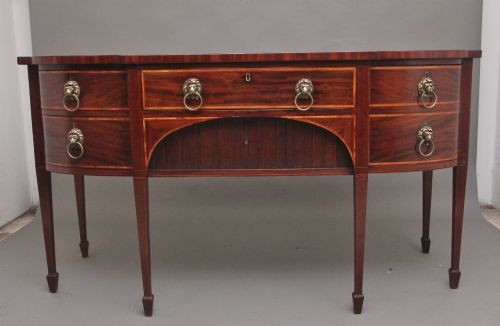


Regency Bowfront Server
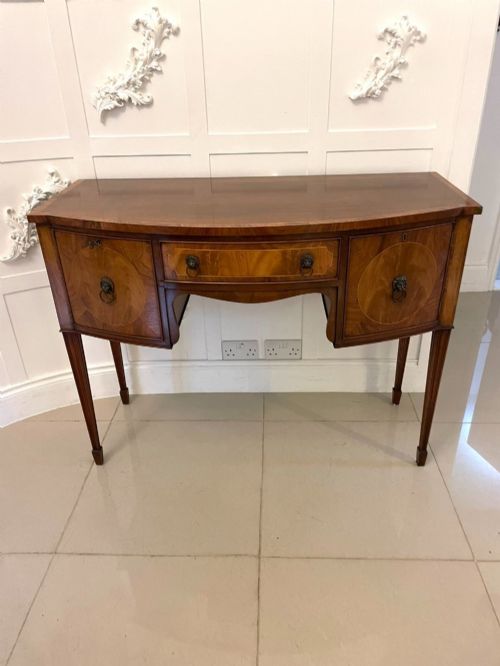
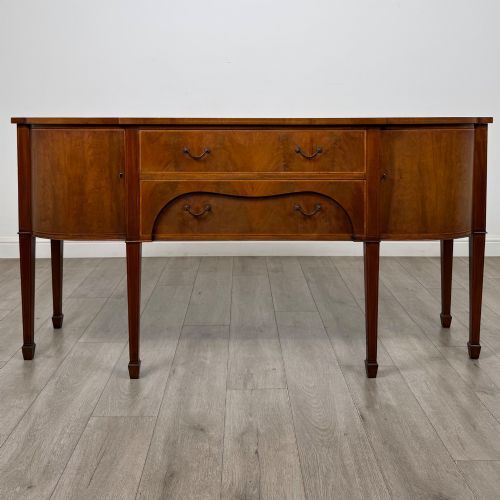
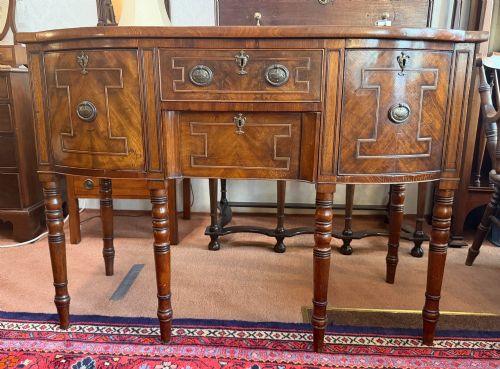
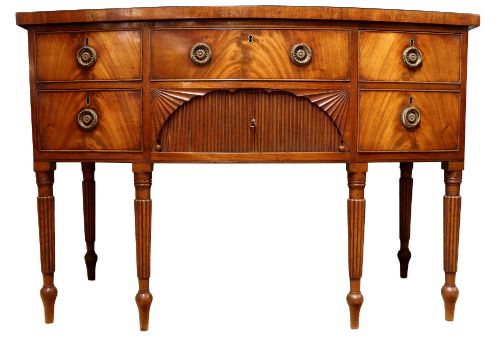
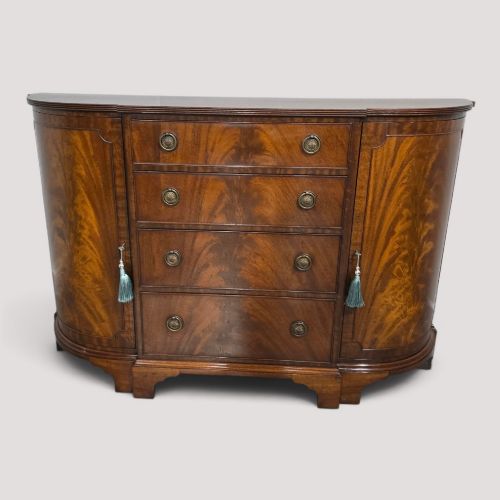
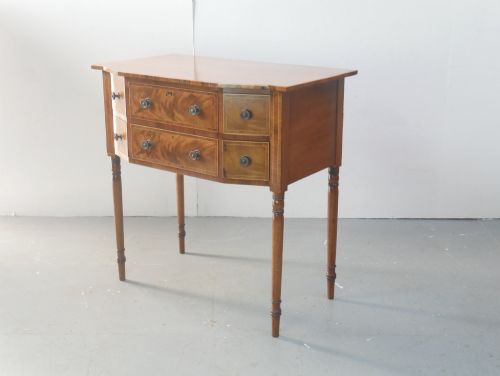
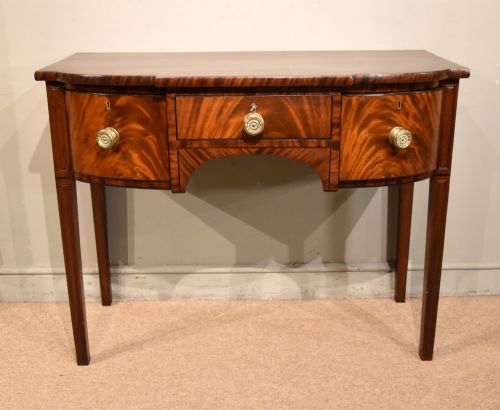
A regency bowfront server brings commanding presence and disciplined storage to a dining room through its curving timber facade.
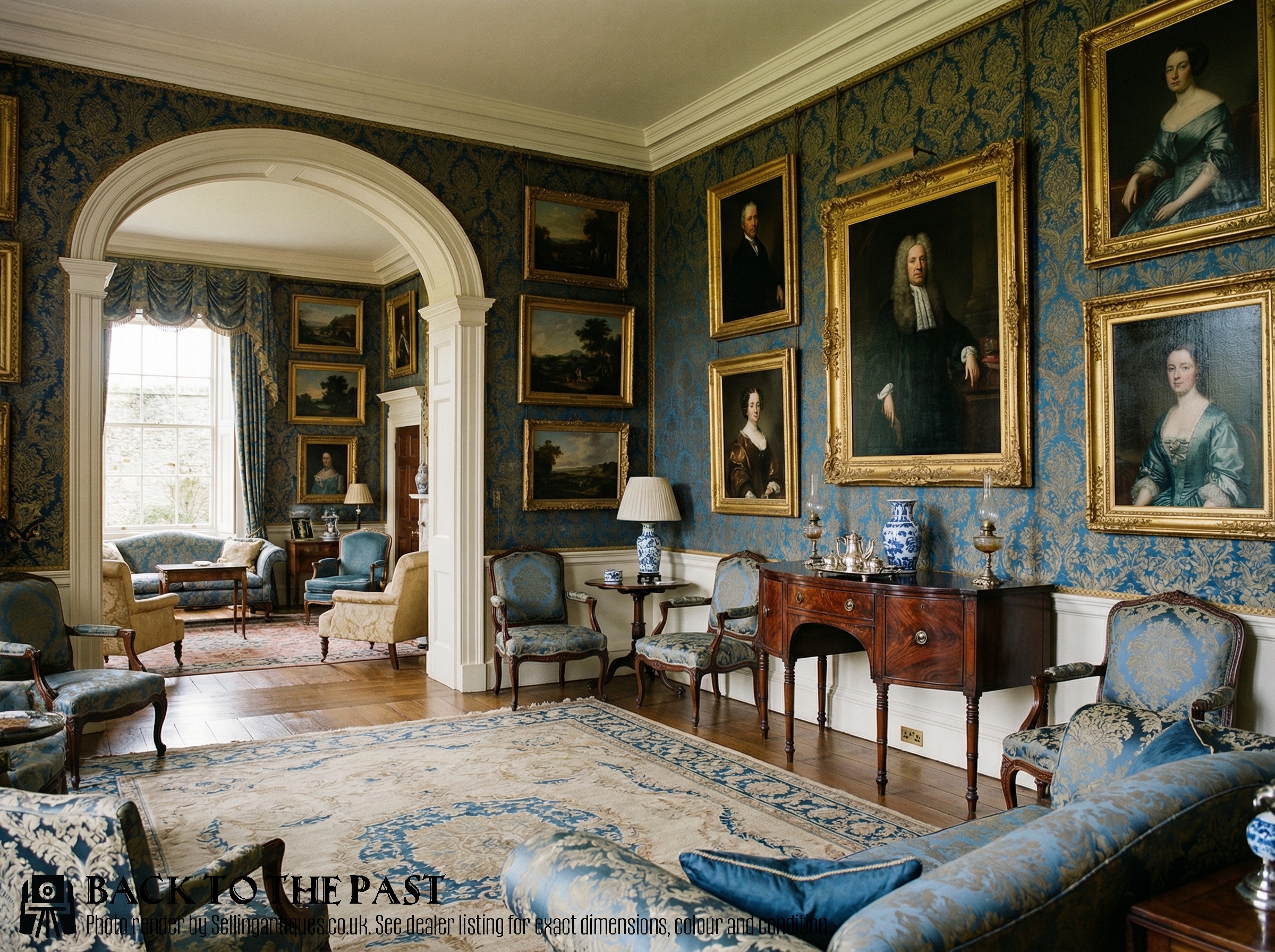
Regency Bowfront Server
A regency bowfront server stands as a primary dining room storage piece, engineered with a distinctive convex curve across the front elevation to soften the rigidity of a room. Most examples found here date from the nineteenth century, encompassing genuine Regency periods alongside later Georgian, Victorian, and twentieth-century interpretations.
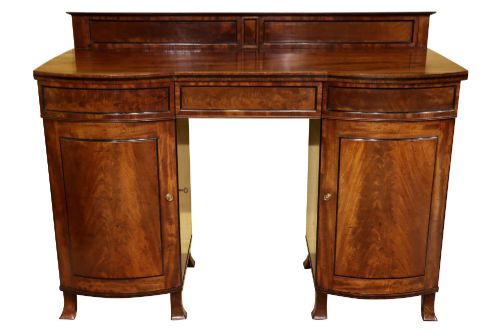
The form typically manifests as a sideboard, dresser, or side cabinet, designed to hold linen, cutlery, and serving vessels while offering a broad top surface. Pieces frequently display compact proportions suited to smaller spaces, though longer Georgian and Regency formats also appear regularly.
The overarching style leans heavily into Regency, George III, George IV, and William IV design canons, often categorised simply under broad nineteenth-century headings. Buyers will encounter both authentic early pieces and later reproductions sharing the characteristic bowed silhouette.
Assessing quality and finish
The depth of figure in the mahogany veneer dictates much of the visual merit, with highly flamed surfaces commanding greater attention than plain stock. Crispness in the inlaid stringing and fidelity in the boxwood or satinwood borders show the precision of the original workshop.
Proportion and scale separate masterwork cabinetmaking from utilitarian production, particularly in smaller examples where managing the curve requires exact geometry. Original brass hardware and clean interior drawer construction with traditional linings elevate the standing of any piece.
Age integration also dictates value, as authentic Georgian and Regency pieces demonstrate hand-cut joinery and period patination that later nineteenth-century or twentieth-century revivals occasionally lack. The alignment of the bow curve relative to the side pedestals or legs reveals the structural ambition of the maker.
Regency Bowfront Server Retail Price Guide 2026
Typical asking prices for regency bowfront server among the pieces listed under this phrase on Sellingantiques today, from the lower quarter to the upper quarter. They describe what is for sale here now, not the wider market.
Listings span the eighteenth, nineteenth, and twentieth centuries, uniting Georgian proportion with Regency styling and later revival periods.
The Regency Bowfront Server Glossary
- Bowfront
- A convex, outwardly curving front elevation typical of select sideboards and servers. This shape maximises internal volume while presenting a softened silhouette.
- Flame mahogany
- A decorative veneer cut from timber fork joints, displaying a distinctive feather-like grain pattern. Cabinetmakers reserved this timber for principal facade surfaces.
- Stringing
- Thin inlaid lines of contrasting wood, such as boxwood or ebony, used to edge drawer fronts and tabletops. It provides a sharp linear boundary against darker primary woods.
- Pedestal sideboard
- A form featuring distinct flanking cabinet pedestals united by a central serving section. These configurations often appear in larger Regency dining rooms.
Regency Bowfront Server: Frequently Asked Questions
Where should I place a bowfront server?
These pieces suit dining rooms, large hallways, or drawing rooms where surface area and concealed storage are both required. Their curved profile prevents them from dominating a walkway in the way a flat-fronted cabinet might.
Ensure adequate clearance for drawers and cabinet doors to open fully without obstruction from nearby furniture. Placing the server against a primary wall allows the flame mahogany grain to catch natural light effectively.
Are these servers suitable for modern dining rooms?
The compact proportions found in many of these pieces allow them to integrate seamlessly into contemporary domestic interiors. They provide practical storage for modern tableware while introducing historical character and warmth.
The neutral tones of polished mahogany and brass complement a wide range of interior colour schemes, from minimalist spaces to traditional heritage settings.
How can I distinguish Regency from later styles?
Authentic Regency pieces typically exhibit hand-cut dovetails, secondary timbers such as oak, and period-specific brass hardware. Later nineteenth-century or twentieth-century revivals often utilise standardised machine-cut joinery and different interior lining woods.
Examine the patination of the wood and the precision of the inlaid stringing for signs of period handcrafting rather than mass production methods.