




Red Wool Saddle Bag
These heavy utility containers bring nomadic artistry directly to the floor, built by tribal weavers across Persia, Anatolia and the Caucasus.
Red Wool Saddle Bag
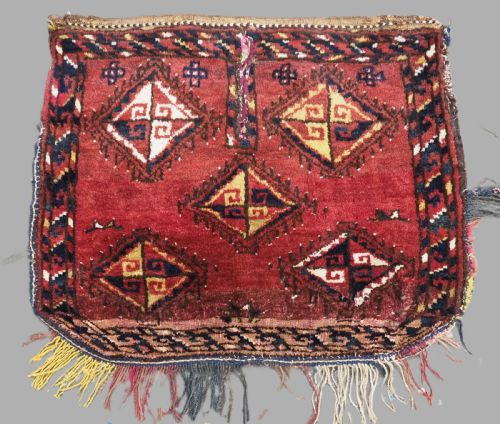
A red wool saddle bag functions primarily as a heavy utility container woven by nomadic groups for transport on pack animals, carrying everything from household provisions to personal belongings across vast regional territories. When exploring this selection, buyers frequently encounter complete pairs intended to hang across a beast of burden, alongside individual bag faces and half sections preserved as decorative textiles.
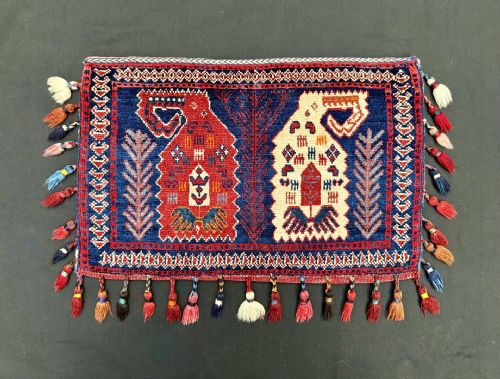
Geographical origins span multiple tribal traditions, notably the Qashqai, Afshar, Shahsavan, Luri, Kurdish, and Baluch weavers of Persia, alongside examples originating in the Caucasus, Anatolia, and Central Asia. The prevalent palette relies heavily on rich madder red tones derived from natural dyes, providing a striking backdrop for traditional geometric, boteh, and tile motifs.
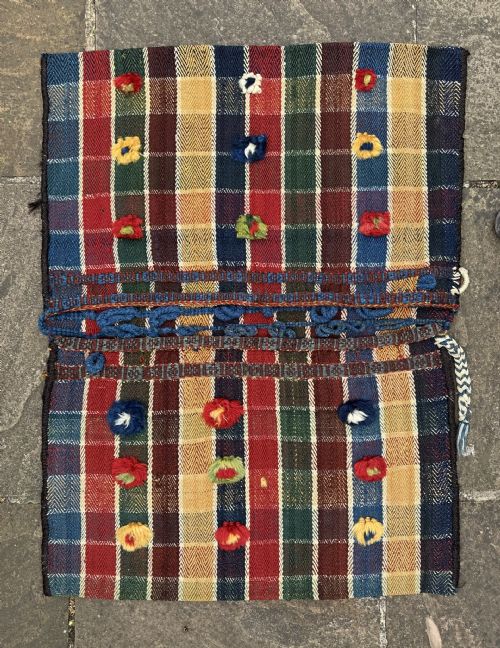
Formats vary from full double-sided khorjin sets complete with plain weave backs to single panels designed as cushion covers or small wall hangings. Dating generally centres on the nineteenth and early twentieth centuries, capturing a period when tribal weaving remained an essential part of nomadic daily life.
Assessing quality in nomadic textiles
Knot density and structural tightness dictate the longevity and definition of the pattern, separating densely packed village and nomadic pieces from looser utility weaves. The quality of the hand-spun wool itself directly affects handle and visual depth, with certain fleeces retaining natural lanolin that preserves lustre.
Completeness alters historical value significantly, preserving original plain weave backs, closure loops, and leather attachments intact. Natural dye consistency across the field and crisp execution of tribal motifs indicate superior execution by experienced makers.
Listings feature wool, natural dyes, cotton, leather, and metal across pieces dated from the mid-nineteenth century through the early twentieth century.
The Red Wool Saddle Bag Glossary
- Khorjin
- The traditional Persian term for a double-sided saddle bag used by nomadic tribes for transport.
- Soumak
- A flat-weave technique where coloured weft threads wrap around the warp threads, creating a durable textured surface.
- Boteh
- A recurring teardrop or almond-shaped motif representing a floral spray or cypress tree, common in Persian textiles.
- Gul
- A medallion pattern or block print design frequently repeated across Turkmen and Central Asian tribal rugs.
- Warp
- The vertical foundation threads stretched tightly on the loom before weaving commences.
Red Wool Saddle Bag: Frequently Asked Questions
How were saddle bags used originally?
Nomadic families slung these containers across horses, camels, or donkeys to transport personal possessions, grain, and household goods during seasonal migrations.
Once the tribe reached camp, the bags served as floor storage chests inside tents, keeping contents organised and protected from dirt and moisture.
Can I use a saddle bag as a cushion?
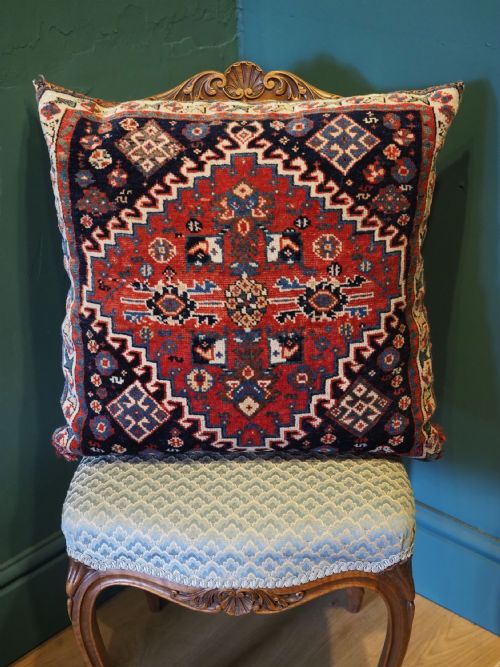
Many surviving bag faces and half-sections adapt well to being stuffed and utilised as heavy decorative floor cushions or decorative pillows.
To protect the antique wool and natural dyes, place them in low-traffic areas away from direct sunlight.
How do I tell different tribal groups apart?
Weavers from different regions relied on distinct colour palettes, structural techniques, and specific geometric or zoomorphic motifs passed down through generations.
For instance, Shahsavan pieces often showcase precise soumak work, while Afshar examples frequently emphasise rich madder reds and bold boteh designs.
Why do some listings mention complete sets?
A complete set includes both connected pockets of the khorjin alongside the central bridging panel, often retaining the original plain weave back.
Surviving sets are uncommon because pairs were frequently cut in half over time to be sold separately as wall hangings or cushion faces.