
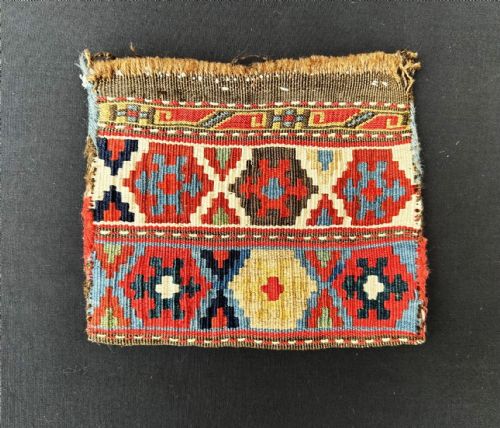


Caucasian Kilim Bag
These caucasian kilim bag pieces are woven storage containers and panels carrying tribal designs from the nineteenth and early twentieth centuries.
Caucasian Kilim Bag
A caucasian kilim bag typically appears as a complete mafrash storage bag, a saddle bag, or a repurposed bag face used for cushions and pillows. These items stem from tribal and nomadic groups, including Shahsevan nomads of Moghan in Azerbaijan and Jaf Kurd weavers.
The forms range from large rectangular storage containers designed for bedding to pairs of saddle bags meant for transport. Buyers frequently encounter bag faces that have been converted into decorative cushions alongside complete structural pieces.
Construction and Materials
Weavers constructed these pieces using hand-spun wool and cotton foundations, employing flat-weave kilim techniques without a pile. Natural dyes provided the deep colour palette characteristic of these nomadic textiles.
The structural integrity relied on tight slit-weave construction, often paired with plain weave backs and sturdy side panels designed to withstand regular transport and use.
Listings for this phrase include pieces dated across the nineteenth century and into the nineteen-twenties, originating from regions including Azerbaijan.
Assessing Quality
Quality depends upon the tightness of the weave and the complexity of the geometric or tribal motifs displayed across the surface. Completeness also elevates a piece, as intact mafrash storage bags or matching pairs of saddle bags retain greater structural context than individual fragments.
The vibrancy and depth of the natural dyes distinguish superior examples, alongside the fineness of the hand-spun wool used by the nomadic makers.
The Caucasian Kilim Bag Glossary
- Kilim
- A flat-woven carpet or textile produced without a pile by tightly interweaving warp and weft strands. This technique creates a smooth, durable surface with distinct geometric patterns.
- Mafrash
- A large rectangular storage bag used by nomadic groups for bedding and household goods. These containers usually consist of four side panels and a base.
- Bag Face
- The decorative front panel of a nomadic storage bag. These are often separated from the plain back panel and adapted into cushions or pillows.
- Slit-weave
- A flat-weaving technique where the weft threads loop back at the edge of each colour block. This creates a small vertical slit between different coloured motifs.
Caucasian Kilim Bag: Frequently Asked Questions
What is a mafrash bag?
A mafrash is a large rectangular storage container used by nomadic tribes to transport bedding and domestic belongings. These pieces are constructed from multiple flat-woven panels joined together.
Today, collectors appreciate these complete storage bags for their striking tribal geometry and structural integrity.
How were these bags used?
Nomadic groups utilised these woven containers on pack animals for moving household goods across regions like Azerbaijan and the broader Caucasus. Saddle bags served a similar transport function for personal items during travel.
Over time, many of these functional objects transitioned into decorative interior items such as floor cushions.
How do I care for a kilim bag?
Protect these antique textiles from direct sunlight to prevent natural dyes from fading over the years. Gentle vacuuming through a mesh screen helps remove dust without damaging the flat weave.
Professional textile cleaning is recommended for deep maintenance rather than washing at home.
How can I tell the age of a bag?
Dating relies on examining the materials, particularly the presence of hand-spun wool and traditional natural dye palettes. Structural clues like original plain weave backs and tribal attribution also help narrow down the period.
Pieces recorded in the evidence typically date from the nineteenth century up to the nineteen-twenties.