

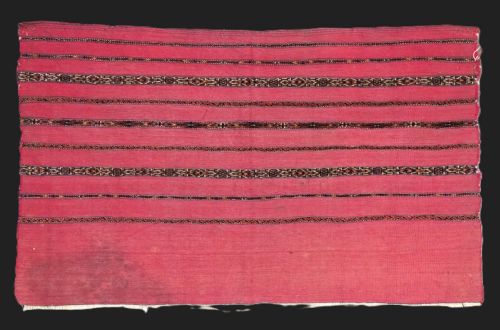


Red Turkmen Rug Face
When you search for a red turkmen rug face, you encounter tribal weavings created for nomad tent storage and household utility across Central Asia.
Red Turkmen Rug Face
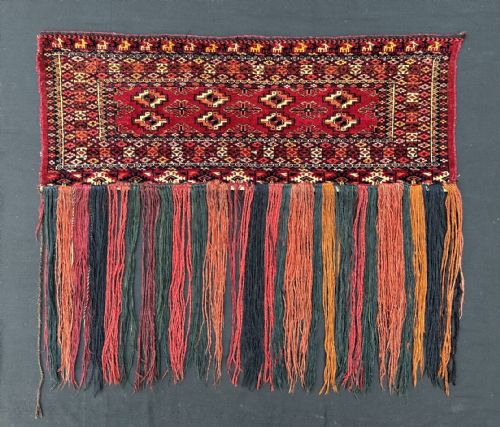
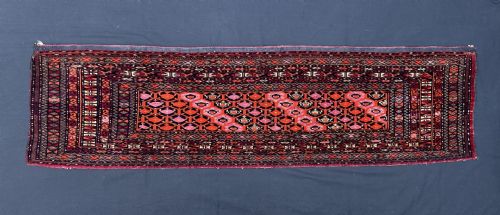
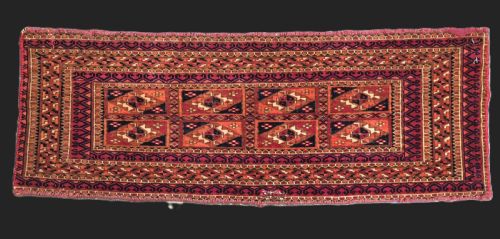
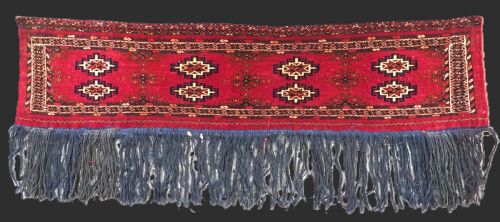
A red turkmen rug face originates from tribal groups such as the Tekke, Saryk, Yomut, and Ersari tribes of the Trans-Caspian steppes and oases. These items are typically the decorated front panels of storage bags, torbas, chuvals, and mafrashes used inside yurts.
The selections on this page span from the middle of the nineteenth century into the early twentieth century, demonstrating traditional nomadic textile art. Collectors encounter various tribal gull motifs, including the primary gul, 'aina gul', and 'kedjebe' patterns.
Many examples survive as cut or preserved bag faces rather than complete utilitarian sacks, having been separated from their plain weave backs over generations. Their format is generally rectangular, designed to hang against a tent lattice or store personal belongings.
Materials and Construction
The construction relies primarily on wool and hand-spun wool, frequently supported by cotton and occasionally supplemented with silk highlights or linen. Artisans knotted the pile tightly onto foundational warps and wefts to create dense, durable surfaces.
Natural dyes provide the characteristic deep madder red grounds, offset by ivories, browns, and dark blues. Some pieces incorporate flatweave techniques, embroidery, or plain weave backs alongside the knotted pile.
Listings span the eighteenth century to the early twentieth century, incorporating wool, natural dyes, cotton, silk, and hand-spun wool across tribal forms.
Assessing Quality
The fineness of the weave distinguishes standard utility items from exceptionally accomplished tribal commissions. Denser knotting permits sharper precision in drawing the complex tribal guls and secondary motifs.
Colour saturation and the vibrancy of natural dye palettes contribute significantly to visual impact. Examples displaying crisp ivory grounds, balanced proportions, and scarce design variations command greater appreciation.
The Red Turkmen Rug Face Glossary
- Torba
- A small Turkmen storage bag used for household items within the tent. These pieces were traditionally hung on the lattice walls.
- Chuval
- A large Turkmen tent bag designed for bedding and clothing storage. They often feature multiple primary guls arranged in rows.
- Gul
- The primary medallion or octagonal motif characteristic of Turkmen tribal weaving. Each tribe utilised distinct repeating geometric gull patterns.
- Mafrash
- A rectangular Turkmen storage container or chest piece. They frequently utilise banded flatweave designs or pile-woven faces.
- Kap
- A general term for a Turkmen bag or cover. These textiles formed an essential part of nomadic domestic furnishings.
Red Turkmen Rug Face: Frequently Asked Questions
What is a red turkmen rug face?
It is the decorative pile-woven front panel of a nomadic storage bag made by tribes in Central Asia. These panels were preserved when the utilitarian back portions wore out.
Nomads utilised these bags inside tents for storage, and their distinct red colour palette stems from traditional natural dye methods.
How were these bags used?
Nomadic families used them inside yurts to store bedding, clothing, and personal possessions. They hung from the wooden lattice walls or were stacked on top of one another.
Over time, many of these storage sacks were cut down, leaving only the decorative face to survive as a textile art object.
How do I identify different tribes?
Tribes are identified by their specific repeating geometric motifs, known as guls, and the structural details of the weave. Tekke, Saryk, Yomut, and Ersari weavers each employed distinct design vocabularies.
Secondary ornaments, border patterns, and colour variations also help distinguish between tribal workshops and oases like Merv or Yolatan.
How should I display a bag face?
These textiles can be mounted and framed or hung directly on interior walls using appropriate conservation methods. Their dense wool construction makes them durable when kept away from direct moisture and heavy foot traffic.
Regular gentle rotation and protection from harsh sunlight preserve the natural dyed wool and silk highlights.