


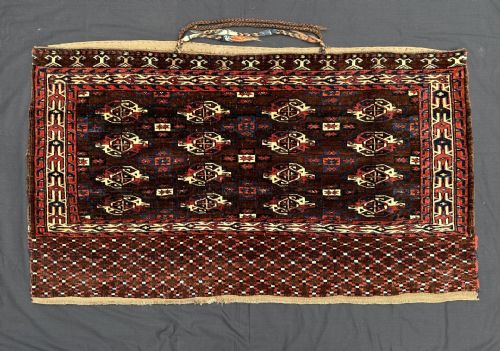


Nomadic Tent Storage Bag
These nomadic tent storage bag examples are tribal trappings woven by Central Asian weavers, offering genuine utility and striking geometric patterns for the modern interior.
Nomadic Tent Storage Bag
A nomadic tent storage bag represents the rich weaving heritage of tribal groups across the Trans-Caspian steppes and Central Asia. Collectors encounter forms such as the torba, chuval, and okbash, each serving a specific domestic purpose inside a tribal dwelling.
The pieces listed on this page span the mid-nineteenth century to around nineteen hundred, capturing traditional Turkmen tribal work. Buyers frequently find torba faces and chuval storage bags featuring distinct tribal guls and complete plain weave backs.
Materials and Construction
Weavers utilised hand-spun wool and natural dyes to create durable pile surfaces, often incorporating cotton and silk highlights for contrast. These textiles combine pile-woven faces with flat-woven details and plain weave wool backs.
Tribal makers constructed these containers for daily domestic use in nomadic camps, resulting in robust structures designed to withstand rigorous handling. The use of natural dyestuffs yields deep colour saturation that matures distinctively over time.
Nomads wove specialised cylindrical bags simply to keep their tent poles tidy during seasonal migrations across the steppes.
Assessing Quality
Quality rests upon the fineness of the weave, the clarity and complexity of the tribal gul design, and the survival of original structural elements like plain weave backs. Pieces featuring unusual design variations or distinct silk highlights command greater attention.
The Nomadic Tent Storage Bag Glossary
- Torba
- A small tent hanging or bag used for domestic storage within a nomadic dwelling. These pieces typically display intricate primary guls across the face.
- Chuval
- A large storage bag utilised by Turkmen tribes for household goods and bedding. They often feature multiple rows of guls and robust pile construction.
- Gul
- A repeating medallion or motif associated with specific tribal groups and clans. These geometric designs act as visual markers of cultural identity.
- Okbash
- A specialised cylindrical bag designed to cover and protect tent poles during transit. They are uncommon tribal trappings.
- Flat weave
- A textile construction technique without pile, utilised for the backs and detailing of nomadic storage bags. It provides lightweight durability.
Nomadic Tent Storage Bag: Frequently Asked Questions
How were these storage bags used?
Nomads utilised these containers inside tents to organise clothing, bedding, and smaller personal items. Their robust construction and practical dimensions suited the mobile lifestyle of pastoral communities.
Today, collectors repurpose these textiles as wall art or decorative interior accents, mounting them on walls or placing them on floors where foot traffic is light.
How do I identify different tribal groups?
Attribution relies on the specific gul motifs, colour palettes, and structural characteristics visible in the weave. Different tribes such as the Yomut or Ersari employed distinct design vocabularies.
Examining the secondary colours, border patterns, and knotting style helps experienced collectors distinguish between various nineteenth-century tribal workshops.
Should I look for bags with backs?
Many surviving examples consist solely of the decorative pile face, having been separated from their original plain weave wool backs over the decades. Finding a complete piece retains its original form.
Both complete bags and individual faces are collectible, though intact specimens offer a more comprehensive view of how the original storage containers functioned.