
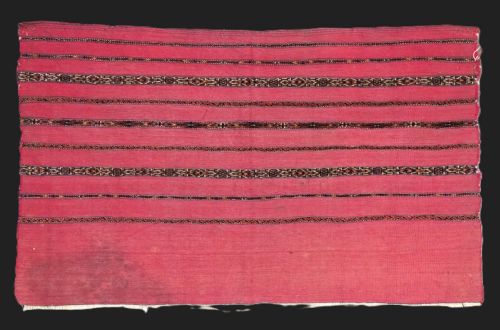


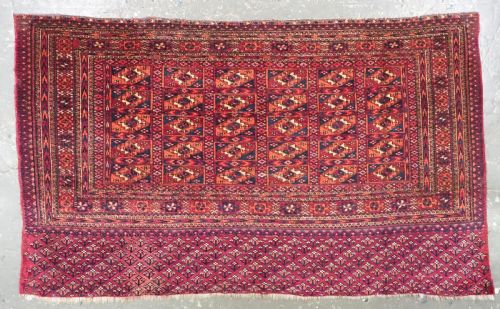


Red Tekke Chuval Face
A red tekke chuval face brings the dense, saturated geometry of Central Asian tribal weaving directly into your home as a rich wall hanging or textile art.
Red Tekke Chuval Face
When you search for a red tekke chuval face, you are looking at antique Turkmen tribal textile art originating from Central Asia. These items represent the front panels of large storage bags used traditionally within nomadic households.
The pieces you meet on this page date predominantly from the nineteenth century, spanning from the mid Victorian decades through to nineteen hundred. They appear primarily as rectangular wall hangings, rugs and textile fragments bearing distinct tribal motifs.
Makers utilised characteristic formats such as the gul design, featuring repeating medallions across a field of red wool. Examples range from smaller torba formats to complete storage bag faces equipped with hanging loops.
How they were made
Weavers constructed these tribal textiles using wool and cotton foundations, employing natural dyes to achieve deep red colour palettes. The pile is tightly knotted, resulting in durable surfaces designed for practical nomadic storage.
Designs incorporate detailed motifs such as salor guls, turreted variations, and tree patterns arranged in precise geometric grids. Many surviving examples demonstrate very fine weave structures executed by skilled Turkmen hands.
Some nineteenth-century weavers thoughtfully left their hanging loops attached, sparing modern collectors the puzzle of how to display a nomadic storage bag on a wall.
What varies in quality
The distinction between standard examples and the finest pieces lies in the density of the weave and the clarity of the natural dyes. Exceptional chuval faces display remarkably fine knots and deeply saturated red tones that retain their visual impact.
Compositional variety also dictates worth, with scarce gul arrangements or unusual banded designs commanding greater attention from collectors. The inclusion of original hanging loops or intact elem panels adds structural completeness to a textile.
The Red Tekke Chuval Face Glossary
- Chuval
- A large Turkmen storage bag used for household goods inside a yurt. The front face is typically preserved as a decorative textile.
- Gul
- A repeating primary medallion motif used in Turkmen tribal rugs and bag faces. These octagonal patterns often identify the specific tribe or sub-group.
- Torba
- A smaller Turkmen storage bag format compared to the chuval. These pieces were often used for smaller domestic items.
- Kizil
- A term denoting the red ground colour characteristic of certain Turkmen weavings. It translates literally to red in Turkic languages.
- Aina
- A mirror-form gul motif incorporated into Turkmen textile designs. This pattern adds geometric complexity to the field.
Red Tekke Chuval Face: Frequently Asked Questions
How were these bags used originally?
Nomadic families utilised chuvals inside tents to store clothing, bedding, and household possessions. The sturdy wool construction protected contents during transit and daily tribal life.
Only the decorative front face is typically preserved today, often retaining original hanging loops for display purposes.
How do I hang a textile safely?
Wall hangings require careful mounting to distribute weight evenly across the wool and cotton foundation. A padded Velcro system or a custom sleeve sewn by a textile conservator works best.
Avoid direct sunlight and high humidity to preserve the natural dyes and fibres over time.
What do the different gul designs mean?
Guls are tribal crests and geometric medallions passed down through generations of Turkmen weavers. Variations like salor guls or aina designs indicate specific tribal lineages and weaving traditions.
Counting and identifying these motifs helps collectors date and attribute nineteenth-century pieces accurately.