





Vintage Tekke Rug Face
These vintage tekke rug face pieces are Central Asian tribal weavings valued for precise wool geometry and rich reddish tones.
Vintage Tekke Rug Face
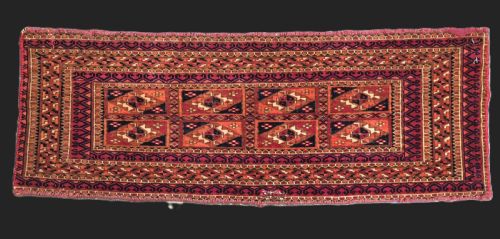
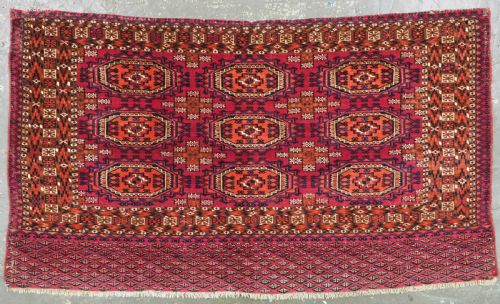
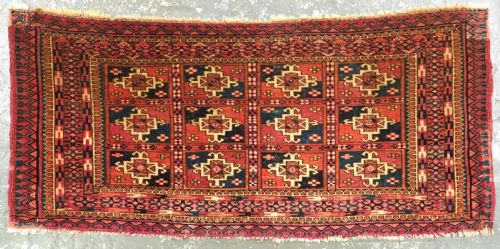
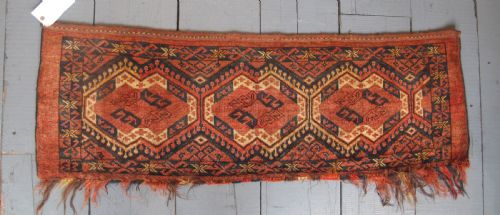
A vintage tekke rug face represents the severed front panel of a nomadic Turkmen storage bag, such as a chuval or torba, rather than a complete floor covering. When you search for a vintage tekke rug face, you encounter fragments of Central Asian tribal material culture that were originally utilised inside family yurts for bedding or household goods.
The objects on this page span the mid-nineteenth century to the end of that hundred-year period, covering Turkmen tribal, Tekke Turkmen, and Central Asian tribal styles. Most examples take the form of chuval faces, torba faces, or storage bagfaces, occasionally retaining original hanging loops or displaying ivory grounds.
How they were made
Every piece recorded in the evidence is constructed from wool, spun and knotted by hand across tribal workshops in Central Asia. The weavers deployed dense knotting techniques to achieve a very fine weave, which allowed complex geometric motifs to remain crisp and defined.
The structural palette relies on natural dyes to create deep reds alongside contrasting ivory and dark outlines. Artisans arranged repeating primary motifs across the field, such as guls, aina gul designs, and curled leaf patterns.
Listings span dates from eighteen-fifty through to nineteen-hundred, restricted entirely to wool material.
What varies in quality
Quality rests primarily on knot density and the precision of the wool foundation. Pieces displaying a very fine weave demonstrate greater technical mastery by the weaver than looser structures do.
The sophistication of the design layout also separates examples. Refined spacing of guls, unusual structural variations like Salor guls on Tekke grounds, and intact original hanging loops elevate particular bagfaces.
The Vintage Tekke Rug Face Glossary
- Chuval
- A large Turkmen storage bag used for bedding and household possessions within the yurt. The face is the decorative front panel that survived after the utility back was discarded.
- Torba
- A smaller Turkmen storage bag hanging variant used for domestic storage. It shares the precise wool technique and tribal motifs of larger chuvals.
- Gul
- The primary octagonal medallion repeated across Turkmen weavings. Different tribal groups developed distinct variations of this motif.
- Mafrash
- A rectangular storage container or bedding chest face produced by nomadic tribes. These panels display characteristic tribal designs executed in wool.
- Aina Gul
- A specific mirror-pattern motif found within Turkmen tribal weavings. It adds intricate geometric detail to the wool field.
Vintage Tekke Rug Face: Frequently Asked Questions
What is a vintage tekke rug face?
A vintage tekke rug face is the decorative front panel cut from a nomadic Turkmen storage bag. These wool textiles were originally produced in Central Asia during the nineteenth century.
Nomads used these bags inside tents for storing domestic goods. Today, collectors preserve the remaining panels as flat textiles or wall hangings.
How do I hang a bag face?
Many bag faces feature original hanging loops attached to the top edge. You can suspend these textiles from a discreet iron rod or wooden slat.
Alternatively, conservation mounting behind glass or securing the edges to a padded backing board protects the wool from tension.
What do guls mean?
Guls are the repeating octagonal medallions that dominate Turkmen tribal rugs and bag faces. These geometric motifs often identified specific clans or tribal lineages.
Weavers arranged them in precise rows across the wool field, sometimes incorporating secondary motifs like Salor designs.
How do I date a Turkmen piece?
Dating relies on wool quality, dye palette depth, and structural characteristics like weave fineness. Mid-nineteenth-century examples often display exceptional knot density and early natural tones.
Comparing the arrangement of guls and secondary motifs against documented tribal pieces helps narrow the decade of production.