


Red Cut to Clear
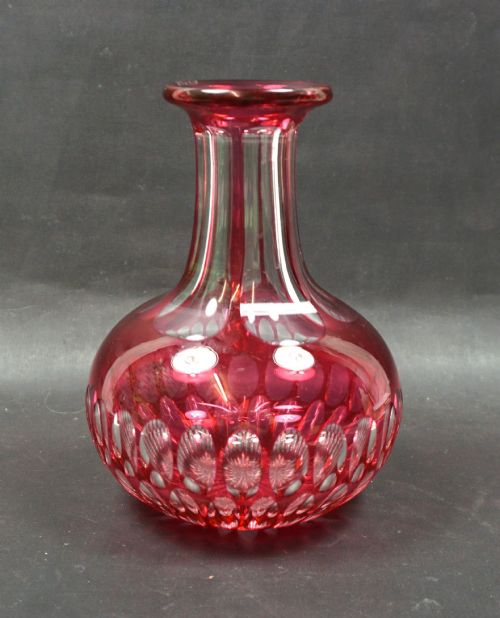
Red cut to clear glass pieces are layered vessels that reveal brilliant clear facets beneath rich coloured surfaces.
Red Cut to Clear
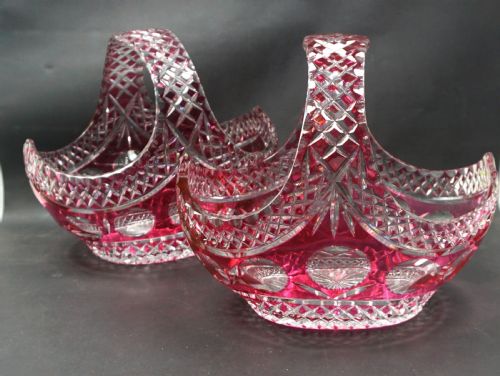
When you search for red cut to clear, you find layered glassware originating from Victorian and twentieth century makers. The pieces on this page include vases, carafes, decanters, bowls, beakers, tumblers, champagne coupes, wine glasses, scent bottles and decorative baskets.
Most items you meet here belong to the Victorian period or date from around eighteen eighty to nineteen thirty. English and Bohemian workshops dominate the selection alongside Belgian production by Val St Lambert.
Forms range from simple engraved tumblers to large panelled ovoid vases and matched pairs of baskets. Cranberry and ruby glass overlay clear lead crystal to create striking contrast through faceted cutting.
Materials and construction
Makers formed these items using a core of clear glass or lead crystal covered by an outer layer of ruby or cranberry glass. Artisans then cut through the coloured exterior on a wheel to expose the transparent crystal beneath.
Decoration often combined deep geometric cutting with fine wheel engraving to depict floral motifs such as convolvulus. Workshops shaped heavy glass into vessels like carafes, goblets and layered scent bottles with fitted tops.
Materials appearing across the inventory include ruby glass, cranberry glass, lead crystal and overlay glass.
Judging quality in layered glass
Quality rests upon the depth of the red colour layer and the precision of the wheel cutting. Superior examples display crisp facet edges and clear separation between the ruby surface and the transparent crystal beneath.
Weight and balance distinguish better pieces, particularly in larger vases, baskets and decanters. Finer items feature detailed hand engraving rather than purely mechanical moulding or shallow surface etching.
Val St Lambert·Charles Graffart
The Red Cut to Clear Glossary
- Overlay glass
- A vessel formed from a base body of clear glass encased in one or more outer layers of coloured glass. This technique allowed artisans to cut away the exterior colour and reveal intricate patterns.
- Ruby glass
- A deep red glass coloured traditionally with gold chloride. It serves as the primary outer layer for many Victorian and Bohemian cut items.
- Cranberry glass
- A lighter pinkish-red glass variant often utilised in nineteenth century tableware and decorative scent bottles. The shade derives from the addition of copper or gold during melting.
- Lead crystal
- A heavy, highly refractive form of glass containing lead oxide. It provides the clear interior body that catches light beneath coloured overlay layers.
- Coupe
- A shallow stemmed glass used for champagne. Examples in this category feature engraved floral decoration cut through ruby surfaces.
Red Cut to Clear: Frequently Asked Questions
What is red cut to clear glass?
These items consist of a clear crystal body covered by a distinct layer of red glass. Artisans cut patterns through the outer layer to expose the transparent material underneath.
Production spans from the nineteenth century Victorian era through to twentieth century European studios, particularly in Bohemia, England and Belgium.
How do I identify Victorian pieces?
Victorian examples often feature rich cranberry or ruby colouring combined with hand engraving such as convolvulus flowers. Look for heavier lead crystal bases and traditional forms like scent bottles and carafes.
Later twentieth century pieces from makers like Val St Lambert often show sharper geometric lines and distinct Art Deco influences.
Were these glasses used daily?
Many items including wine glasses, champagne coupes and tumblers served functional roles at dining tables. Heavier beakers and carafes were built to handle regular service.
Decorative baskets, scent bottles and large vases functioned primarily as display pieces in nineteenth century interiors.
How should I clean red glass?
Wash these vessels by hand using warm water and mild soap to protect the polished surface and engraved details. Avoid sudden temperature changes to prevent stress fractures in the layered material.
Dry them gently with a soft cloth to maintain the clarity of the cut crystal facets.