


Bohemian Red Glassware
These bohemian red glassware pieces bring deep crimson tones and rich gilding to a room, spanning Victorian vases to Art Deco decanter sets.
Bohemian Red Glassware
You are most likely to meet Victorian pieces, particularly ruby glass vases and gilded beakers bearing enamel work, alongside later Art Deco Czech decanter sets and geometric vessels. The forms range from pairs of ganging bells to overlaid ovoid vases and sets of wine glasses.
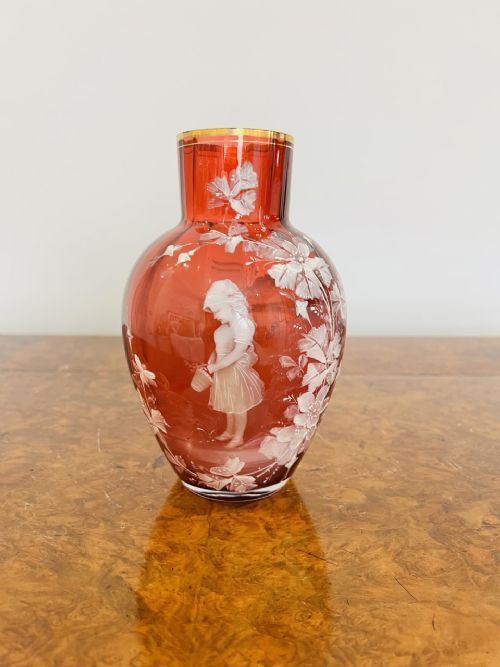
The material identity shifts across the periods, moving from eighteenth-century ruby glass through nineteenth-century cranberry glass and ruby flash glass to twentieth-century opaque glass. Each era brings distinct decorative choices, from Mary Gregory painting to gold leaf highlights.
How they were made
The makers formed these pieces using glass, cut crystal, and ruby glass, frequently applying gold leaf and white enamel for surface decoration. Engraving and hand-painting appear across the Victorian and twentieth-century items, creating layered textures on the red surfaces.
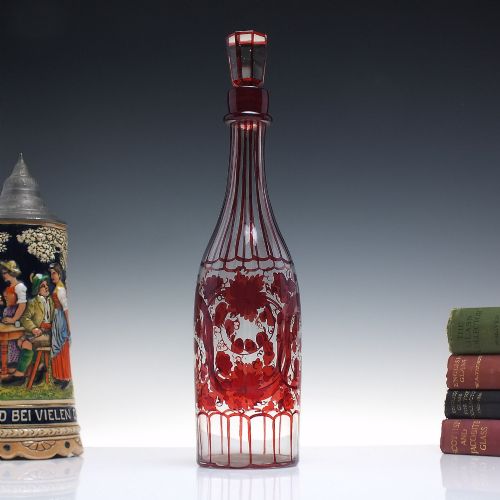
Overlay techniques created contrasting panels on ovoid vases, where clear or white glass beneath the ruby surface was cut away to reveal the design. Gilding and enamel work completed the decoration, fired onto the glass to secure the metallic and coloured details.
Listings span from the 18th century through the Victorian era to 1930, utilising ruby glass, enamel, and gold leaf on vases and decanter sets.
What varies in quality
The depth of the red colour and the precision of the glass cutting separate standard items from finer works. Rich ruby and cranberry tones combined with crisp facet cutting or delicate engraving indicate higher production standards.
The preservation of the gold leaf and enamel detailing heavily influences the character of a piece. Intact hand-painted figures, such as Mary Gregory white enamel scenes, and unrubbed gilding mark the more accomplished examples.
The Bohemian Red Glassware Glossary
- Ruby glass
- A deep red glass coloured with gold chloride during the melting process. It forms the base material for many Victorian and eighteenth-century items.
- Cranberry glass
- A pinkish-red transparent glass popular during the Victorian period. It is often found in vases and jars decorated with white enamel.
- Ruby flash glass
- Colourless glass coated with a thin layer of ruby glass before being cut away to show the clear glass beneath. This technique creates high contrast patterns.
- Mary Gregory glass
- Glass decorated with white enamel silhouettes of children, usually set within natural landscapes. The style became widespread in the Victorian era.
- Ganging bells
- Table bells made of glass, designed to summon servants or signal courses. Pairs of these often feature ruby glass and gilding.
Bohemian Red Glassware: Frequently Asked Questions
What is bohemian red glassware?
It encompasses decorative and functional glass items produced in the Bohemia region, featuring distinct red hues, ruby glass, and cranberry tones. The pieces range from Victorian vases to Art Deco decanter sets.
Craftsmen utilised techniques like engraving, enamelling, and gold leaf gilding to decorate the surfaces, creating items intended for both display and use.
How do I care for antique red glass?
Wash these pieces gently by hand in lukewarm water using a mild detergent. Avoid soaking items with gold leaf or enamel decoration to protect the surface.
Keep them away from direct sunlight and sudden temperature changes to preserve the integrity of the coloured glass and any applied gilding.
How do I tell Victorian pieces apart from Art Deco?
Victorian examples tend to feature rich ruby or cranberry tones, intricate hand-painting, white enamel figures, and heavy gilding. The forms lean towards ornate vases, beakers, and tazzas.
Art Deco items, particularly from twentieth-century Czech production, show geometric lines, opaque glass, and streamlined decanter sets with matching glasses.
Were these pieces used for dining?
Many items served practical dining and entertaining purposes, including decanter sets, wine glasses, tumblers, and serving bottles. Sets of glasses and decanters were standard for serving drinks.
Other forms, such as ganging bells, decorative dishes, and vases, served decorative functions in the nineteenth-century home.