

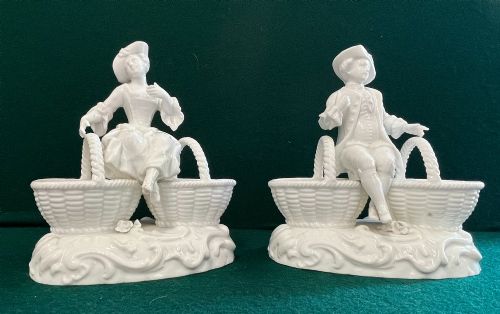
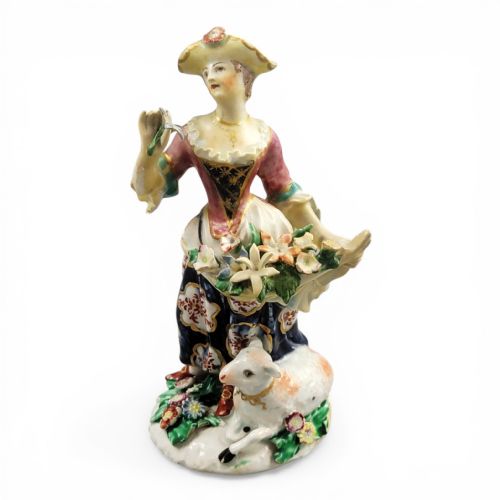


Porcelain Basket Figures
Porcelain basket figures combine modelled ceramic human or animal forms with woven or moulded receptacles, offering a charming focal point for a traditional interior.
Porcelain Basket Figures
Porcelain basket figures depict human characters, putti or animals holding, carrying or standing beside woven receptacles, frequently functioning as sweetmeat dishes, centrepieces or decorative ornaments. The selection spans centuries of European and Chinese ceramic production, ranging from eighteenth-century soft-paste compositions to nineteenth-century hard-paste figures.
You are most likely to encounter nineteenth-century pieces on this page, particularly Victorian examples and creations from continental factories such as Royal Dux, Meissen and Sitzendorf. These often take the form of paired figures holding flowers, fruit or puppies, rendered in styles that draw heavily on Rococo Revival and Victorian tastes.
How they were made
Makers utilised hard-paste and soft-paste porcelain, shaping the clay through press-moulding or slip-casting before applying detailed hand-modelling to delicate elements like flower petals and basket weaves. Enamel paints, glaze and occasional gold leaf or gilt highlights were then applied to the surface before a final kiln firing fixed the colours.
Intricate basket sections often required separate modelling and assembly before firing, alongside applied porcelain flowers known as florrel work. Parian ware pieces relied on unglazed biscuit porcelain to achieve a matt, marble-like finish that highlighted the sculptural contours of the figures.
Porcelain Basket Figures Retail Price Guide 2026
Typical asking prices for porcelain basket figures among the pieces listed under this phrase on Sellingantiques today, from the lower quarter to the upper quarter. They describe what is for sale here now, not the wider market.
Listings feature hard-paste porcelain, parian ware and enamel, spanning the eighteenth to the twentieth centuries.
What varies in quality
The refinement of the hand-painted enamel and the careful placement of gilt or gold leaf also separate ordinary production from finer factory work. Furthermore, the survival of fragile applied details like delicate handles and petals without loss elevates the standing of a piece.
Meissen·Royal Dux·Bow·Vion and Baury·Volkstedt·Royal Worcester·Dehua·Sitzendorf·Samson of Paris·Royal Doulton·Staffordshire·Minton
The Porcelain Basket Figures Glossary
- Sweetmeat dish
- A small ceremonial dish designed for holding confectionery, nuts or sweetmeats, often incorporated into the centre of a figural porcelain grouping.
- Parian ware
- A type of fine biscuit porcelain developed in the nineteenth century, named after Parian marble due to its smooth, unglazed white appearance.
- Florrel
- Applied porcelain flowers and foliage modelled by hand and attached to figures or baskets, typical of eighteenth and nineteenth-century ceramic decoration.
- Hard-paste porcelain
- A durable ceramic composition fired at very high temperatures, made from kaolin and petuntse, commonly used by continental European factories.
- Bisque porcelain
- Unglazed ceramic fired once to vitrify the body, leaving a matt, porous surface that resembles carved marble.
Porcelain Basket Figures: Frequently Asked Questions
What were porcelain basket figures used for?
Many examples served as decorative sweetmeat dishes or centrepieces on formal dining tables during the eighteenth and nineteenth centuries, holding small confectioneries or fruit.
Others were created purely as decorative ornaments or mantel figures, designed to display fine craftsmanship and enliven a parlour or drawing room.
How can I tell eighteenth-century figures apart from later pieces?
Eighteenth-century figures typically utilise soft-paste porcelain with softer glazes and hand-modelled details that show subtle irregularities from the kiln.
Later nineteenth-century and revival pieces often employ hard-paste porcelain with crisper moulding, brighter enamel colours and distinct factory stamps or impressed model numbers.
How do I care for antique porcelain figures?
Keep delicate pieces out of direct sunlight to prevent fading on the hand-painted enamel and gilt surfaces over time.
Dust them very gently with a soft, dry brush, avoiding water or liquid cleaners, especially around fragile applied floral elements and basket handles.