
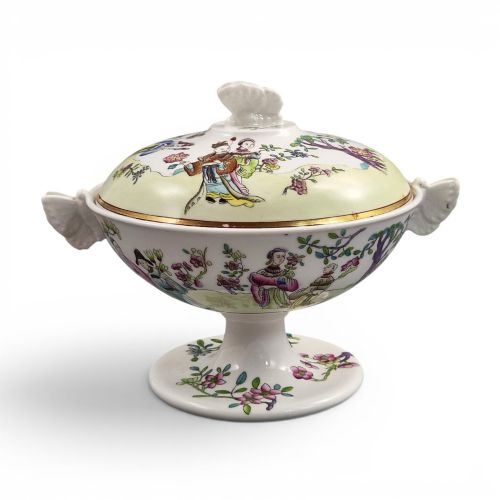


Polychrome Ceramic Tureen
A polychrome ceramic tureen brings bright pattern and robust form to the table, and these pieces offer striking colour through ironstone, enamel, and porcelain.
Polychrome Ceramic Tureen
When you search for a polychrome ceramic tureen, you seek a covered vessel designed for serving soup, sauce, or decorative display on the dining table. The pieces available here span the Georgian, Regency, and Victorian eras, alongside late eighteenth-century Spanish examples.
You will encounter various forms ranging from large soup tureens and sauce tureens to covered pedestal bowls and centrepiece bowls. Most pieces originate from English makers working in ironstone and porcelain, though continental faience also appears.
The decorative schemes rely heavily on coloured enamels, gilt, and gold leaf, often applied in Chinoiserie, Mandarin, or Imari patterns. These vibrant surfaces distinguish the group from plain white wares and demonstrate the era's taste for bold orientalist designs.
Materials and manufacture
Makers utilised durable ironstone ceramic and refined felspar porcelain as the primary bodies for these vessels, providing a sturdy foundation for heavy use. Ironstone offered a resilient alternative to standard earthenware, while porcelain allowed for more delicate pedestal forms.
Surface decoration relies on polychrome enamel painting, often hand-applied over transfer prints, supplemented by gilding and gold leaf accents. Faience examples employ tin-glazed earthenware techniques to achieve their characteristic colourful glaze surfaces.
Listings feature ironstone, felspar porcelain, and faience spanning the eighteenth and nineteenth centuries, finished with enamel, gilding, and gold leaf.
Judging quality and execution
Quality in a polychrome ceramic tureen rests on the crispness of the moulding and the richness of the enamel palette. Finer examples display precise hand-painted details in the Chinoiserie or Mandarin patterns without blurring.
The preservation of the gilding and gold leaf significantly influences the standing of a piece, as does the integrity of the original cover. Weight and thickness in ironstone bodies also indicate the ambition of the original production.
Spode·Mason’s·Coalbrookdale
The Polychrome Ceramic Tureen Glossary
- Ironstone
- A dense, durable ceramic body patented in the nineteenth century to rival true porcelain. It withstands heavy service while taking enamel colours well.
- Felspar porcelain
- A refined ceramic material incorporating felspar into the paste, allowing for thinner walls and a bright white ground. It provides a smooth base for detailed painting.
- Imari
- A decorative scheme employing iron red, cobalt blue, and gold leaf on a ceramic ground. The style derives from Japanese export wares popular during the Regency and Victorian periods.
- Faience
- Tin-glazed earthenware produced in continental Europe. It offers an opaque white surface suitable for painted polychrome decoration before firing.
Polychrome Ceramic Tureen: Frequently Asked Questions
What is a polychrome ceramic tureen used for?
These vessels served at the dining table for holding soups, sauces, or larger prepared dishes during formal meals.
Today, they function effectively as decorative centrepieces or serving pieces in a traditional or eclectic interior.
How do I date a nineteenth-century ironstone tureen?
Dating relies on maker marks, pattern names, and stylistic shifts between Regency neo-classical lines and later Victorian ornamentation.
Ironstone bodies became widespread in the early nineteenth century, with specific patterns recorded between approximately eighteen hundred and eighteen eighty.
What does Chinoiserie pattern mean on these tureens?
Chinoiserie denotes European interpretations of Chinese design motifs, featuring figures, pagodas, and exotic foliage in bright enamel colours.
This style was particularly favoured by English ironstone makers during the Regency period to add vibrant visual interest to functional tableware.
Can I use an antique tureen for serving food?
While structurally sound, antique ironstone and porcelain may have crazed glazes or delicate gilding that requires careful hand washing.
Many collectors prefer to display them as decorative objects rather than subjecting them to modern dining use.