
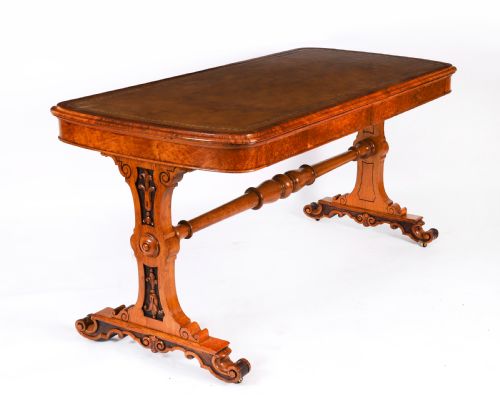


Pollard Oak Desk
A pollard oak desk brings together rich, knotted timber figures and practical writing forms from the Regency and Victorian periods.
Pollard Oak Desk
When you search for a pollard oak desk, you encounter substantial writing furniture spanning the Regency, William IV, and Victorian eras. These pieces range from compact Davenport desks and slope forms to grand partners desks designed for central placement in a room.
Makers often utilised the striking grain of pollard and burr oak for primary writing surfaces and drawer fronts. Writing tables, pedestal desks, and secretaire bookcases complete the primary forms found within this category.
Materials and Construction
Cabinet makers selected pollard oak and burr oak timbers for their distinctive knotted growth patterns, frequently pairing the figured veneers with solid oak carcases. Brass mounts, leather writing inserts, and occasionally glass elements provided functional contrast to the dark timber.
Joinery techniques from the nineteenth century ensured stability across large pedestals and partners desks. Skilled craftsmen matched veneer panels symmetrically to emphasise the natural movement of the wood.
Pollard Oak Desk Retail Price Guide 2026
Typical asking prices for pollard oak desk among the pieces listed under this phrase on Sellingantiques today, from the lower quarter to the upper quarter. They describe what is for sale here now, not the wider market.
Listings feature pollard oak across diverse forms including bracket clocks, centre tables, dining chairs, and Davenport desks.
Assessing Craftsmanship
Quality rests upon the selection and matching of the pollard oak veneer across major surfaces. Superior examples display dense, evenly distributed burr patterns without awkward interruption.
The sophistication of internal drawer construction and the integration of original brass hardware distinguish finer workshops from standard production. Cabinetwork attributed to notable makers demonstrates superior structural precision.
James Winter and Sons·Williams and Gibton·Thomas Turner·Whytock and Reid·James Shoolbred·Maple and Co
The Pollard Oak Desk Glossary
- Pollard oak
- Timber harvested from trees that were cut back close to the trunk to encourage dense, highly figured branch growth. This process produces distinctive clusters of small knots.
- Partners desk
- A large double-sided pedestal desk designed to accommodate two people sitting opposite one another. These pieces typically feature drawers and cupboards on both faces.
- Davenport desk
- A compact writing desk featuring a sloped, hinged writing surface above a bank of drawers accessed from the side. They emerged during the late eighteenth century and remained popular through the Victorian era.
- Secretaire
- A cabinet or chest incorporating a pull-down or drop-front writing drawer that conceals smaller compartments and pigeonholes. It combines storage with a dedicated writing space.
- Burr oak
- A woody outgrowth on an oak tree yielding highly gnarled veneer with swirling grain patterns. It is frequently utilised alongside pollard oak on high-status nineteenth century furniture.
Pollard Oak Desk: Frequently Asked Questions
What periods do these desks date from?
The majority of pieces date from the nineteenth century, encompassing the Regency, William IV, and Victorian eras. Earlier examples from the George III period also appear occasionally.
Stylistic cues such as turned legs, brass gallery rails, and pedestal proportions help determine the specific decade of manufacture.
How do partners desks differ from standard desks?
Partners desks provide workspace on both sides, featuring duplicate drawers and cupboards facing outward in opposite directions. They were originally built for banking and legal environments.
Standard pedestal desks place drawers against a single front with a finished back panel designed to sit against a wall.
How should I care for pollard oak timber?
Maintain stable indoor humidity levels and keep wooden surfaces away from direct heat sources to prevent timber movement. Regular dusting with a dry cloth preserves the polished finish.
Condition leather writing inserts periodically with appropriate balms while avoiding harsh chemical cleaners on the oak veneer.
What distinguishes pollard oak from standard oak?
Pollard oak derives from the pollarding method of tree management, which creates tightly clustered knot formations and dynamic visual movement across the grain. Standard oak displays straight, uniform growth rings.
Cabinet makers reserved pollard oak veneers for decorative exterior surfaces due to their striking visual depth.