


Pierced Splat Corner Chair
Pierced splat corner chairs are characterful seating designs engineered to fit snugly into room angles, prized by collectors for their clever spatial economy and sculptural joinery.
What these pieces are
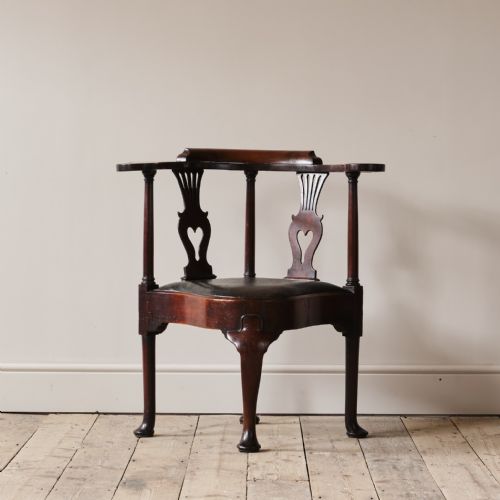
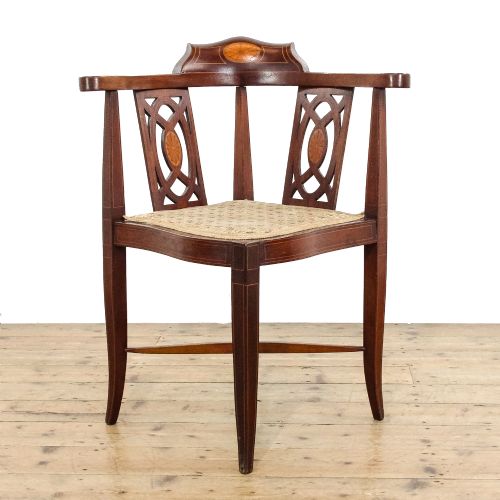
A pierced splat corner chair offers a unique seating silhouette designed specifically to occupy the junction of two walls. The configuration relies on a diagonal footprint, placing one leg forward and supporting a curved backrail that sweeps around the perimeter. Examples on this page span the eighteenth century and the Edwardian era, showing both formal mahogany drawing-room seating and vernacular country furniture.
The form typically incorporates a pierced splat within the back framing, providing both structural support and ornamental refinement. You will encounter refined George II mahogany editions alongside robust Georgian North Country oak and later Edwardian variations upholstered in fabric or leather. Each piece demonstrates how cabinetmakers adapted standard armchair comfort into an angular format.
How they were made
Construction relies heavily on dense timbers such as mahogany, oak, and satinwood, chosen for their ability to hold intricate joints under load. Cabinetmakers utilised sturdy mortise and tenon joinery to link the sweeping arms and backrails to the central corner post. Upholstered variants integrate drop-in or fixed pads covered in fabric or leather, secured directly over the seat frame.
The defining ornamental feature, the pierced splat, required meticulous hand-sawing and carving to achieve openwork patterns within the vertical backrest. Artisans shaped the surrounding wood using hand planes and gouges to create smooth curves along the crest rail and arm supports.
Retail Price Guide 2026
Typical UK retail prices for pierced splat corner chair, calculated from the Sellingantiques database of over a million retail prices indexed since 2003. This retail price guide relies exclusively on Sellingantiques data; no external sources or auction records are used, so the figures do not describe the wider market.
Listings span the eighteenth century, including specific dates around seventeen-fifty, alongside Edwardian revivals in mahogany, oak, and satinwood.
What varies in quality
Quality in a pierced splat corner chair rests upon the crispness of the carving and the integrity of the timber selection. Finer pieces display deeply figured mahogany with precise fretwork in the splats, whereas utilitarian country examples use plainer oak with simpler profiles.
The rigidity of the frame construction dictates longevity, particularly at the vulnerable corner joints where multiple rails converge. Superior workshop output maintains tight, flush joints without excessive secondary reinforcement, preserving the intended lightness of the silhouette.
The Pierced Splat Corner Chair Glossary
- Crest rail
- The top horizontal framing member of the chair back. It often follows a curved contour to accommodate the corner orientation.
- Mortise and tenon
- A traditional woodworking joint where a protruding tongue fits tightly into a matching cavity. This method provides the primary structural strength for the frame.
- Drop-in seat
- A removable wooden frame padded and covered in fabric or leather that rests upon a ledge inside the seat rails. This design facilitated easy reupholstery.
Frequently Asked Questions
Where do you put a corner chair?
These chairs are specifically proportioned to slot into the dead space of a room junction. They work effectively in studies, hallways, or bedrooms where standard rectangular seating obstructs pathways.
Because the diagonal design presents an engaging profile from every angle, placing one outward in a corner draws the eye without cluttering floor space.
Are corner chairs comfortable to sit in?
The seating experience differs from a standard armchair due to the enclosing semicircular backrest and the angled leg placement. They function well for brief reading or writing tasks.
Upholstered variants provide softer padding, while wooden saddle seats offer firmer support characteristic of eighteenth-century seating.
How do I date a corner chair?
Dating relies on examining the timber species, secondary woods, and stylistic motifs. Eighteenth-century versions often feature rich mahogany with finely pierced splats, whereas Edwardian reproductions show later manufacturing techniques.
Tool marks and the method of joint construction also reveal the period of origin when surface finishes have been renewed.
What is the difference between George II and Edwardian versions?
George II pieces date from the mid-eighteenth century and utilise dense, patinated timbers with hand-carved details suited to formal interiors. They represent the original period of invention for the form.
Edwardian interpretations date from around nineteen hundred and often revive earlier Georgian aesthetics using slightly lighter construction methods and machine assistance.