



Persian Rug Panel
When you search for a persian rug panel, you are looking at fragments and woven textile faces drawn from nomadic and village workshops.
Persian Rug Panel
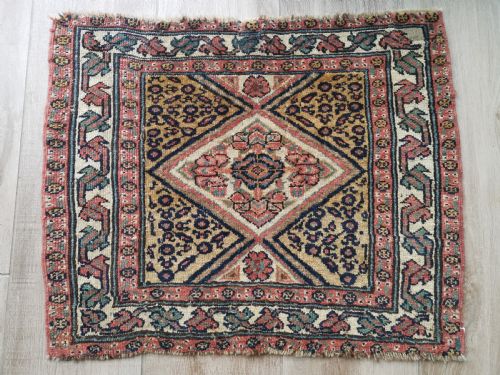
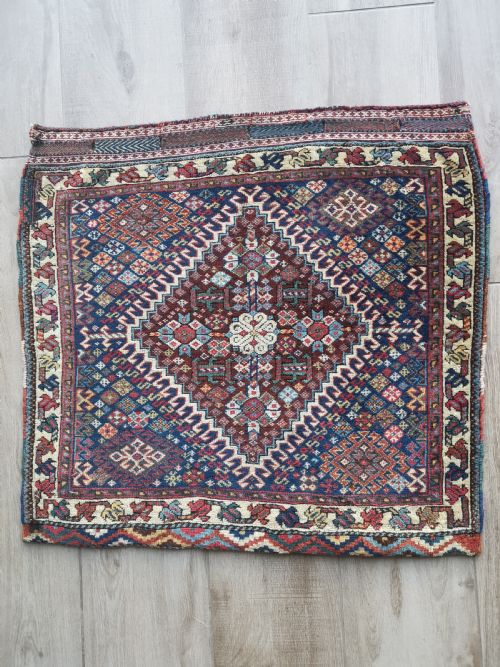
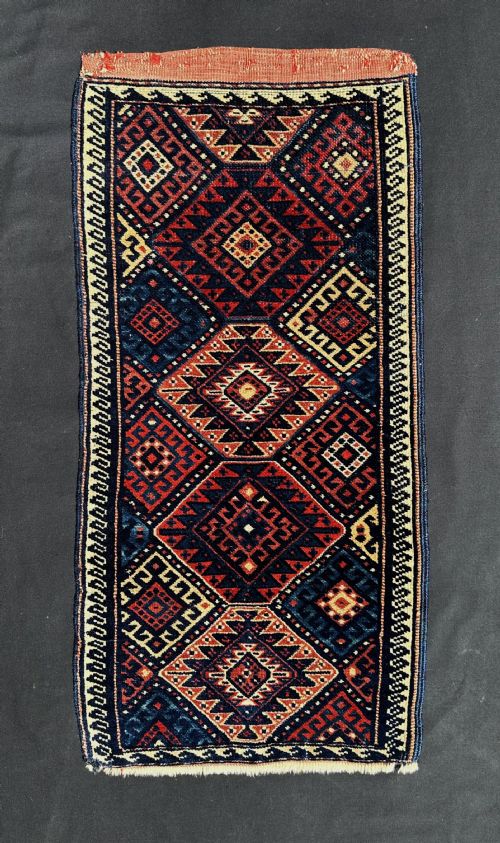
A persian rug panel encompasses repurposed bag faces, saddle-bags, embroidery fragments, and flatweaves originating from nineteenth and early twentieth-century nomadic and village traditions. These items represent sections of larger utilitarian objects, such as storage sacks or cradles, that have been mounted or preserved as independent textiles.
The most common examples on this page are tribal bag faces and pictorial embroideries from regional groups like the Shahsavan, Qashqai, and Bakhtiari. Collectors encounter these works as compact windows into specific tribal designs and weaving structures.
Materials and Techniques
Makers utilised hand-spun wool, cotton, and silk foundations, often incorporating natural dyes to achieve rich colour palettes across the surface. Flatweave soumak technique and intricate appliqué work on wool felt grounds appear frequently in the construction of these panels.
Embroidery utilises fine silk threads stitched onto wool felt backgrounds, while structural weaves employ traditional warps and wefts to create durable tribal textiles. These methods ensure that even fragmentary sections retain structural integrity and textural depth.
Listings feature textiles spanning from the mid-nineteenth century through to the 1940s.
Evaluating Quality
Quality rests upon the fineness of the knotting or stitch density, the clarity and complexity of the tribal motifs, and the depth of the natural dye palette. Pieces featuring balanced proportions and well-executed figurative or geometric designs stand apart from simpler variations.
The condition of the wool or silk surface, the preservation of original selvedges or borders, and the complexity of techniques like soumak wrapping or appliqué dictate the standing of an individual panel within the wider range.
The Persian Rug Panel Glossary
- Bagface
- The decorative front of a utilitarian storage sack produced by nomadic tribes for domestic use. These faces are frequently removed and preserved independently.
- Soumak
- A flatweave technique utilising supplementary weft wrapping to create a textured, durable surface with a braided appearance on the face.
- Applé
- A decorative technique where pieces of fabric, such as silk, are sewn onto a larger background material like wool felt to form patterns.
- Jajim
- A type of flatwoven textile traditionally used as a cover or bedding band, characterised by colourful striped patterns.
- Khorjin
- The Persian term for a double saddle-bag utilised by nomadic groups for transport and storage during migration.
Persian Rug Panel: Frequently Asked Questions
What is a persian rug panel?
A persian rug panel is a textile fragment, often a repurposed bag face or embroidery, taken from a larger nomadic or village piece.
These sections preserve traditional tribal patterns and techniques for decorative display.
How were these panels used originally?
Nomadic tribes utilised them as functional storage sacks, saddle-bags, or animal trappings during daily migration and camp life.
Over time, worn or unused portions were separated and preserved as distinct textile art.
How do I display a panel at home?
Many collectors choose to mount and frame these textiles to protect the delicate wool, silk, and felt structures from physical wear.
Alternatively, smaller flatweaves can be placed on flat surfaces or handled with appropriate conservation mounting.
How can I tell different tribal designs apart?
Tribal designs depend on specific regional motifs, such as the geometric patterns of Shahsavan soumak work or the floral medallions of Bakhtiari panels.
Palettes and weaving structures often point directly to the specific province or confederation of origin.