
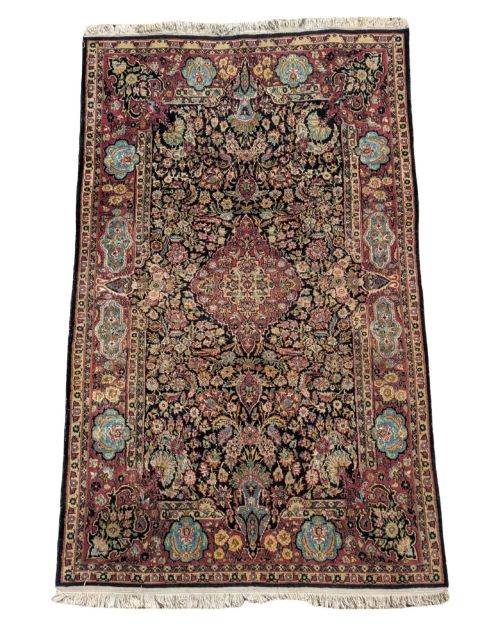
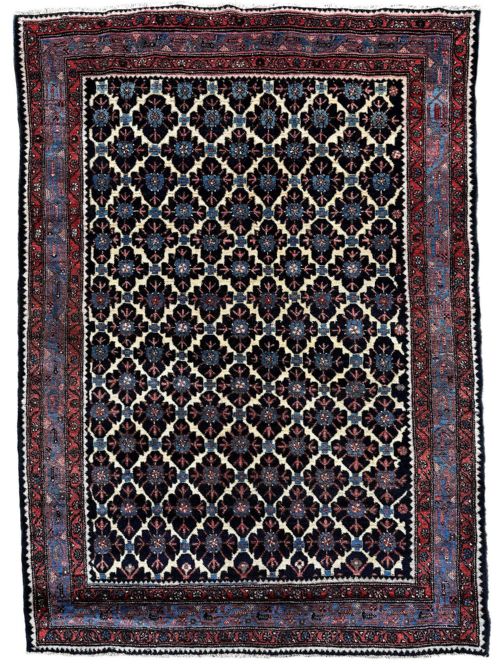


Patterned Wool Accent Rug
These patterned wool accent rug pieces bring traditional Persian, tribal, and Ottoman designs into smaller spaces with rich wool and cotton textures.
Patterned Wool Accent Rug
A patterned wool accent rug brings regional warmth and distinct historical design into smaller spaces. When searching for a patterned wool accent rug, buyers encounter room-sized carpets, smaller scatter rugs, prayer rugs, and textile cushions dating from the mid-nineteenth century through to the 1930s. The selection spans Persian workshops, Caucasian weaving traditions, Ottoman regions, and Bessarabian or Moldavian styles.
The pieces on this page lean heavily toward authentic hand-knotted and flatwoven formats originating from Hamadan, Senneh, Malayer, Ferahan, Heriz, and Kula Oushak. Alongside traditional floor rugs, inventive pieces such as carpet cushions repurpose older woven fragments for domestic seating. Buyers are most likely to meet classic room accents measuring under two metres in length, executed in rich wool pile or flatweave structures.
What varies in quality
Quality in these textiles rests upon the precision of the weave and the complexity of the design layout. Finer knots per square inch and crisp delineation of motifs distinguish master workshop productions from simpler provincial or tribal pieces.
The condition of the wool pile, the vibrancy of the remaining colour palette, and the intactness of the original borders and foundations determine the standing of each individual piece.
Listings feature pieces from the 1850s to the 1930s, constructed in wool, cotton, and silk across Persian, tribal, and Ottoman styles.
The Patterned Wool Accent Rug Glossary
- Kilim
- A flatwoven carpet or rug produced without a pile, common in traditional Anatolian, Caucasian, and Eastern European workshops. These textiles utilise warp-faced weaving techniques to create sharp geometric patterns.
- Prayer rug
- A small rug featuring a mihrab or niche design used historically for ritual prayer. Regional variations from the Caucasus and Anatolia display distinctive architectural arches and symbolic motifs.
- Pile
- The raised surface of a rug formed by the vertical cut ends of knot threads. Wool forms the primary material for this dense upper layer in traditional carpets.
- Foundation
- The underlying grid of warp and weft threads that supports the decorative pile of a rug. Cotton typically serves as the stable base material in many Persian and Caucasian pieces.
- Selvedge
- The reinforced side edges of a rug formed by wrapping the outermost warp threads. Secure finishing prevents fraying along the lateral margins of the textile.
Patterned Wool Accent Rug: Frequently Asked Questions
Where should I place an accent rug?
These smaller rugs suit compact areas such as hallways, bedside spaces, and reading corners where full room-sized carpets overwhelm the floor plan. They anchor furniture groupings and add concentrated warmth to wooden or tiled flooring.
Because dimensions vary, measure your intended space carefully before selecting a piece. Ensure doors can swing freely over the pile height of the chosen textile.
How do I care for antique wool rugs?
Gentle vacuuming without a rotating brush roll prevents dust accumulation within the wool pile. Protect the textile from prolonged direct sunlight to preserve natural dye colours.
Professional cleaning tailored to antique hand-knotted rugs remains essential for deep maintenance. Avoid harsh chemical spot treatments that might compromise the wool and cotton fibres.
What is the difference between a kilim and a piled rug?
Kilims are flatwoven without any raised pile, resulting in a lighter, thinner textile that functions well as a floor covering or wall hanging. Piled rugs feature vertical knotting that creates a dense, plush surface.
Both styles utilise wool and sometimes cotton foundations, but their tactile qualities and structural techniques differ entirely.
How can I identify regional carpet designs?
Regional styles reveal themselves through specific motif vocabularies, colour palettes, and weaving structures. For instance, Heriz rugs often feature bold geometric medallions, while Kula Oushak pieces display distinct prayer arches and soft tones.
Examining the weave density and foundation materials further clarifies the geographical origin of each textile.