




Pastoral Porcelain Statues
Pastoral porcelain statues bring rural romance indoors, capturing shepherds, milkmaids and musicians in delicate ceramic form.
Pastoral Porcelain Statues
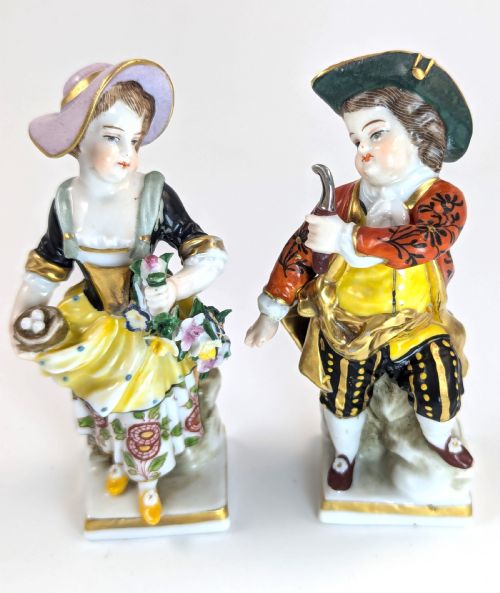
When you search for pastoral porcelain statues, you enter a world of idealised countryside figures modelled across the eighteenth, nineteenth and early twentieth centuries. These decorative objects depict shepherds, shepherdesses, musicians, gardeners and farmers in romanticised rural settings. You are most likely to encounter nineteenth-century Continental interpretations, including French and German works styled after earlier models.
The forms range from single standing figurines to large sculptural groups with sheep, cows and baskets of fruit. Many examples draw inspiration from eighteenth-century manufactories like Derby and Chelsea, reimagined later by makers such as Samson, Vion et Baury and Carl Thieme. These pieces served as parlour ornaments for Georgian and Victorian homes wishing to display a taste for pastoral charm.
The materials span soft-paste and hard-paste porcelain, alongside unglazed bisque porcelain and blanc-de-chine finishes. Styles shift from the curves of Rococo Revival to the heavier modelling of the Victorian era and the clean lines of later works. Surviving figures often appear in pairs, balancing male and female rural archetypes across a mantelpiece or side table.
Materials and methods
Makers utilised press-moulding and slip-casting techniques to form the complex shapes of human figures, animals and natural bases. Skilled artisans then hand-modelled intricate additions such as foliage, flower garlands and wool textures before high-temperature firing in kilns. Enamels and gilding were applied in subsequent lower-temperature firings to fix the vibrant colours.
Listings feature hard-paste porcelain, bisque porcelain and soft-paste porcelain, spanning eighteenth-century Georgian origins to twentieth-century German workshops.
Distinguishing quality
The quality of a pastoral figure rests primarily upon the crispness of the modelling and the sensitivity of the hand-painting. Superior pieces display finely rendered facial expressions, distinct fingers, delicate lace work and meticulously painted floral details rather than flat, heavy brushwork. The integration of the figures with their natural bases demonstrates the sculptor's skill in creating a balanced composition.
Heavier, robustly fired bodies and cleanly finished undersides indicate careful manufacturing standards in larger Victorian and Continental workshops. Lesser examples exhibit murky enamel colours, obscured mould details and clumsy additions of applied leaves or flowers. The prestige of the original factory or the fidelity of a revival piece to its eighteenth-century inspiration also elevates the standing of a statue.
Derby porcelain·Samson Paris·Vion et Baury·Carl Thieme Dresden·Royal Dux·Sitzendorf
The Pastoral Porcelain Statues Glossary
- Bisque porcelain
- Un-glazed white ceramic that has been fired once, offering a matte finish resembling marble. This material highlights the fine sculptural details of the figures without the distraction of glossy glazes.
- Soft-paste porcelain
- An artificial porcelain composition fired at lower temperatures than hard-paste, used extensively in early European manufactories. It possesses a warm, slightly creamy body that absorbs enamel colours with a soft depth.
- Hard-paste porcelain
- A true porcelain made from kaolin and petuntse fired at high temperatures, producing a durable, vitreous body. This material resists scratching and forms the basis of most nineteenth-century Continental figures.
- Blanc-de-chine
- A French term for white Chinese porcelain, adopted in Europe to describe white glazed figures without enamel decoration. It relies entirely on the purity of the white glaze and the quality of the sculptural form.
- Gilt
- A thin layer of gold applied to the porcelain surface as decoration, often highlighting garment edges and scrollwork bases. This metallic embellishment adds a rich contrast to painted enamels and white porcelain bodies.
Pastoral Porcelain Statues: Frequently Asked Questions
How do I identify a reproduction?
Look closely at the modelling crispness, paint application and base marks to understand whether a piece is an eighteenth-century original or a nineteenth-century revival.
Revival pieces, such as those made by Samson, often bear imitation marks or distinct paste characteristics that reveal their later nineteenth-century French or German origins.
How should I clean my figures?
Dust these delicate ceramic pieces gently with a soft, dry brush to prevent the accumulation of dirt within the intricate folds and applied floral elements.
Avoid using water or chemical cleaners, especially on unglazed bisque surfaces and delicate enamel or gilt decorations, which can easily suffer damage.
Why are many figures found in pairs?
Makers frequently produced male and female rural counterparts, such as a shepherd and shepherdess or a boy and milkmaid, to create balanced decorative arrangements.
Displaying them together on a mantelpiece or table reflected the classical desire for symmetry in interior decoration.