
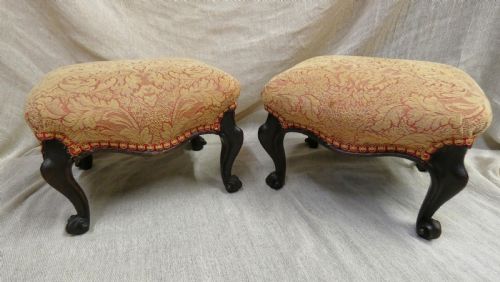

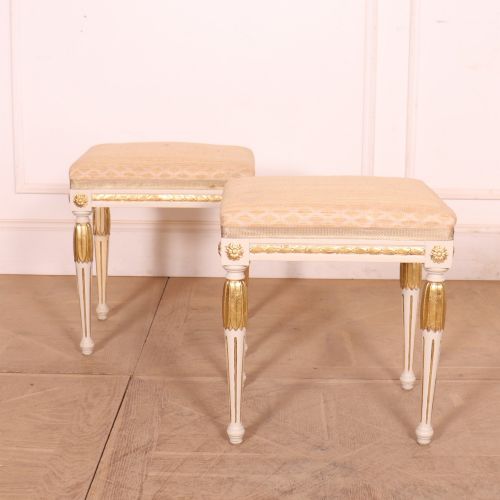
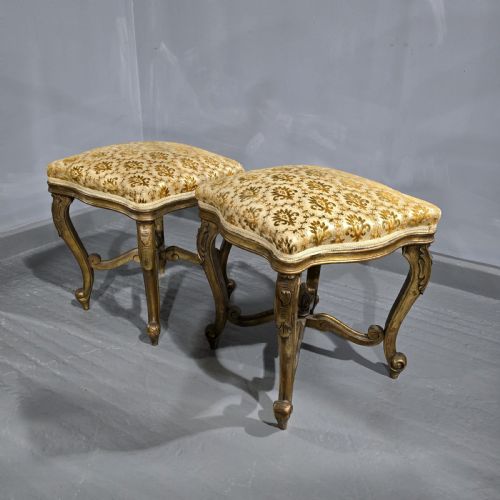

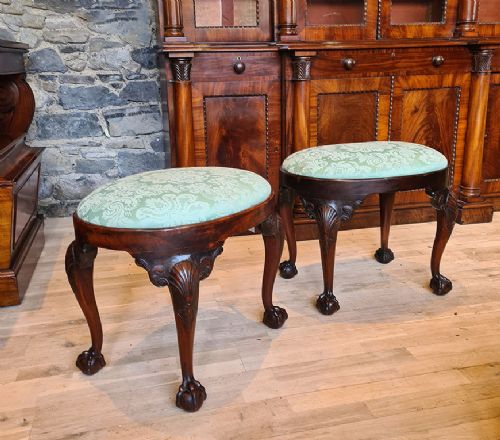


Pair Upholstered Footstools
These pair upholstered footstools bring twin proportions and textile warmth to a room, offering functional elegance rooted in centuries of craftsmanship.
Pair Upholstered Footstools
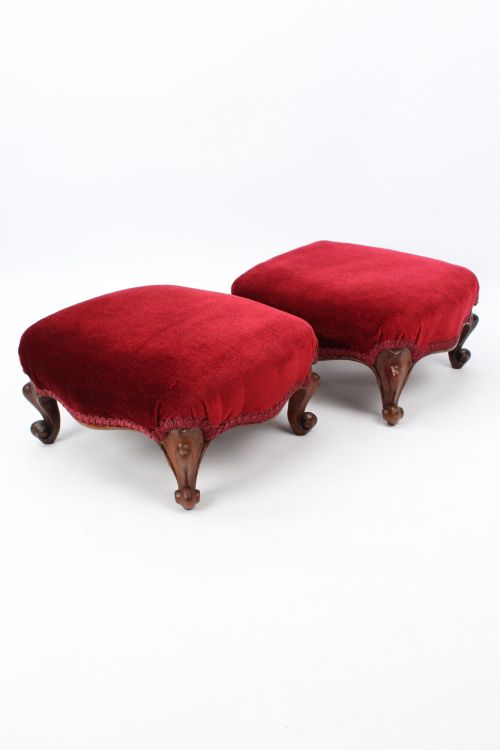
When you search for pair upholstered footstools, you encounter matched sets designed for dual comfort, matching furniture arrangements, or balanced interior schemes. The examples available range from compact nineteenth-century Victorian walnut models to eighteenth-century Swedish Gustavian pieces.
The inventory encompasses various forms, including circular footstools, long library window seats, and architectural "X" framed stools. You will frequently meet Victorian mahogany variants alongside continental revival styles.
Origins span British workshops, French salons, and Swedish homes, reflecting diverse regional tastes in seating design. These objects combine wooden frames with varied textile coverings to serve both domestic utility and decorative balance.
What varies in quality
The refinement of timber carving and the integrity of the frame construction distinguish different tiers of craftsmanship. Finer pieces display crisp hand-carving on mahogany or walnut, whilst simpler versions rely on plain turned legs.
The selection and preservation of the textile covering significantly influence the overall character of a pair. Original needlework, quality leather, or period silk upholstery elevates the integrity of an antique stool above later replacements.
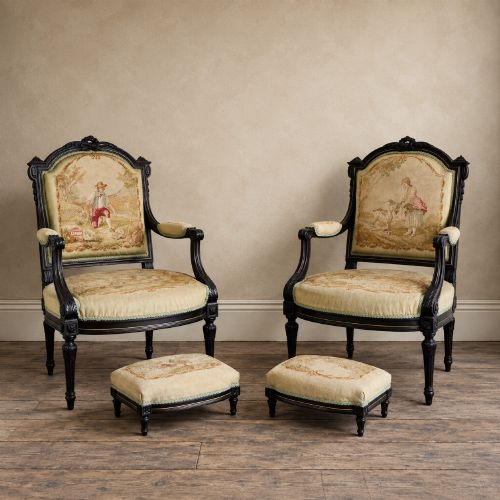
Object forms span standard footstools, ottoman stools, armchairs with matching stools, and long window seats.
James Shoolbred
The Pair Upholstered Footstools Glossary
- Gustavian
- A Swedish neoclassical style characterised by light painted finishes and restrained classical proportions. It developed under the influence of King Gustav III in the eighteenth century.
- Giltwood
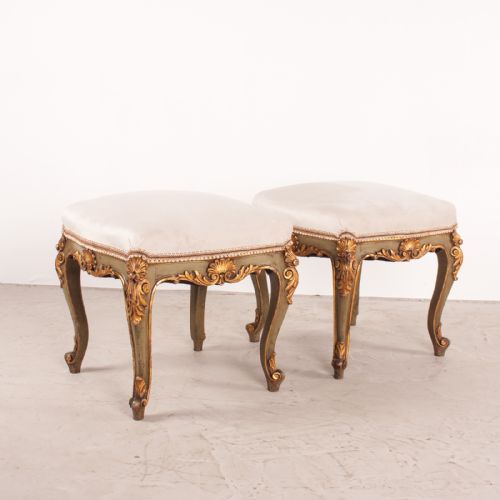
- Timber treated with gold leaf or gold paint to create a lustrous metallic surface. This finish appears frequently on French revival and continental frames.
- Cabriole leg
- A furniture leg that curves outward and then tapers inward, mimicking an animal's limb. It is common on eighteenth and nineteenth-century revival stools.
- Petit point
- A needlepoint stitch worked on canvas, allowing for fine pictorial detail. It is often seen on nineteenth-century tapestry upholstered footstools.
- Tunbridge inlay
- A form of mosaic woodwork using tiny wood blocks to create geometric or pictorial patterns. This technique appears on Victorian mahogany stool tops.
Pair Upholstered Footstools: Frequently Asked Questions
How were pair upholstered footstools originally used?
These stools served primarily to support the feet while sitting in armchairs or by the fireplace in nineteenth-century drawing rooms. Long variants functioned additionally as window seats or end-of-bed furnishings.
Matched pairs allowed for symmetrical placement within formal reception rooms, often flanking a fireplace or aligning with larger library armchairs.
How do I distinguish Victorian from Regency examples?
Regency pieces often display classical architectural influences, such as the distinctive "X" frame construction derived from ancient Roman curule seats. Tuned mahogany and restrained decorative lines typically characterise this earlier period.
Victorian variants frequently incorporate heavier proportions, buttoned upholstery, and cabriole legs with more exuberant carved detailing. Walnut and rosewood became especially popular woods during the later Victorian decades.
Are these stools suitable for daily modern use?
Solid timber frames and traditional joinery make these pieces structurally robust for contemporary domestic environments. Their compact proportions allow them to fit easily beside modern sofas or chairs.
Consider the condition of the internal webbing and padding when planning regular use, as nineteenth-century upholstery may require careful preservation or reupholstery.
What defines Swedish Gustavian footstools?
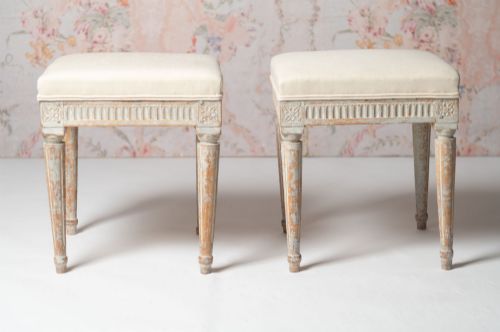
Swedish Gustavian stools are distinguished by pale painted wooden surfaces, often in shades of grey, white, or cream. Their design reflects a Scandinavian interpretation of French neoclassical forms.
Hand-carved fluting and restrained floral motifs frequently adorn the frames, creating a lighter visual presence than heavier Victorian mahogany equivalents.