
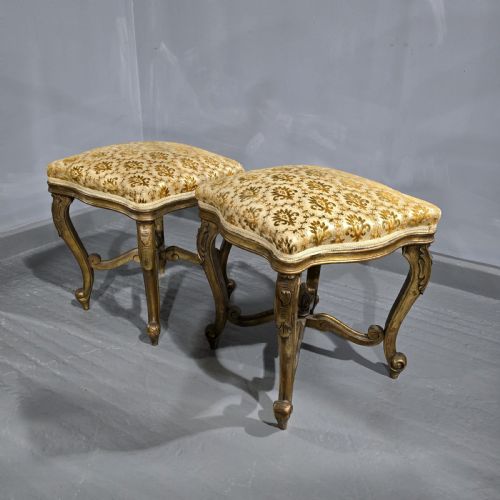
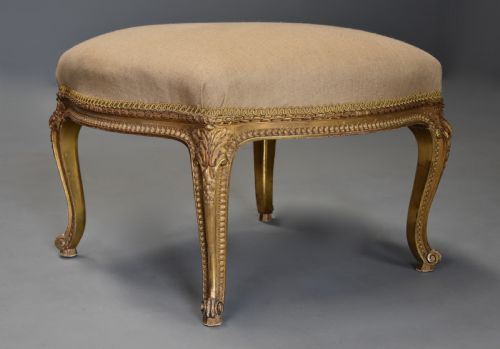


Gold French Footstool
These gold french footstool selections bring ornate French revival design and rich gilding into the room.
Gold French Footstool
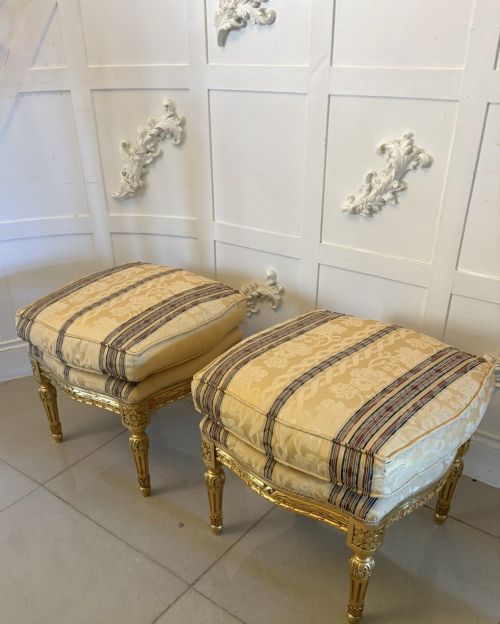
A gold french footstool encompasses heavily carved wooden frames finished in gilt, often upholstered in textile, velvet, or silk. These pieces typically take the form of low stools, ottomans, or boudoir seats designed to complement period seating.
The selections span the nineteenth century alongside early twentieth-century revivals, drawing heavily on Louis XV, Louis XVI, and Baroque design idioms. Makers ranged from Paris workshops to British cabinetmakers producing continental interpretations.
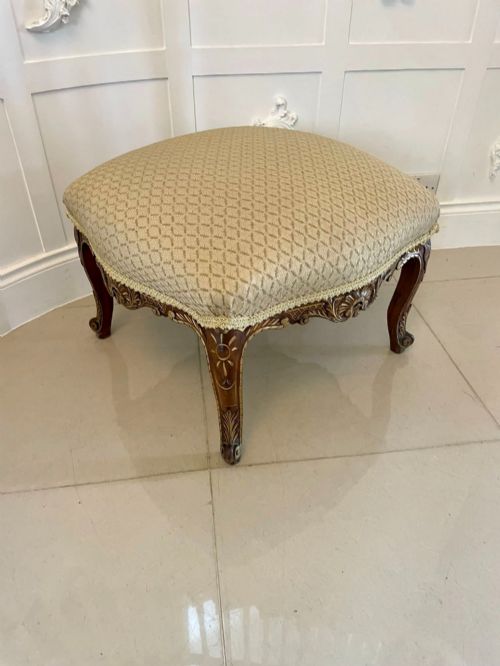
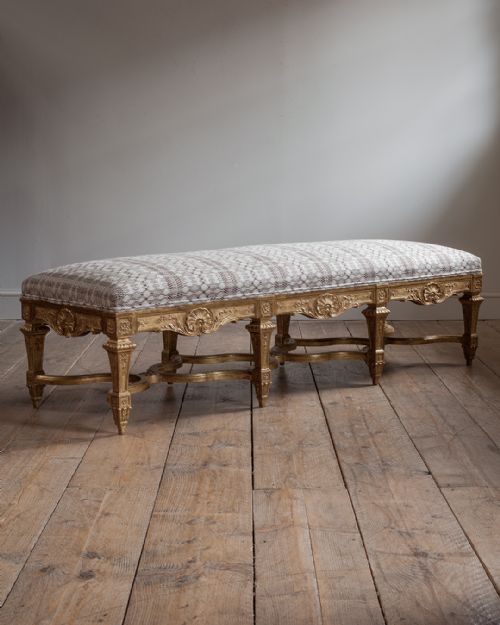
Buyers encountering this search phrase will find everything from modest circular boudoir seats to large carved giltwood centre stools and matched pairs. Walnut and timber provide the structural foundation underneath the heavy gilding and upholstery.
Materials and Construction
Frames are constructed from solid timber, predominantly walnut and carved wood, providing the structural integrity required for ornate forms. Artisans shaped these timbers with deep relief carving before applying the surface finishes.
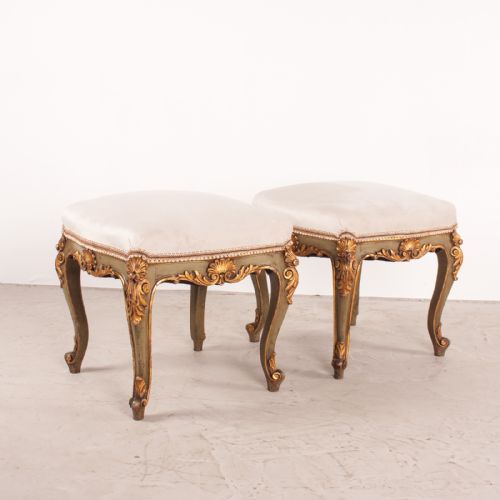
Giltwood, paint, and parcel gilding create the characteristic metallic sheen across the woodwork, reflecting the decorative tastes of the nineteenth century. Upholstery materials including silk, velvet, and various textiles are secured over padding to complete the seat.
A rocking gilt gout stool from the late nineteenth century proves that even Victorian feet deserved a gentle sway.
Assessing Quality and Craftsmanship
The depth and crispness of the hand carving separate standard commercial seating from exemplary workshop output. Finer examples display intricate foliage, scrolls, and mouldings that remain sharp beneath the gilt layers.
The application of gold leaf or gilding dictates the visual richness of the surface over time. Superior pieces exhibit expert preparation of the wooden ground, allowing the metallic finish to age gracefully without flaking.
LOIDRAULT FRERES PARIS·A.M.E. Fournier
The Gold French Footstool Glossary
- Giltwood
- Timber that has been coated with gold leaf or a gold-coloured metallic finish. This technique was widely utilised across nineteenth-century seating to project opulence.
- Parcel gilt
- A decorative treatment where only specific portions of the wood frame are highlighted with gold leaf while the rest remains painted or exposed. It creates a striking contrast on revival furniture.
- Rococo Revival
- A nineteenth-century design movement mimicking the asymmetrical scrolls, shell motifs, and natural curves of the eighteenth-century French style. Stools from this era feature exuberant carved wooden frames.
- Curule stool
- An ancient Roman magistrate form of stool featuring crossed legs, reinterpreted in nineteenth-century design. These pieces offer a distinct architectural silhouette compared to standard four-legged footstools.
- Centre stool
- A larger freestanding stool finished on all sides for placement in the middle of a room rather than against a wall. They often match large armchairs or serve as principal decorative seating.
Gold French Footstool: Frequently Asked Questions
What periods do these footstools come from?
The available pieces originate primarily from the nineteenth century, including specific decades like the eighteen-sixties, seventies, and eighties, alongside Victorian and Regency periods.
Later examples extend into early twentieth-century revivals, capturing classic French styles across various decades of production.
How were these stools used historically?
These pieces served as functional footrests alongside large armchairs or as standalone decorative boudoir seats in formal reception rooms. Their ornate gilt frames were designed to display wealth and complement lavish interior schemes.
Larger centre stools also functioned as flexible seating options in drawing rooms and dressing spaces.
What fabrics cover these footstools?
Upholstery materials recorded in the listings include traditional velvet, silk, and general textiles. Red silk deep buttoning appears alongside standard fabric covers.
Many pieces retain or have been updated with upholstery that reflects period revival aesthetics.
How do I identify a Louis XVI style stool?
Louis XVI style stools typically display straighter structural lines, neoclassical motifs, and painted or gilded wooden frames. They contrast with the more sinuous, curved outlines found in Rococo revival pieces.
Circular boudoir seats and tailored frames often carry these neoclassical design characteristics.