

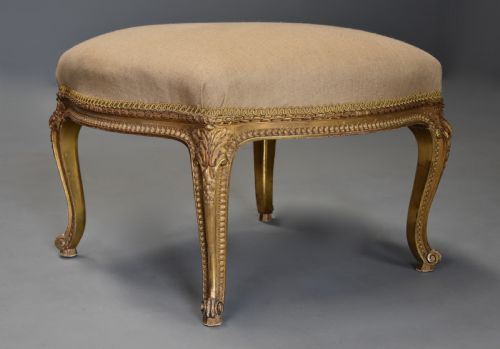


French Giltwood Stool
A French giltwood stool brings architectural carving and gilded warmth into a room, offering a seat that doubles as decorative sculpture.
French Giltwood Stool
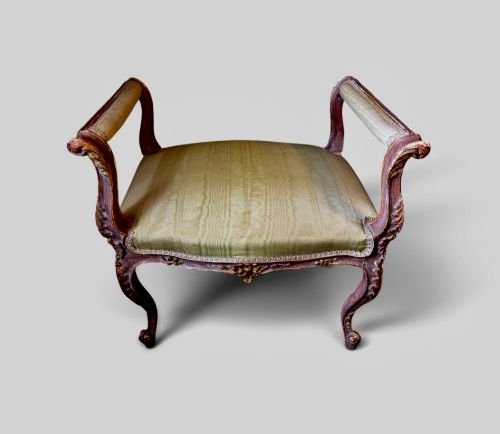
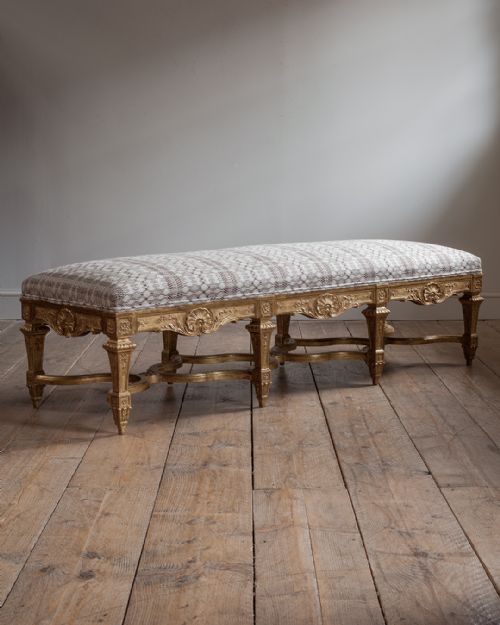
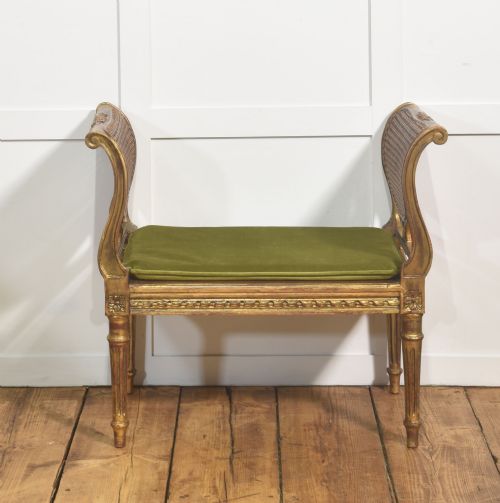
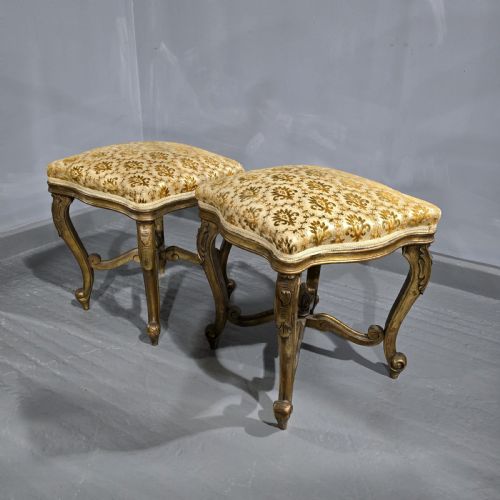
A French giltwood stool encompasses low footstools, long window seats, and wide duet stools designed for domestic seating and display. The selection leans heavily toward nineteenth-century production, incorporating revived historical idioms from the reigns of Louis XIV, Louis XV, and Louis XVI.
Makers adapted classical vocabulary for nineteenth-century interiors, producing X-frame curule shapes, circular footstools, and low parlour benches. Many pieces display revival styles that mimic earlier royal workshops while serving Victorian and Edwardian drawing rooms.
Materials and construction
Carvers shaped timber substrates, typically utilising softwoods or hardwoods, before applying thin gold leaf over a prepared gesso ground. This traditional gilding technique creates a reflective metallic surface that catches light across carved acanthus leaves, reeding, and cabriole legs.
Upholstery forms an integral part of the construction, utilising materials such as silk, velvet, red silk deep buttoning, tapestry, and cane inserts. Frames occasionally incorporate structural brass elements, adjustable screw mechanisms, or maker stamps directly into the timber.
One extraordinary nineteenth-century survival incorporates a rocking mechanism into a gilt gout stool, proving that even formal furniture occasionally yielded to practical comfort.
Distinctions in craftsmanship
Quality rests primarily on the depth and crispness of the hand carving, where skilled carvers rendered organic ornament with sharp undercut details rather than soft, mechanical repetition. The density of the underlying timber and the smoothness of the gesso preparation dictate how well the gilt surface holds its brilliance over decades.
The integrity of the original gilding and the fidelity of the period style separate standard commercial seating from workshop pieces bearing maker stamps or attribution. Proportion and architectural balance in the frame geometry distinguish superior seating from simpler regional variants.
LOIDRAULT FRERES PARIS·A.M.E. Fournier
The French Giltwood Stool Glossary
- Giltwood
- Timber coated with gold leaf applied over a gesso base. This finish provides the characteristic metallic sheen seen on antique French seating.
- Louis XVI Style
- A neoclassical design vocabulary defined by straight tapered legs, fluting, and geometric symmetry. It emerged during the eighteenth century and saw major revivals in the nineteenth century.
- Curule stool
- An ancient Roman magistrate seat shape featuring intersecting curved legs forming an X-frame. Nineteenth-century makers revived this form for formal reception rooms.
- Window seat
- An elongated stool designed to fit within a window recess or serve as a long bench. These pieces often feature low arms or upholstered ends.
- Gesso
- A plaster mixture applied to wood frames to create a smooth surface for gilding. Its thickness allows carvers to sharpen details before applying gold leaf.
French Giltwood Stool: Frequently Asked Questions
How do you identify the different revival periods?
Louis XIV and Rococo revival pieces display exuberant asymmetry, scrolling acanthus leaves, and curved cabriole supports. These forms emphasise dynamic movement and heavy sculptural relief.
Louis XVI and Neoclassical examples shift toward rectilinear geometry, fluted columns, and disciplined symmetry. Empire style introduces heavier classical proportions with architectural X-frames and curule bases.
Where were these stools placed in historical homes?
Nineteenth-century drawing rooms and grand salons utilised giltwood seating alongside matching armchairs to create formal conversation groups. Window seats occupied architectural bays, providing a functional perch for daylight reading.
Smaller footstools and ottomans paired with armchairs to support posture during long periods of sitting. Their decorative surfaces ensured they functioned as sculptural objects even when unoccupied.
How should textile upholstery be maintained?
Silk, velvet, and tapestry require gentle brushing with soft natural bristles to remove dust from the pile and woven fibres. Direct sunlight should be avoided to prevent fading in delicate historic textiles.
Professional textile conservators can secure antique buttoning and reinforce fragile edges without compromising the original frame. Maintaining stable room humidity protects both the fabric and the underlying wooden substrate.