

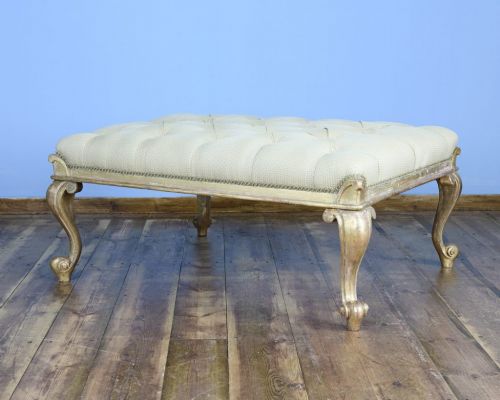

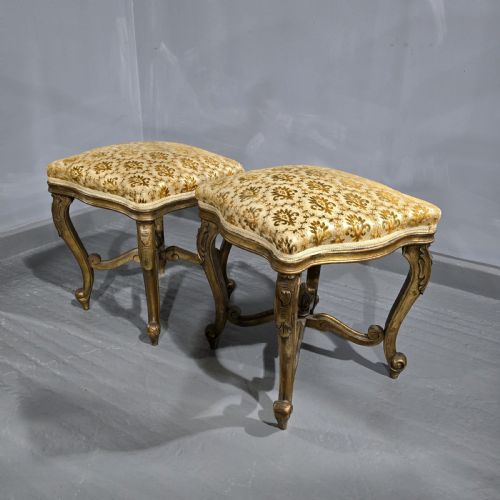


Carved Giltwood Ottoman
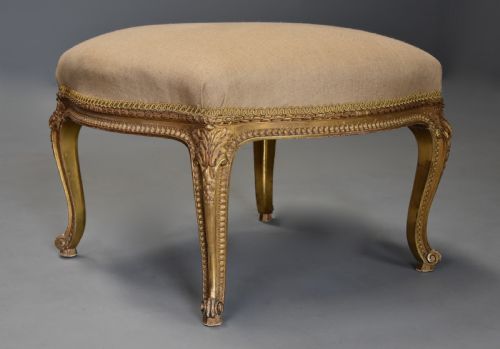
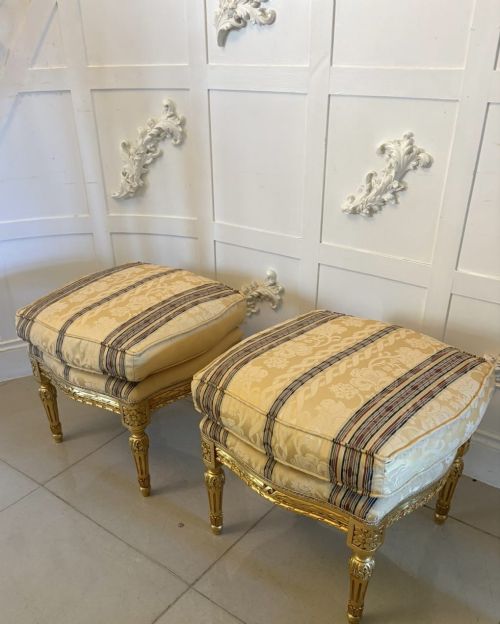
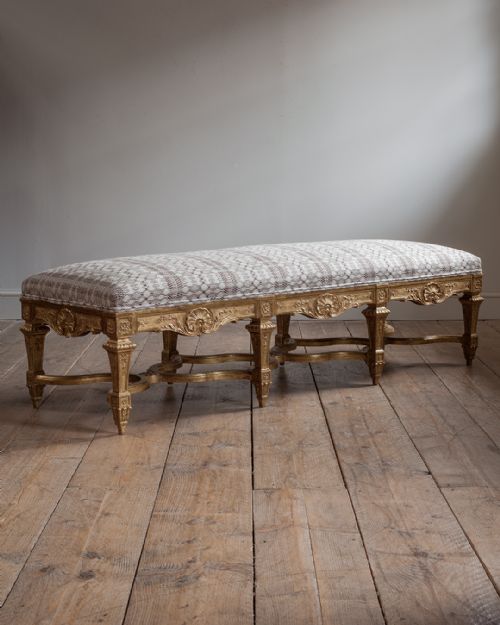
These carved giltwood ottoman pieces and associated stools bring continental grandeur and gilt brilliance to a room.
Carved Giltwood Ottoman
A carved giltwood ottoman or related stool sits among the most decorative seating forms available, crossing paths with footstools, window seats, and larger modular arrangements like duchesse brisee sections. The examples appearing here span the nineteenth century into the early twentieth century, showing strong French and Italian design influences.
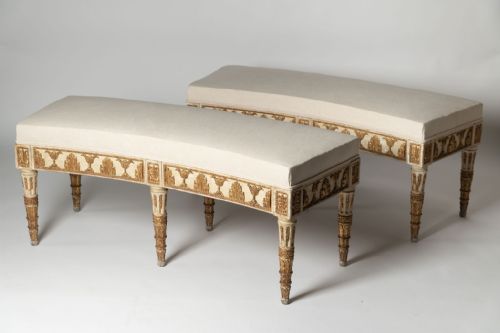
Buyers meet variations ranging from compact curule X-frame stools to grand scale Victorian and Georgian parcel gilt benches. Many pieces follow revival aesthetics such as Louis XIV, Louis XV, Louis XVI, and Baroque styles, translated through European craftsmanship.
How they were made
The foundation of a carved giltwood ottoman relies on timber frames shaped by hand and enriched with gesso to create crisp relief for subsequent gilding. Artisans applied thin layers of gold leaf or metallic gilt over prepared surfaces, occasionally combining this with parcel gilt highlights against painted or exposed wood.
Upholstery forms an integral part of the construction, utilising traditional textiles including velvet, linen, and contemporary decorative fabric. Frames often incorporate elaborate hand-carved floral scrolls, acanthus motifs, and structural elements secured through traditional joinery.
Carved Giltwood Ottoman Retail Price Guide 2026
Typical asking prices for carved giltwood ottoman among the pieces listed under this phrase on Sellingantiques today, from the lower quarter to the upper quarter. They describe what is for sale here now, not the wider market.
Listings feature pieces spanning the Georgian era through the nineteenth century and into 1920, utilising timber, gesso, giltwood, and diverse textile upholstery.
What varies in quality
The crispness and depth of the hand carving separate standard commercial seating from exceptional workshop production. Finely modeled gesso work holds sharp edges and delicate relief beneath the metallic leaf, whereas lesser pieces show softer, shallower ornamentation.
The integrity of the underlying timber frame and the authenticity of the gilding application dictate the standing of an individual piece. Maker stamps, attribution to known ateliers, and well-preserved original surface patination elevate certain examples well above standard decorative items.
LOIDRAULT FRERES PARIS·Miles & Edwards·A.M.E. Fournier
The Carved Giltwood Ottoman Glossary
- Giltwood
- Timber covered with a thin layer of gold leaf over a prepared gesso ground. This finish gives furniture a brilliant metallic sheen that reflects candlelight and daylight.
- Gesso
- A plaster-like mixture applied to wood frames to create a smooth, durable surface for carving and gilding. It allows craftsmen to model intricate three-dimensional decorative details.
- Curule stool
- An ancient Roman magistrate's seat design featuring crossing curved legs forming an X-shape. Revival versions adapt this ancient folding form into rigid, highly ornamental footstools.
- Parcel gilt
- A decorative treatment where only specific portions of a wooden object are gilded, leaving the remaining surface exposed as natural timber or painted finish.
- Duchesse brisee
- A multi-part chaise longue or daybed system that breaks down into chairs and footstools. These grand pieces combine seating and ottoman functions into a unified ensemble.
Carved Giltwood Ottoman: Frequently Asked Questions
How do I use a giltwood ottoman?
These pieces function traditionally as luxurious footstools placed before armchairs or sofas, or independently as window seats and low accent seating.
Their decorative gilt surfaces allow them to act as focal points in drawing rooms, dressing areas, and hallways where formal seating is desired.
Are these pieces French or Italian?
The selection includes both French and Italian origins, heavily influenced by continental court styles and revival periods.
French pieces often lean towards Rococo and Louis XVI elegance, while Italian examples frequently showcase bold Baroque carving and neoclassical curule forms.
How do I date a giltwood stool?
Dating relies on examining the underlying timber construction, the preparation layers beneath the gilding, and the stylistic vocabulary of the carving.
Nineteenth-century examples frequently adopt earlier Louis XIV, XV, or XVI revival motifs, making construction methods crucial for accurate age identification.
What is parcel gilding?
Parcel gilding involves applying gold leaf selectively to highlighted areas of a carved wooden frame rather than covering the entire surface.
This technique creates contrast between the gleaming gilded ornaments and the darker exposed timber or painted background beneath.