
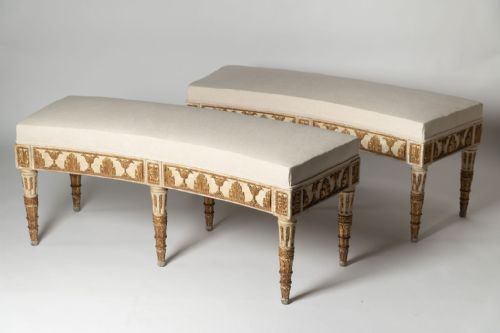


Gilded Ottoman Seat
A gilded ottoman seat brings neoclassical polish and carved luxury to a room, offering versatile seating through low stools and window benches.
Gilded Ottoman Seat
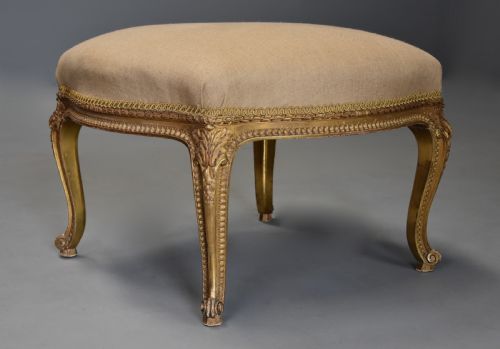
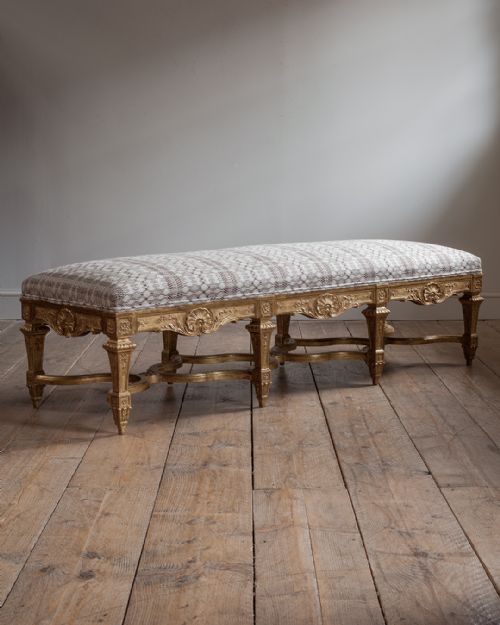
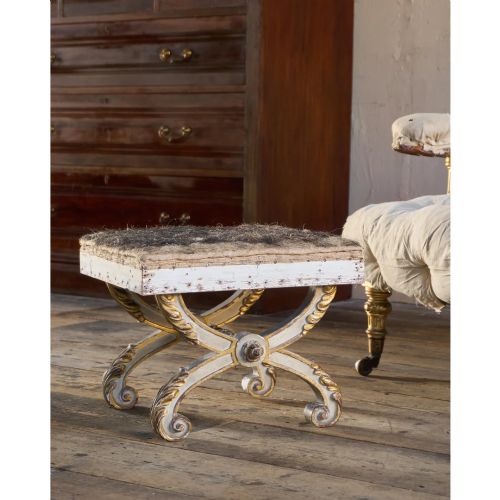
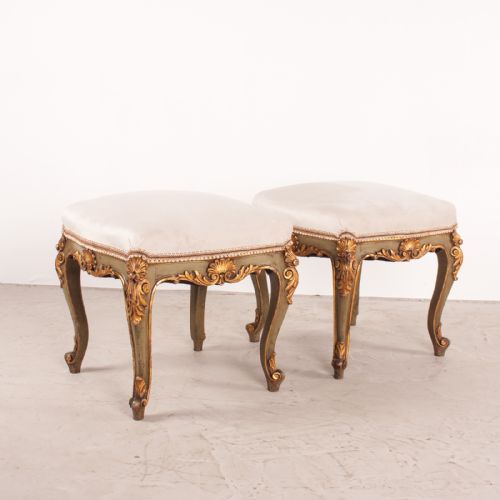
A gilded ottoman seat covers a range of low stools, footstools, benches, and window seats originating from the nineteenth century up to the Edwardian era. These pieces appear in French neoclassical, Louis XIV revival, continental rococo, and regency styles, frequently taking curule or X-frame forms.
The most common versions met here are nineteenth-century giltwood stools and painted or gilded continental examples, alongside occasional Edwardian black lacquered chinoiserie footstools and Middle Eastern low stools.
Makers such as Miles & Edwards and pieces attributed to A.M.E. Fournier represent the maker-signed or attributed items found among these seating forms.
How they were made
Construction relies primarily on wood, timber, and walnut as structural bases, shaped into carved frames and X-frame curule supports. Surfaces receive applications of gesso, paint, and gold leaf to create the characteristic giltwood or painted and gilded finishes.
Upholstery involves fabric and textile coverings applied to the tops of benches, window seats, and footstools to complete the seating surface.
Some nineteenth-century makers crossed ancient Roman chair designs with plush upholstery just to keep imperial ambition comfy.
What varies in quality
The depth and crispness of the wood carving distinguish higher quality frames, particularly on Italian and French neoclassical pieces where hand-carving defines the ornament. Gesso application and the burnishing of the gilt surface also determine the visual richness of the finish.
Structural integrity of the timber frame and the quality of the textile or fabric upholstery separate standard production pieces from finer workshop outputs.
Miles & Edwards·A.M.E. Fournier
The Gilded Ottoman Seat Glossary
- Giltwood
- Wood that has been coated with gold leaf or a gold-like substance. This finish defines the reflective surface seen on many neoclassical and revival seats.
- Curule stool
- An ancient Roman chair shape featuring opposing concave legs that cross in an X-frame. This form is common in nineteenth-century footstools.
- Gesso
- A plaster mixture applied to wood surfaces to prepare them for gilding or painting. It provides a smooth base for intricate carved detail.
- Window seat
- A long bench designed specifically to fit in the recess of a window. These pieces often feature upholstered tops and decorative wooden frames.
Gilded Ottoman Seat: Frequently Asked Questions
What is a curule stool?
A curule stool is a seating form featuring an X-frame construction with intersecting curved legs, originating from classical antiquity.
Makers in the nineteenth century revived this ancient shape for formal footstools and low seats.
How do I identify French style?
French style seating usually displays neoclassical or Louis XIV revival ornamentation, including carved giltwood and formal proportions.
Continental examples often combine painted wood with gold leaf highlights to achieve a lighter decorative effect.
Where should I place a window seat?
Window seats fit naturally beneath domestic window recesses, providing an elongated surface for occasional sitting.
They also function effectively at the foot of a bed or along a hallway wall.
What materials are used?
Construction materials primarily consist of timber, walnut, and wood shaped into structural frames.
Surfaces are finished with gesso and gold leaf gilding, while top surfaces feature various decorative fabrics and textiles.