







Pair Regency Hall Tables
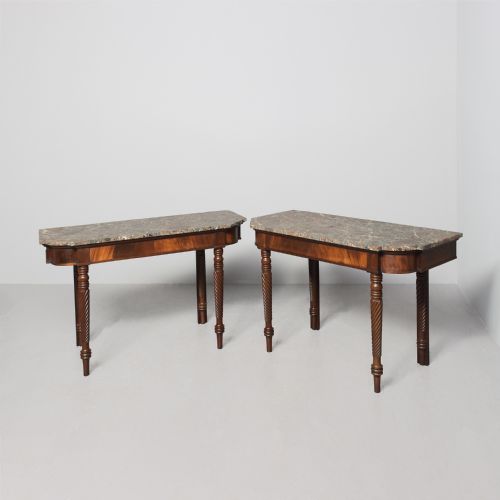
A pair regency hall tables brings architectural symmetry to an entrance, offering polished mahogany and marble surfaces designed to welcome guests in style.
Pair Regency Hall Tables
These pieces are matching pairs of furnishings designed primarily for entranceways and reception spaces, encompassing console, side, occasional, and demi-lune forms. When you search for a pair regency hall tables, you encounter examples stretching from the Georgian era through the Regency and William IV periods into later revivals.
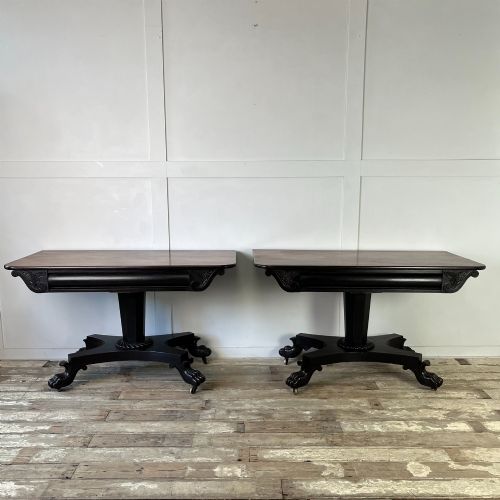
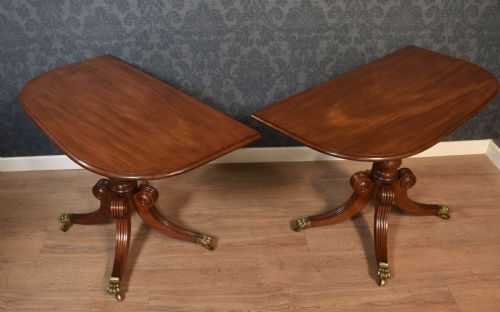
The dominant material recorded in these listings is mahogany, frequently paired with marble tops, brass details, and ebonised wood. Forms range from straight break-front console tables to semicircular demi-lune designs and foldover library or tea tables.
Most entries reflect nineteenth-century craftsmanship, alongside occasional twentieth-century interpretations such as Sheraton Revival pieces. Buyers meet both grand console tables intended for sweeping hallways and more compact occasional or side tables suited to domestic spaces.
Markers of distinction
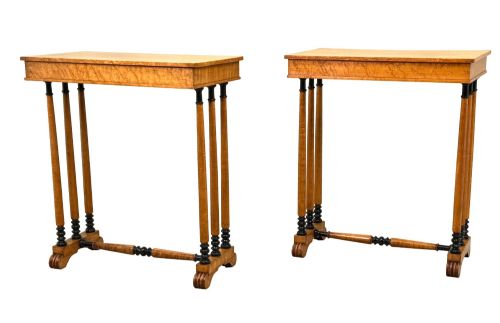
Quality rests on the selection of timber, where figured mahogany or striking birdseye maple sets superior examples apart from standard painted or plain constructions. The crispness of carved wood details and the integration of brass mounts reveal the maker's hand.
The choice of top material elevates a piece, with heavy marble slabs or meticulously matched mahogany veneers indicating higher ambition. Structural integrity in weight-bearing console frames ensures lasting stability without wobble.
Attribution to known workshops, such as Gillows, elevates the standing of specific pieces through documented joinery and refined proportions. Consistency between paired items dictates whether they function as a cohesive matching set or a matched pair assembled later.
Listings feature mahogany, marble, ebonised wood, and birdseye maple across Georgian, Regency, and William IV periods.
Gillows
The Pair Regency Hall Tables Glossary
- Console table
- A table designed to be fixed against a wall, frequently supported by front legs or brackets.
- Demi-lune
- A half-moon shape characteristic of side and console tables built to fit snugly against entrance walls.
- Ebonised wood
- Timber treated to resemble ebony, providing a dark, contrasting finish popular in Regency design.
- Break-front
- A piece of furniture whose facade projects forward in sections, adding architectural depth to the front edge.
- Birdseye maple
- A decorative timber featuring small, circular markings resembling bird eyes, used for surface veneers.
Pair Regency Hall Tables: Frequently Asked Questions
What is a pair regency hall tables used for?
These tables served primarily to furnish grand entrance halls, providing a surface for lamps, calling card trays, or decorative items. They created an immediate impression of symmetry and order for arriving visitors.
In domestic settings, paired tables offered flexibility for display or were pulled into service during gatherings for serving tea or playing games.
How do I identify Regency style?
Regency pieces often draw on classical architectural motifs, featuring clean lines, restrained carving, and dark timbers like mahogany. Brass inlay and ebonised details are common hallmarks of the aesthetic.
Proportions tend to be balanced and formal, reflecting the influence of Greek and Roman design on British furniture makers of the early nineteenth century.
Are marble-topped tables original?
Many console and hall tables from the period featured marble tops to provide a durable, cool surface for heavy items. These stone surfaces were integrated into the design to withstand daily use in busy entranceways.
Inspect the seating of the marble within the wooden frame to understand how the top relates to the overall construction of the base.
What distinguishes a console from a side table?
Console tables were traditionally designed to stand against a wall, sometimes requiring wall fixings for total stability. Side tables generally stood independently on four legs without wall support.
Over time, these terms often overlap in descriptions, but console tables frequently emphasise architectural wall presence.