
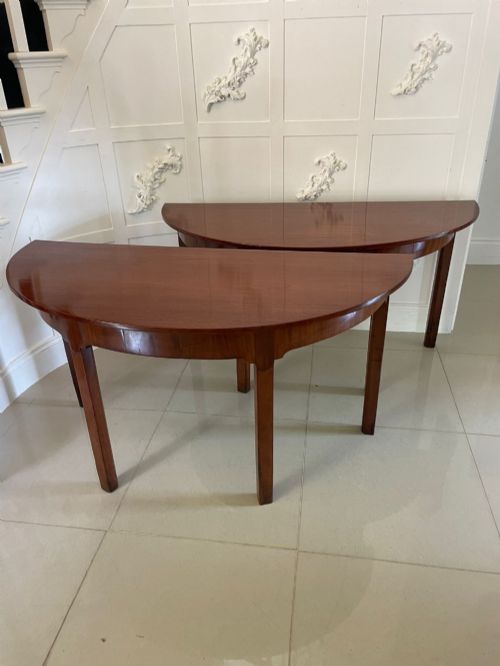

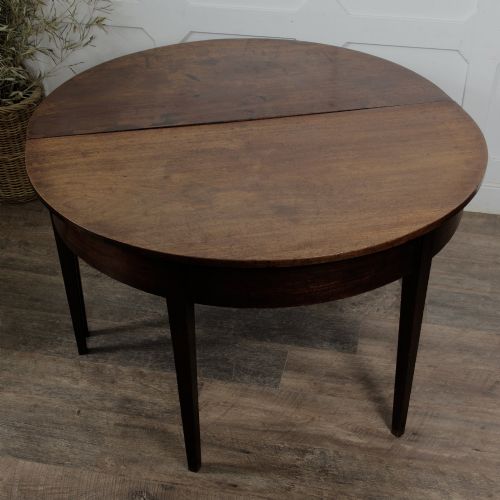
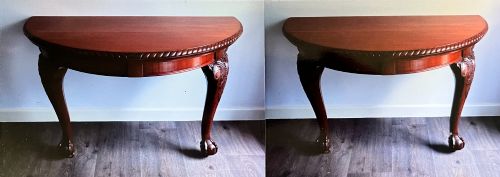

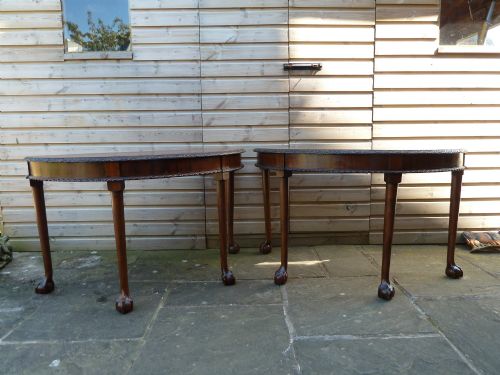


Pair Demilune Wall Tables
These pair demilune wall tables bring symmetry and architectural grace to a hallway or drawing room, offered in rich timbers and marble tops.
Pair Demilune Wall Tables
A pair demilune wall tables selection comprises semi-circular furniture designed to stand flush against a wall, frequently serving as console tables or hall tables. These pieces originate from various eras including the Georgian, Victorian, and early twentieth-century periods.
Buyers will encounter both understated timber surfaces and more decorative examples displaying inlay or carved details. They function effectively in pairs to anchor a room and balance spatial design.
How they were made
Cabinetmakers constructed these semi-circular frames predominantly using solid hardwoods such as mahogany and walnut, frequently applying veneers to achieve figured surfaces. Pine served as a secondary timber for structural elements and carcases.
Many examples incorporate marble slabs fitted directly to the wooden frame, whilst others utilise carved giltwood or painted finishes. Inlaid decoration and brass accents appear on specific Georgian and later iterations.
Half-round tables whisper secrets to the wall they hug, turning dead hallway space into grand architectural gestures.
What varies in quality
The standard of timber selection heavily dictates the overall appeal, with figured mahogany and burr walnut commanding greater visual depth than plain woods. Grain matching across a pair demonstrates higher workshop competence.
Carved ornament and crispness of inlaid detail reveal the original maker's skill level. Heavy marble tops and well-executed structural joints also distinguish finer pieces from simpler utility items.
The Pair Demilune Wall Tables Glossary
- Demilune
- Shaped like a half-moon or semi-circle. This term describes tables built to stand flat against a wall.
- Console table
- A table supported by wall brackets or console legs rather than four independent legs. They often stand beneath mirrors or in entrance halls.
- Giltwood
- Wood that has been coated with gold leaf or gold paint. It appears frequently on decorative frames and neoclassical furnishings.
- Pie crust
- A carved, raised decorative moulding along the edge of a table top. This decorative flourish is found on specific nineteenth-century pieces.
Pair Demilune Wall Tables: Frequently Asked Questions
Where should I place these tables?
These semi-circular tables suit entrance halls, reception rooms, and narrow corridors where floor space is limited. Placed flat against a wall, they provide a surface for lamps, bowls, or decorative objects.
Using them as a pair allows for symmetrical arrangement beneath mirrors or windows, creating a balanced focal point in a formal interior.
How do I identify the wood?
Mahogany typically displays a reddish-brown tone with a straight or slightly figured grain, whereas walnut shows darker brown hues with rich swirling patterns. Maple offers a lighter, pale appearance with subtle grain variation.
Closer inspection of the underside or unpolished areas helps reveal whether the piece uses solid timber or a decorative veneer over a secondary wood like pine.
Are marble tops original?
Marble tops on these tables generally reflect the intended design for specific formal or continental pieces, particularly those originating from Italy or country house settings. The weight and fit within the wooden frame indicate how the stone was integrated.
Examining the rebate where the marble rests helps determine if the top aligns with the construction methods of the stated period.
How do I care for the surface?
Timber surfaces benefit from occasional polishing with traditional beeswax to maintain the sheen and nourish the grain. Direct sunlight and excessive heat should be avoided to prevent the wood or veneer from drying out.
Marble tops require gentle cleaning with a damp cloth and mild soap, avoiding acidic solutions that can etch the polished stone.