


Antique Crescent Side Tables
These antique crescent side tables are half-moon console pieces designed to sit flat against a wall, offering elegant surface space without crowding a room.
Antique Crescent Side Tables
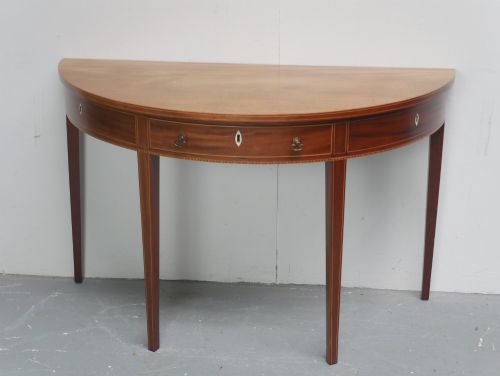
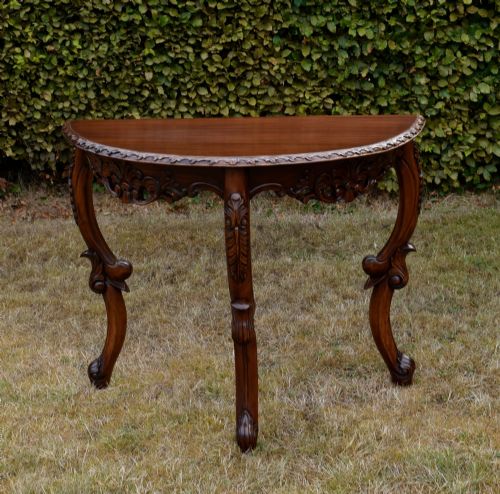
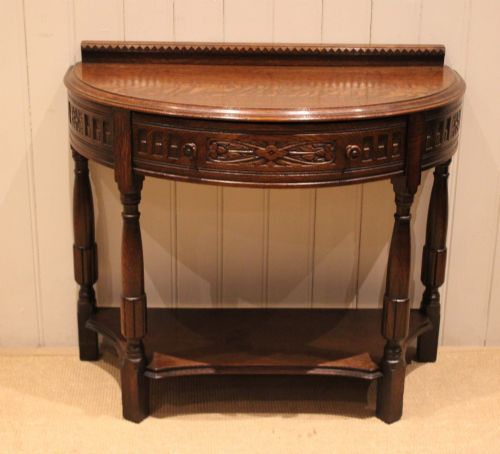
When searching for antique crescent side tables, collectors encounter half-moon console and demi-lune forms designed to stand flush against walls in hallways and principal rooms. The selection ranges from compact Edwardian satinwood examples and 1930s cabinets to substantial Regency mahogany pieces and carved French oak consoles.
Makers utilised various regional styles, spanning English Sheraton Revival and Chippendale interpretations alongside Swedish painted finishes and Dutch designs. Buyers frequently meet painted wood and polished timber versions alike, often shaped as paired console tables or individual hall pieces.
The assortment includes occasional tables, side cabinets, and console tables spanning the eighteenth century through to the early twentieth century. Each period brings distinct decorative motifs, from marquetry inlay to red lacquer and simple solid wood construction.
Materials and construction methods
Cabinetmakers constructed these crescent tables primarily using mahogany, satinwood, oak, pine, and rosewood, often applying detailed marquetry inlay to the semicircular top. Timber selection dictated the structural grace of the half-moon frame, supporting both polished wood finishes and painted surfaces.
Craftsmen incorporated brass hardware and carved detailing on select models, ranging from pie-crust mahogany edges to red lacquer finishes on imported forms. Structural integrity relied on solid framing and precise curved joinery to support the cantilevered or leg-supported tops.
Even walls need a hug sometimes, which is precisely why cabinetmakers curved these little tables to tuck in tight.
Factors of quality and distinction
Quality separates through the finesse of the timber figuring, the precision of the marquetry inlay, and the crispness of the carved ornamentation on the half-moon apron. Superior examples demonstrate harmonious proportions between the curved top and the supporting legs, whether delicate tapering supports or robust carved pedestals.
The integration of secondary timbers and the retention of original surface finishes, such as aged lacquer or untouched polish, determine the standing of an individual console table. Finer pieces exhibit meticulous attention to edge details like pie-crust moulding and balanced wood grain selection across the curved surface.
Edward and Roberts
The Antique Crescent Side Tables Glossary
- Demi-lune
- A half-moon shape characteristic of the tabletops and frames in this category. This form allows the furniture to sit flat against a wall while projecting into the room.
- Console table
- A table designed to be fixed against a wall, often supported by front legs with the rear secured to the architecture. They frequently serve decorative and display functions in entrance halls.
- Marquetry
- Decorative patterns formed by the insertion of contrasting pieces of wood, veneer, or shell into a solid timber background. This technique decorates many Edwardian and Georgian style tops.
- Satinwood
- A durable, yellowish timber prized for its smooth grain and reflective sheen, frequently utilised in high-status cabinetmaking during the Edwardian period.
- Sheraton Revival
- A late nineteenth and early twentieth century design movement that reinterpreted the light, classical furniture forms of the eighteenth-century designer Thomas Sheraton.
Antique Crescent Side Tables: Frequently Asked Questions
What is a demi-lune table?
A demi-lune table is a half-moon shaped furniture piece designed with a flat straight edge to stand flush against a wall. It functions primarily as a console or side table in narrow spaces like hallways.
These tables provide a decorative surface for lamps or ornaments without obstructing room walkways due to their curved front profile.
Where should I place a crescent table?
Crescent side tables suit entrance halls, narrow corridors, and living room perimeters where rectangular furniture projects too far into the space. Their flat back rests securely against the wall while the curved front softens room angles.
They also pair effectively with matching wall mirrors, as seen in Edwardian interior arrangements.
How do I identify a Regency crescent table?
Regency tables typically feature classical proportions, dark timbers like mahogany, and restrained decorative elements reflecting early nineteenth-century neoclassical tastes. Look for structural elements such as reeded legs or brass mounts.
These pieces often display substantial weight and craftsmanship distinct from lighter Edwardian revival or painted continental variants.
Are these tables used for dining?
Crescent tables generally serve as console, hall, or occasional display furniture rather than primary dining surfaces. Some historical dining sets included half-moon sections that locked into larger extension dining tables, though standalone side versions were built for display.
Their primary historical role was decorative presentation against interior walls.