
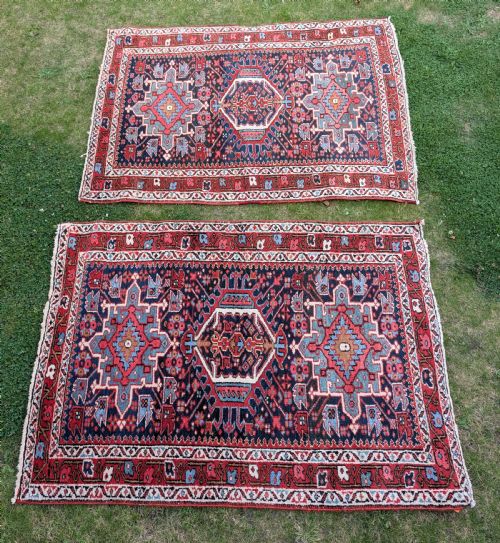


Pair Persian Rugs
These pair persian rugs bring matched geometry and natural dyes straight from nineteenth and twentieth-century Persian weaving floors into modern rooms.
Pair Persian Rugs
When you search for pair persian rugs, you are looking at matched textile sets created across Persia, including regional workshops and nomadic tribes. The examples here span from the late nineteenth century through to the 1930s, encompassing standard floor rugs, narrow runners, prayer rugs, and saddle-bag fronts.
You are most likely to meet Karaja and Kashan pairs on this page, alongside Qashqa'i, Shahsavan, and Hamadan pieces. These items were woven as dual companions for tents, houses, and formal spaces, maintaining symmetrical motifs or complementary colour palettes.
The format ranges from compact village mats to exceptionally long runners and pictorial woven panels. Each set records the distinct tribal or urban aesthetic of its origin, from north-west Persia down to Fars province.
How they were made
These textiles are built primarily from wool foundations and piles, often supported by cotton warps and wefts in workshop productions. The dyestuffs employed are natural dyes, which yield the characteristic deep reds, indigos, and earth tones seen across the inventory.
Weavers knotted the pile by hand onto stretched warps, utilising structural techniques handed down through generations of village and tribal makers. Saddle-bags and kilim bags incorporate flatweave construction alongside pile sections, fulfilling both decorative and utilitarian roles.
The documented periods span consecutively from the 1880s through the 1930s.
What varies in quality
The distinction between ordinary production and top-tier pieces rests on knot density, precision of layout, and the brilliance of the natural dyes. Workshop productions from Kashan demonstrate fine pictorial detail and precise curvilinear drafting, whereas tribal village rugs from Karaja or Hamadan rely on robust geometric vigour and saturated colour.
Completeness alters desirability, particularly with saddle-bags and prayer rugs that survive as matching pairs. The clarity of the original palette and the crispness of the secondary motifs separate standard survivors from exceptional collector examples.
Karaja·Senneh·Qashqa'i·Hamadan·Kurdish·Kashan·Nejafabad Isfahan·Kirman
The Pair Persian Rugs Glossary
- Natural dyes
- Colourants derived from plants, roots, and insects rather than synthetic aniline compounds. These dyes age gracefully and develop a rich patina over decades of light and wear.
- Warp
- The stationary vertical threads stretched upon a loom before weaving begins. The pile knots are tied around these foundational elements.
- Weft
- The horizontal threads passed across and between the warps to bind the knot rows together. In many Persian pieces, these threads are made of cotton.
- Prayer rug
- A small textile featuring a mihrab or niche design oriented towards Mecca. They were used for daily devotions in domestic or travelling settings.
- Saddle-bag
- A dual-pouch container woven for transport on pack animals, often separated later into matched decorative panels. The surviving faces display vibrant tribal iconography.
Pair Persian Rugs: Frequently Asked Questions
Why were Persian rugs woven in pairs?
Weavers often produced matched sets to flank a fireplace, line a long hallway, or furnish a traditional Persian room symmetrically. These pairs shared dye lots and motif structures to create a balanced interior.
In nomadic contexts, dual saddle-bags were constructed as functional transport companions that were later separated or preserved together as decorative textile art.
How do I distinguish village rugs from workshop rugs?
Village and tribal rugs, such as those from Karaja or Hamadan, display bold geometric medallions, rectilinear motifs, and expressive imperfections. They rely on heavy wool and robust local colour palettes.
Workshop rugs from centres like Kashan utilise finely spun wool, cotton foundations, and intricate curvilinear floral designs that reflect formal master weavers' blueprints.
Can antique runners withstand modern hallway foot traffic?
Antique wool runners handle normal domestic foot traffic well when supported by a quality underlay that prevents sliding and cushions the pile. Their dense hand-knotted structure was engineered for practical household use.
Heavily pictorial or fragile silk-admixed pieces benefit from placement in lower-traffic areas to preserve their fine details and natural dye integrity over time.
How can I tell the age of these Persian rugs?
Dating relies on structural analysis, wool quality, and the chemistry of the dyestuffs before synthetic colours became widespread around the late nineteenth century. Design layouts and regional stylistic shifts also point towards specific decades.
Pieces originating from the late nineteenth century up to the 1930s exhibit distinct wear patterns, shorthand signatures, and structural traits characteristic of their specific weaving eras.